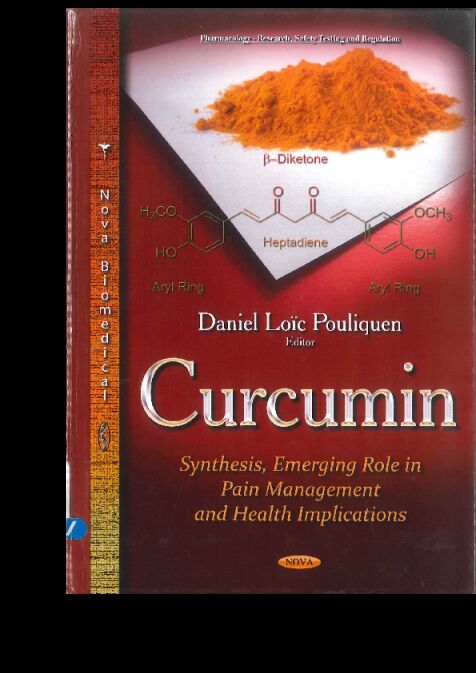
书名:Curcumin
责任者:Daniel Loic Pouliquen .
出版时间:2014
出版社:Nova Science Publishers, Inc.,
前言
Plants synthesize sophisticated molecules with considerable structural diversity and it is fascinating to realize that some of these molecules can interact with so many cellular targets. Curcumin belongs to this category, exhibiting an exceptionally long list of biological effects demonstrated in preclinical models and in human studies. In the history of biology and medicine, this natural product, together with the tropical plant from which it is produced, Curcuma longa, represents one of the best examples of a continuous link between the past, present and future. It is also a good example of how the exchange of knowledge between different parts of the world could benefit humankind in improving the health status of millions of people.A\The use of turmeric, the dried powdered rhizome of C. longa, and of other species of the same genus, diat are native to south and southeast Asia, for the treatment of various diseases, dates back to antiquity. Ethnobotanists have reported that this plant has been used throughout a large part of human history, in particular in Orissa, India, and probably well before the great Indus valley civilization. However, the paucity of historical records regarding its origin suggests that it was cultivated in more than one center. Trade by sea and land, with the exchange not only of spices but also of spice plants, has certainly contributed to the spread knowledge regarding its medicinal use over great distances in antiquity, before being later transmitted to the Middle East, Africa, Europe and America.A\As a result of the invaluable work of many pioneers from the middle of the 18th to the first third of the 20th century, who described the first pharmacological uses of turmeric identified its major chemical principles and documented the successful treatment of hepatic and biliary diseases in patients in the scientific literature, the medical interest for curcumin began to grow during the 1930s. Curiously, one of the most important publications during this period was by a young American roentgenologist working in Beirut, Lebanon, a site famous in the history of exchange between the Eastern and Western parts of the world since the Phoenicians. In addition to being a choleretic, the antiseptic properties of curcumin were considered to be responsible for the therapeutic effects observed in patients with biliary diseases. From this background, many additional properties were successively documented, particularly after 1949, an important date in the scientific demonstration of its antibacterial effects. The visionary words of Oppenheimer in 1937, and the findings twelve years later in Erlangen that curcumin totally inhibited the growth of four species of bacterial pathogens definitively launched a new era in research on this molecule. This also echoed the numerous empirical observations in Ayurvedic and Chinese medicine some millenia previously regarding the potential of turmeric against infectious diseases.A\Besides the confirmation of the first pharmacological properties of curcumin by Indian scientists and its use in the food technology industry in the mid-1950s, another field of investigation began in 1963-1964 in Mysore, India, with the demonstration of a hypocholesteremic effect of turmeric in rats, an effect which was confirmed in 1970 to be due to curcumin. This work was probably responsible for the emergence of another body of evidence by this team, including the discovery of the effect of curcumin in diabetes, and by other research groups, for example in Lucknow, India, leading to the first reviews of the pharmacological properties of this molecule by independent groups in the first third of the 1970s. A primary field of investigation encompassed the exploration of its anti-inflammatory properties and correlation with antioxidant action. A secondary field corresponded to the demonstration of its antithrombotic and antirheumatic effects, initiating a long period of intense research relevant to the implications of curcumin in the treatment of cardiovascular and immune diseases. This decade was also characterized by the use of new techniques, such as labelling with radionuclides, allowing quantification of uptake, distribution, and rapid metabolism in rats. In parallel, the first demonstrations of the potential anticancer activities of C. longa and C. zedoaria, using modern techniques, were described in India and China.A\Until 1991, a small number of teams in Western countries were convinced of the wide therapeutic potential of curcuminoids, and a maximum of ten articles relevant to biomedicine was published annually in the field. This situation began to change during the following year, after a more complete review of the pharmacology of C. longa was published following an invitation by the Thai government to German pharmacologists to help to improve the scientific standards of evaluation of some medicinal plants. Over the next decade, the number of articles published per year increased tenfold, and then about tenfold again from 2000 to 2013.A\The future of this exciting research field thus began a few years ago. The limited bioavailability and rapid metabolism of curcumin has stimulated the search for and design of analogs, derivatives, prodrugs and curcumin-loaded nanostructured systems, which are now under intensive development. Its biophysical and chemical properties have been investigated in detail. New administration routes have been explored. In parallel, a growing interest in additional pharmacological properties has emerged, such as antinociceptive and neuroprotective actions, extending even further the multiple potential applications of this agent. Its pleiotropic properties now appear to be the result of a synergy of interactions on multiple signaling pathways, which have been well established. The subtlety of the complex interactions between curcumin and a number of targeted protein structures has begun to be deciphered, opening a new era for experts in drug design. Given that curcumin interacts with an extraordinarily wide range of biological targets through many different mechanisms, this point also has important consequences for the future, for example as an investigation tool in the functional organization of the heterogeneous and dynamic water macromolecule interfaces in the cell, a central question for future cell biology.A\Excellent reviews have already been published dealing with the properties and applications of curcumin in biomedicine, and many of these are cited in the individual chapters of this book. However, at a time when research is being conducted more intensively than ever, a reference book appears to be essential for scientists, clinical researchers and students who wish to become familiar with recent developments relating to their own research interests and with other topics relevant to this research field. The following work aims to provide a view of the wide scope of the subject and attempts to present the main advances that have been made.A\At present, a growing number of clinical trials are already programmed and the determination of the conditions of optimal use of curcumin and its many derivatives, alone or in combination with other natural or synthetic drugs, are now in the hands of all involved in this research. It is hoped that constructive exchanges between experts involved in the various topics covered by this book, and throughout the world, will serve as a good stimulus to build a bright future for patients.A\This volume is primarily a tribute to all the contributions which have been made to the subject, and I would like to thank the authors of the numerous research papers, reviews and books, which are acknowledged as references at the end of the various chapters. I also wish to thank warmly all the contributors who have made this book possible and who have accepted to present their views and experience on the different topics covered in this volume. This work is dedicated to all the people who have experienced a real improvement in their health with this molecule, and to those who will, I am sure, experience the same in the near future.
查看更多
目录
Preface ix
Part I: Physical and Chemical Properties, Structure-Activity, Biological Targets, Synthesis of Derivatives and Prodrugs, and Development of Nanoformulations 1
Chapter 1 Photophysical and Photochemical Aspects of Curcumin 3
Chapter 2 Elucidating the Structure-Activity Relationship of Curcumin and Its Biological Activities 49
Chapter 3 Curcumin Derivatives: Aβ-ligands As Potential Diagnostic and Therapeutic Tools for Alzheimer's Disease 87
Chapter 4 Biological Targets and Pharmacology of Curcumin 103
Chapter 5 Design, Synthesis and Biological Activities of Curcumin Prodrugs 135
Chapter 6 Nanoencapsulated Curcumin: In Vivo Findings of Its Implications for Human Health 177
Part II: Pain Management, Anti-Inflammatory and Immunomodulatory Properties, and Antiparasitic Effects 211
Chapter 7 Therapeutic Role of Curcumin in Neurological Diseases and Pain Management 213
Chapter 8 Challenges and Opportunities in Developing Curcumin for Chronic Pain Management 237
Chapter 9 Analgesic and Anti-Inflammatory Properties of Curcumin: Application for Burn Wounds 255
Chapter 10 Curcumin and Inflammation: The Role of Neutrophils 281
Chapter 11 Role of Curcumin on Asthma: Route of Administration and Immunomodulation 297
Chapter 12 Curcumin: A Natural Drug with Interesting Pharmacological Effects for the Treatment of Parasitosis 317
Part III: Antitumor Activities, Emerging Therapeutic Strategies for Cancer Treatment with Curcumin and Its many Derivatives 329
Chapter 13 Role of Curcumin in Cancer Therapy: Radioprotecting and Radiosensitizing Properties 331
Chapter 14 Curcumin Analogues for the Treatment of Breast Cancer Revisited: The Nanotechnology Approach 347
Chapter 15 Curcumin Analogs and Combination Therapies Open Promising Prospects for Cancer Treatment 379
Chapter 16 Glorious Past and Promising Future of Curcumin-Based Antitumor Therapeutic Strategies 395
Chapter 17 Curcumin: A Broad Spectrum Inhibitor Targeting Pathways Relevant to Glioblastomas 409
Chapter 18 New Prospects with Curcumin in the Treatment of Mesothelioma:Lessons from an Orthotopic Rat Tumor Model 435
Chapter 19 Curcumin Suppresses Angiogenesis, Invasion and Metastasis through Inhibiting Matrix Metalloproteinases in Human Cancers 457
Chapter 20 Curcumin As a Potential New Therapeutic Approach against Oral Cancer 471
Editor's Contact Information 489
Index 491
查看PDF
查看更多
馆藏单位
中国医科院医学信息研究所