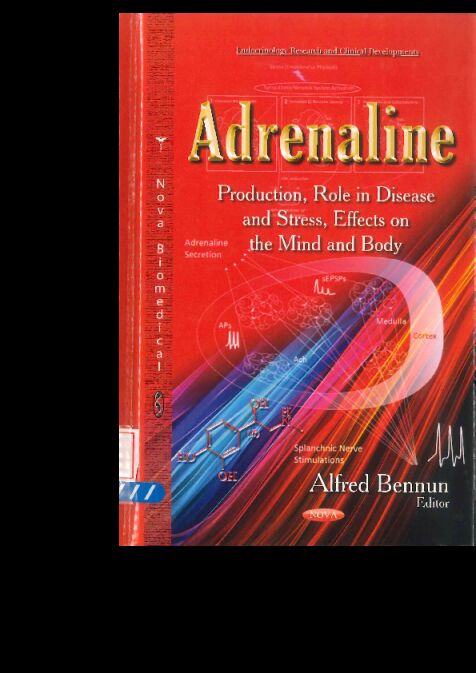
书名:Adrenaline
出版时间:2014
出版社:Nova Biomedical,
前言
The progress in the areas reported in this book include using the difference in origin between adrenaline and noradrenaline levels, determined in peripheral blood and adrenal venous samplings (AVS) to estimate whether a pheochromocytoma is located in the adrenal or extra-adrenal regions. Simple comparisons between catecholamine concentrations in bilateral adrenal veins may not be useful to localize adrenal pheochromocytoma. On the other hand, adrenal and inferior vena cava adrenaline concentrations obtained by AVS can serve as one of the methods to determine the selectivity of AVS and localize the adenoma-bearing gland in primary aldosteronism.
Genetic encoded behavior (instinct) fails to adapt to a variable environment, leading to the emergence of a brain with multi-sensorial inputs capable to diversify the outcome response through fight-or-flight behavior. A presynaptic Ca~2+-dependent releases of noradrenaline (NA) vesicles inhibits postsynaptic adenylyl cyclase (AC). This effect is reversed by Mg~2+ activation of the responsiveness of AC to NA. The long axons of the corpus coeruleus discharge NA at cortex and corpus striatum and others regions to conform the contribution of many sensor neurons into sceneries of the cognitive circuits of short and long-term memories. Signaling by glucose level converges into the hypothalamic-pituitary-adrenal (HPA) axis to activate the fight-or-flight response. Adrenaline inhibiting insulin secretion flattens the glucose circadian rhythms antagonizing the circadian homeostasis. Evolution favors a blood-brain barrier preventing adrenaline negative feedback and predominance of a cognitive/psychic perception (allowing psychoanalytic treatment) for HPA return into the steady state. The mind/body fragility allows persistence of high levels of adrenaline and cortisol, favoring degrading proteins into amino acids to support gluconeogenesis, unchaining psychosomatic diseases. Trigemino-cardiac reflex (TCR) is described in non-neurosurgical conditions, physiological responses and other procedures related to skull base surgeries. Also are described the role of factors like adrenaline/noradrenaline in relation to the TCR.
Three competing, though not necessarily mutually exclusive, hypotheses are reviewed to explain how adrenaline plays a key role in precipitating stress-induced cardiomyopathies. The first of these the vascular micro spasm hypothesis focused on overstimulation of primarily β_2-adrenergic receptors, in the coronary microvasculature feeding the left ventricle (LV) referred as Apical-Ballooning Syndrome. The second concerns the differential beta-receptor expression, which postulates that there is a higher density of beta-adrenergic, and especially β_2-adrenergic receptors in the apical zone of the LV compared to other regions. A third focuses on differential production of local adrenaline within the left myocardium itself. In this last case, selective myocardial stunning in the LV results from local overload of adrenergic stimulation due to autocrine/paracrine actions, in addition to sympathetic stimulation and circulating catecholamines in periods of stress. The evidence for each is critically evaluated, with discussion of potential future directions for work in this field in relation to the role of gender (sex), age, and menopausal status.
It is reported that the effect of increased adrenaline levels during initial stages of the stress increases the number of adrenoceptor which decreases under prolonged stress. The regulation of G protein-coupled receptors comprises desensitization, internalization or down-regulation of receptors. The modifications in total receptor number can comprise changes in receptor degradation as well as the changes in receptor gene expression. This impacts the heart in terms of fine-tuning the functional signaling.
The stress hormones alter the oxygen transport properties of erythrocytes and infrared spectroscopy show that these hormones produce contraction in the ghost membranes. Specific response to adrenaline involves an increase in β-structuring. Cortisol increases the fraction of α-helices. The stress effect increases membrane microviscosity of intact erythrocytes and leads to a reduction of the coronary flow and a fast cardiac arrest.
Arterial and venous pulmonary pressures are increased by adrenaline through direct pulmonary vasoconstriction and increased pulmonary blood flow. However high and prolonged doses can cause direct cardiac toxicity through damage to arterial walls, which causes focal regions of myocardial contraction band necrosis, and through direct stimulation of the myocyte apoptosis. Accordingly, many of the historical uses of adrenaline have been superseded by more specific drugs. However, adrenaline still plays an important clinical role, particularly in emergency treatment and as an adjunct to local anesthesia.
Chapter 1 - The most abundant adrenalines are adrenaline, noradrenaline and dopamine in the human body. Among them, adrenaline is exclusively produced by the adrenal chromaffin cells. The other two adrenalines are produced by adrenal chromaffin cells and adrenergic neurons besides the brain. The difference in origin between adrenaline and noradrenaline can serve to estimate whether pheochromocytoma locates in adrenal or extra-adrenal by their peripheral blood concentration data. Although the normal reference ranges of these adrenaline concentrations are established in peripheral blood in resting condition, they are obscure in normal adrenal veins. Adrenal venous sampling (AVS) has been used to differentiate adenoma and hyperplasia in primary aldosteronism by measuring and comparing aldosterone and cortisol levels in blood samples of both adrenals and the inferior vena cava. However it may be difficult to establish the normal ranges of these adrenalines in human adrenals by AVS, since these adrenalines are sensitive to various stresses including catheter manipulation. Thus simple comparisons between these catecholamine concentrations in bilateral adrenal veins may not be useful to localize adrenal pheochromocytoma. On the other hand, adrenal and inferior vena cava adrenaline concentrations obtained by AVS can serve as one of the methods to determine the selectivity of AVS and localize the adenoma-bearing gland in primary aldosteronism.
Chapter 2 - Signaling by sensor neurons activates the fight-or-flight response of the hypothalamic-pituitary-adrenal (HTPA) axis, increasing the adrenaline output which at the pancreas stimulates secretion of glucagon and inhibits the release of insulin, distorting the pulsatile rhythm of glucose metabolism. This flattens the normal circadian modulation of glucose levels, to allow the rate of ATP generation and consumption to exceed the modulatory limits of Energy Charge, and oppose the ATP-requiring regeneration of glycogen and fat reserves. An "in common" signaling results from depletion of chelating metabolites by the opposite tendencies of ionic equilibrium to decrease ATP~4-, an inhibitor, and increases free Mg~2+, an activator of the hormonal responsiveness of adenylyl cyclases (AC). The increase in dissociated activatory ion Mg~2+ vs the decrease of inhibitors CaATP, ATP~4-, and Ca~2+, allows to integrate several tissues in a in common AC responsiveness to adrenaline and in fat tissue to lipolytic hormones. This, metabolic network activates the mobilization of glycogen and fats, to support liver's gluconeogenesis and its output of glucose. The "n" cooperativity value for Mg~2+ saturation of the AC increases, because to the saturation by Mg~2+ activator sums-up with desaturation of ATP4" an inhibitor. This characterizes a basal AC activity for an "n" value slightly larger than two. The effect of hormones increases "n" to about 4, implicating Mg~2+ saturation sites mediating in the membrane, the bonding of AC to adrenaline-receptor and to the activatory mechanism of G-protein. Cortisol that crosses the blood-brain barrier (BBB) exerts a negative feedback on the HTPA axis, but adrenaline does not, allowing persistence of its stimulatory effect on the HTPA axis uncontrolled secretion of cortisol. Persistent adrenaline-dependent inhibition of insulin secretion interferes with the possibility to maintain a circadian rhythm, controlling availability of glucose to muscle, and brain. The overexposure to adrenaline has an inactivatory effect on the adrenaline-AC complex, which is considerably less stable, than the complexes of AC with either glucagon or ACTH. Stress-mediated redirection of blood flow within the circulatory system could lead to a pattern of metabolic deprived tissues. At the physiological level, muscular tremor relates to depletion of the ATP required for muscle sliding, when overexercising or for lack of insulin. Dysfunctions like Parkinson and schizophrenia share on muscle-tremor symptomatology. The role of BBB extends to prevent that the adrenaline-mediated stress response, could trigger a non-localized, over-excited activity to all brain areas, rather than the ones directly related to an emotional-signaling. Evolution separated stress exerted on the body from the one on the mind/brain. Acute-panic could be related to the corpus coeruleus axons of a large discharge of noradrenaline (NA) that at the postsynaptic cleft located AC, which if not promptly reuptaked could result in the inactivatory overexposure of AC to NA. Thus, if the inactivatory rate exceeds the synthetizing rate of AC it could develop a symptomatology of anxiety followed by depression. At the BBB oxyHb delivers O_2 and Mg~2+, the ion is required to stimulate responsiveness to noradrenaline of postsynaptic AC. Investigators have reported that in vivo stimulation of brain induced a glucose uptake and metabolization, ahead of the increase in O_2 consumption. In neurons the insulin-responsive transporter GLUT3 -glucose complex, crosses the BBB. This allows inferring, not only nutritional but also dysfunctional signaling, by the flattening of glucose-dependent circadian rhythms.
Chapter 3 - Trigemino-cardiac reflex (TCR) is a well-established neurogenic reflex that manifests as bradycardia, hypotension, and gastric hyper motility seen upon mechanical stimulation in the distribution of the trigeminal nerve. Initial reports were based on animal experiments; however, TCR in neurosurgical patients was first elaborated in 1999. Till now, couple of hundred papers has been published in all fields of neurosciences. The TCR is now also described in non-neurosurgical conditions, physiological responses and other procedures related to skull base surgeries. Surgical and other risk factors are postulated; however, the role of different factors influencing the TCR is not well established. In the present work, the authors shed further light on adrenalin / noradrenaline in relation to the TCR.
Chapter 4 - Stress-induced cardiomyopathies such as Tako-Tsubo Syndrome (also known as "Broken-Heart Syndrome") primarily affect post-menopausal women who have experienced sudden emotional shock. Clinical presentation includes symptoms mimicking a myocardial infarction (sever chest pain and S-T elevation on ECG), but do not show significant occlusion of the coronary arteries. Instead, they display left ventricular (LV) dysfunction characterized by hypo- or a-kinetic regions that appear to "balloon-out", particularly in the region near the apex, and this is thus sometimes referred to as "Apical-Ballooning Syndrome". Some of these patients have been reported with high circulating levels of adrenaline, and symptoms have been effectively managed in many cases by treatment with beta-adrenergic receptor blockers. It is not entirely clear, however, why only specific regions of the LV are primarily affected in these patients, nor is it at all clear why postmenopausal women are so susceptible relative to the rest of the population. With respect to the first question, the authors will review three competing, though not necessarily mutually exclusive, hypotheses to explain how adrenaline plays a key role in precipitating stress-induced cardiomyopathies. The first of these is the vascular microspasm hypothesis which focuses on overstimulation of primarily beta2-adrenergic receptors in the coronary microvasculature feeding the LV, leading to microspasms, interrupted regional blood-flow, and corresponding myocardial dysfunction in affected areas of the LV (Dote et al., J Cardiol 1991;21:203). The second hypothesis will be referred to as the differential beta-receptor expression hypothesis, which postulates that there is a higher density of beta-adrenergic, and especially beta2-adrenergic receptors in the apical region of the LV compared to other regions, which thus provides greater sensitivity to adrenergic stimulation to this region, and thereby making it more sensitive to adrenergic overload and myocardial stunning relative to other regions of the heart (Lyon et al., Nature Clin Pract Cardiovasc Med 2008;5:22). A third hypothesis focuses on differential production of local adrenaline within the left myocardium itself (Osuala et al., PLoS One 2011;8:e22811). In this last case, selective myocardial stunning in the LV results from local overload of adrenergic stimulation due to autocrine/paracrine actions of adrenaline in addition to sympathetic stimulation and circulating catecholamines in periods of stress. The evidence for each is critically evaluated, with discussion of potential future directions for work in this field in relation to the role of gender (sex), age, and menopausal status.
Chapter 5 - Stress is common phenomenon that affects multiple systems with the most prominent sign - elevated adrenaline level. The adrenaline binds to adrenoceptors that belong to the largest receptor family - to G protein-coupled receptors. Here the authors first describe adrenoceptor subtypes expressed in the heart and then the consequences of activation in stress. Main heart adrenoceptor subtype is β_1, but there are also expressed other subtypes: β_2, α_1, and β_3 although some authors challenged its presence in the heart. Low affinity receptor states can further make the signaling complex. Increased adrenaline levels during initial stages of stress can decrease the number of adrenoceptor binding sites in first minutes of stress but with prolonged stress the number of receptors often returns to initial values. Stress can also affect functionally antagonistic type of receptors, i.e. muscarinic receptors. Other stress hormones, glucocorticoids, with beginning of elevation in first thirty minutes of stress exposure, can further affect adrenoceptors and also muscarinic receptors. The regulation of G protein-coupled receptors comprises desensitization, internalization or down-regulation of receptors. The changes in total receptor number can comprise changes in receptor degradation as well as the changes in receptor gene expression. Taken together all these systems impact the heart in terms of fine-tuning the functional signaling.
Chapter 6 - It was shown in experiments that stress hormones (adrenaline and cortisol) interact with erythrocyte membranes, which leads to rough structural changes accompanied by an increase of membrane microviscosity in the regions of lipid-lipid and protein-lipid interactions. The nature of such changes is caused by simultaneous interaction of the hormone active groups (NH, OH and their hydrophobic rings) with the lipid and protein components of the membrane resulting in the formation of complex domains. IR spectroscopy was used to study erythrocyte deformation occurring under the action of adrenaline and cortisol. These hormones give rise to mechanical stresses (contraction) on erythrocytes ghosts, which show up as an increased structural orderliness of membrane proteins, in particular, of the protein domains belonging to contraction and integral proteins. An increasing orderliness of protein domains is accompanied by splitting the absorption band of NH peptide bond (stretching vibrations). In this case, changes of domain orderliness occur mainly in contraction proteins due to their high concentration with respect to other membrane proteins, In addition, adrenaline increase β-structure and raise the intensity of absorption bands at 1630, 1686 or 1696 cm~-1. Cortisol increases the fraction of α-helices. Finally, along with alteration of the protein structure, the authors observed an increase of phospholipid orderliness in domains and that of interdomain orderliness, which show up as splitting of absorption bands of the stretching and deformation vibrations of CH bonds as well as P=O and POC bonds. The effects produced by the hormones in erythrocyte ghost are shown to persist on intact erythrocytes. Stress hormones alter the oxygen transport properties of erythrocytes. Experiments with the perfused rat heart demonstrated that erythrocytes with an increased membrane microviscosity cannot move over the capillary system. This produces a sharp reduction of the coronary flow and fast cardiac arrest. This mechanism was supposed to take place also in coronary syndrome X in human.
Chapter 7 - The body has an array of chemical messengers that work to regulate the function of different body systems. Among these is a small family of messengers called catecholamines. It is discuss the early discovery and understanding of adrenaline hormonal role, its production, metabolism, physiologic functions, role in disease and clinical application. Catecholamines are amines containing a 3,4-dihydroxyphenyl (catechol) nucleus. Adrenaline is arguably the most well-known, with noradrenaline and dopamine being the other catecholamines. It is a hormone when carried in the blood and a neurotransmitter when released across a neuronal synapse. It plays a central role in short-term stress reaction, eliciting the 'Fight or Flight response'. Adrenaline has a widespread range of actions on the cardiovascular system. It has cardiac ionotropic and chronotropic effects and vasopressor actions on the vasculature. β-adrenergic effects are more pronounced at low doses and α1-adrenergic effects at higher doses. Coronary blood flow is enhanced through an increased relative duration of diastole at higher heart rates and through stimulation of myocytes to release local vasodilators, which largely counterbalance direct α1-mediated coronary vasoconstriction. Arterial and venous pulmonary pressures are increased through direct pulmonary vasoconstriction and increased pulmonary blood flow. However high and prolonged doses can cause direct cardiac toxicity through damage to arterial walls, which causes focal regions of myocardial contraction band necrosis, and through direct stimulation of the myocyte apoptosis. Its constriction of the mesenteric blood flow leads to problems with absorption and potential GI necrosis. Decreased renal blood flow can lead to acute kidney injury and potentially renal failure. The cardiac effects can potentiate dysrhythmias, particularly in deoxygenated tissue, and therefore its use is sometimes limited to treating anaphylactic shock cases. Due to these concerns, other ionotropic agents and vasopressors are often used to maintain circulatory support. Adrenaline's wide ranging physiological effects are both clinically useful and limiting to the specific use of adrenaline as a drug. Many of its historical uses have been superseded by more specific drugs. However it still plays an important clinical role, particularly in emergency treatment and as an adjunct to local anesthesia. So whilst it is not necessary to remember every step in its production and physiology, every possible clinical indication and contraindication, every exact method of dose related action and interaction, a general appreciation of adrenaline is mandatory for any doctor in clinical practice, one day you may well use it to save someone's life.
查看更多
目录
Preface vii
Chapter 1 Adrenalines in Adrenal Venous Sampling 1
Yasutaka Baba, M.D., Ph.D., Sadao Hayashi, M.D., Ph.D., Shunichiro Ikeda, M.D. and Masayuki Nakajo, M.D., Ph.D.
Chapter 2 NA-Overstimulation of the Hypothalamic-Pituitary Adrenal Axis Turns-On the Fight-or-Flight Response but Adrenaline Lacks a Negative Feedback which Could Normalize Psychosomatic Dysfunctions 13
Alfred Bennun
Chapter 3 New Insights to the Role of (Nor-)/Adrenaline and Trigeminal Cardiac Reflex 71
Tumul Chowdhury, M.D., DM, Nora Sandu, M.D. and Bernhard Schaller, M.D., Ph.D., DSc
Chapter 4 Adrenaline and Stress-Induced Cardiomyopathies: Three Competing Hypotheses for Mechanism(s) of Action 81
Candice N. Baker, Rebekah Katsandris, Chaunhi Van and Steven N. Ebert
Chapter 5 Adrenaline, Heart Adrenoceptors and Stress 117
Jaromir Myslivecek, Paulina Valuskova and Eva Varejkova
Chapter 6 Influence of Stress Hormones (Adrenaline and Cortisol) on Structure and Function of Erythrocyte Membranes 149
L. E. Panin
Chapter 7 Drugs in Cardiopulmonary Resuscitation 177
Isabel Teo, Kuen Yeow Chin, Christopher Stephens and James Paget
Editor Contact Information 213
Index 215
查看PDF
查看更多
馆藏单位
中国医科院医学信息研究所