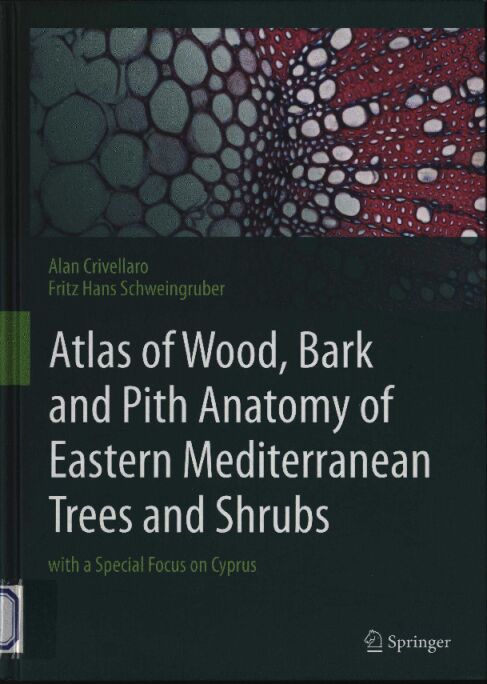
书名:Atlas of wood, bark and pith anatomy of Eastern Mediterranean trees and shrubs
责任者:Alan Crivellaro | Fritz Hans Schweingruber.
ISBN\ISSN:9783642372346,3642372341
前言
Humans have probably always lived with some balance between admiration of the beauty in nature and reliance on what nature can provide us. Wood is a good example. Woodworkers, carvers, builders and paper-makers have created objects and shelters that celebrate wood, exuberantly or quietly. Simultaneously, half the harvested wood on earth is used for fuel to make dwellings habitable and food edible, and most of us use wood products for daily needs from furniture to paper. It is estimated that the average person on earth uses the equivalent of 1,6 kg of dried wood a day—about 600 kg in a year—with the highest consumers, in the US, using four times that much. Economists argue that if we are to continue raising the standard of living throughout the world we need to use more wood, not less, because its use is less costly overall than the alternative materials such as aluminium and steel. Most people consider the stem as “just a piece of wood" when in fact, being situated mid-way between roots and canopy, its activities are essential for the functioning of the plant. The stem transports water, nutrients, sugars, and hormones; buffers water uptake and loss; supports the mass of the canopy plus loads from wind, snow, ice, fruit, and epiphytes; displays foliage and flowers to resources like light and pollinators; protects the plant from abrasion and fire; and harbors materials and meristems that may be needed for growth, reproduction, and recovery from disturbance. All this is done by an organ that is fully functional at the same time that it is able to grow. An enormous number of ways have evolved to perform these functions, and in consequence, there is an enormous diversity of types of woods and barks. This Atlas of Wood, Bark and Pith Anatomy of Eastern Mediterranean Trees and Shrubs is a beautiful contribution toward understanding stems and their adaptations. Moreover, the displays of excellently prepared and stained sections are art in their own right.
This atlas provides a rich treasury of information on stems. Unlike most compendia, this book covers an entire woody flora at one location, and thus gives us a glimpse of the variety of stem tissues that can co-occur.
The island of Cyprus is sufficiently diverse geographically and botanically that we can use this atlas to look for patterns in the tissues related to phylogeny, growth form, and level of endemism. Another unusual feature of this book is the inclusion of images and descriptions of three plant parts in addition to the main stem: twig xylem, the pith region, and the twig's bark region. The twig/stem juxtapositions show us graphically that in many cases twigs are quite distinct anatomically and are not just miniature trunks. The pith images and descriptions detail the surprising diversity of pith anatomies in terms of overall morphology, the variety of cell types within one pith, the shape of the pith cells, and the thickness and optical properties of their walls. The region just exterior to the pith illustrates the primary xylem and the earliest-developed secondary xylem, providing a snapshot of structures present during the vulnerable development stage just after stem elongation. The images of bark demonstrate the many ways it is constructed in twigs. Lastly, having the bark, twig, pith, and stem in a tidy two-page spread invites us to make comparisons among them. We can look, for example, at whether thick-wailed fibers, thick-walled pith parenchyma, and sclereids are all found in the same plant or whether these wall thicknesses are uncoupled from tissue to tissue and organ to organ. The user will also appreciate the plant descriptions and photographs, which help us link the microscopic views to the scale at which we may have known the plants in our hikes and in some cases, in our gardens and kitchens.
An understanding of the stem's adaptations is of growing importance for management. Humans are increasingly relying on plants, but in the future these plants are likely to be growing in more marginal habitats and in climates with more frequent droughts, flooding, and wind. Humans are also finding new uses for species that we have used for millennia, such as phytoremediation, bioenergy, carbon sequestration, and erosion control. Manager and breeders need guidance on what traits— the structures and functions together—contribute to success in the type of habitat where they will be grown. Unfortunately, many of the biologists, agronomists, and foresters involved in tree breeding and selection are no longer trained in anatomy, and instead of investigating the structure/function complexes, they tend to use proxies (like wood density) to estimate the plant's success.
This atlas can fill part of this gap by serving to educate us in the many structural variants that survive and reproduce in one geographic area. For some of the atlas' users, this case study of anatomical diversity will provide a database to help them study how plants work.
Such research is helping increase the number of scientifically based tales on our botanical bookshelves and decrease the number of “Just So” stories (named for Rudyard Kipling’s children's stories in which the narrator tells an unverified purpose for a biological trait). Other readers will use this atlas for specific information on the species or on in the climates encompassed here. Still other readers will enjoy the book for its beauty. However it is used, this atlas is a welcome addition to the resources we have on plant anatomy.
查看更多
目录
Preface and Acknowledgments VII
Foreword IX
1. introduction 1
2. Materials and Methods 3
Origin of the material studied 3
Plant material preparation 3
Wood density 3
3. Definition of Anatomical Features 5
Xylem 5
Bark 24
Pith 31
4. Identification Keys 37
Wood without vessels (Gymnosperms) 38
Wood with vessels and included phloem 39
Wood with vessels and without included phloem 40
5. Anatomical Description of Species 49
Gymnosperms 53
Cupressaceae 54
Pinaceae 64
Taxaceae 76
Gnetales 79
Ephedraceae 80
Angiosperms: Monocotyledons 85
Asparagaceae 86
Graminaceae 88
Ruscaceae 90
Smilacaceae 91
Angiosperms: Dicotyledons 93
Adoxaceae 94
Amaranthaceae 100
Anacardiaceae 102
Apocynaceae VI6
Aquifoliaceae 120
Araliaceae 122
Aristolochiaceae 124
Asclepiadaceae 126
Asteraceae 128
Berberidaceae 1 54
Betulaceae I 56
Boraginaceae 162
Brassicaceae 1 72
Buxaceae 188
Caesalpiniaceae 190
Cannabaceae 192
Capparaceae 196
Caprifoliaceae 1 98
Caryophyllaceae 198
Chenopodiaceae 202
Cistaceae 208
Convolvulaceae 228
Cornaceae 256
Dipsacaceae 253
Ebenaceae 264
Elaeagnaceae 266
Ericaceae 268
Euphorbiaceae 278
Fabaceae 284
Fagaceae 312
Frankeniaceae 326
Hypericaceae 328
Juglandaceae 332
Lamiaceae 334
Lauraceae 400
Lythraceae 402
Malvaceae 404
Mimosaceae 406
Moraceae 410
Myrtaceae 418
Oleaceae 430
Orobanchaceae 440
Phytolaccaceae 442
Platanaceae 444
Plumbaginaceae 446
Polygonaceae 450
Ranunculaceae 452
Rhamnaceae 456
Rosaceae 466
Rubiaceae 506
Rutaceae 514
Salicaceae 522
Sapindaceae 528
Scrophulariaceae 536
Simarubaceae 538
Solanaceae 540
Styracaceae 548
Tamaricaceae 550
Thymelaeaceae 558
Ulmaceae 562
Verbenaceae 564
Vitaceae 568
Zygophyllaceae 570
References 575
List of Species and Families 579
查看PDF
查看更多
馆藏单位
中国农科院农业信息研究所