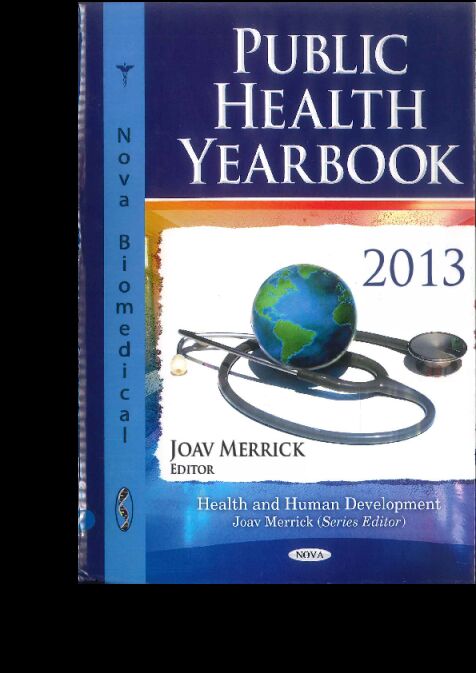
书名:Public health yearbook. 2013.
ISBN\ISSN:9781633210950,1633210952 2164-716X
出版时间:2014
出版社:Nova Science Publishers, Inc.,
摘要
Introduction
Joav Merrick, MD, MMedSci, DMSc:
1 National Institute of Child Health and Human Development. 2 Health Services, Office of the Medical Director, Division for Intellectual and Developmental Disabilities, Ministry of Social Affairs and Social Services, Jerusalem. 3 Department of Pediatrics, Hadassah-Hebrew University Medical Center, Mount Scopus Campus, Jerusalem, Israel. 4 Kentucky Children's Hospital, University of Kentucky, Lexington, Kentucky, United States.
In this Public Health Yearbook 2012 we will touch upon several public health topics like community capacity building, global health and health promotion.
Charles-Edward Amory Winslow (1877-1957) the American bacteriologist and public health expert defined public health or population health, as
"...the science and art of preventing disease, prolonging life and promoting physical health and efficacy through organized community efforts for the sanitation of the environment, the control of community infections, the education of the individual in principles of personal hygiene, the organization of medical and nursing services for the early diagnosis and preventive treatment of disease, and the development of the social machinery which will ensure every individual in the community a standard of living adequate for the maintenance of health...to enable every citizen to realize his or her birthright and longevity" (1).
Winslow already in the early years the 20th century found that for the successful implementation of assuring a healthy population there must be a need for community involvement "...through organized community efforts"
This was prior to the establishment of the terms, community capacity building or community-based participatory research, that in order to prevent disease and promote health, the role of the community in achieving this mission of public health was essential. In this Yearbook you will find two sections of community building with state of the art research with many questions such as:
Specifically, how do we develop shared governance in our partnerships? How do we serve as leaders and contributors? How do we engage in dialogue with the varied stakeholders who often believe another department or agency needs to take on the responsibility of addressing the public health issue? By learning the skills and principles necessary to help our target communities build their capacity to improve the health of their residents, only then will we make great strides towards achieving national, as well as global, health benchmarks.
The World Health Organization defines health promotion "as the process of enabling people to increase control over and to improve, their health". It moves beyond a focus on individual behaviour towards a wide range of social and environmental interventions, but discussions on how to define health promotion already emerged in the 1970s from the Lalonde report in Canada, which contained a health promotion strategy "aimed at informing, influencing and assisting both individuals and organizations so that they will accept more responsibility and be more active in matters affecting mental and physical health".
Health promotion and health service using socio-ecological approach has been effective to promote mental, physical health, improve social functioning and social support in a range of population group. Socio-ecological approach addresses the importance of the interaction between individual level characteristics, families, institutions, and community support to promote health to optimal level.
In this Yearbook you will find evidence to demonstrate the central concepts of health promotion around resilience at individual and organisation and system level as important to children's and youth quality of life, their learning outcomes, benefit employees' performance and health outcome, and chronic disease, dental student stress, depression and anxiety, and dental patients' knowledge about treatment and their health outcomes.
查看更多
目录
Introduction xvii
Section one - Building community capacity 1
Chapter 1 Lessons learned from building an infrastructure for community-engaged research 3
Chapter 2 Learning to use tension to create sustainable partnerships for responsive policy and practice in the health sector 15
Chapter 3 Lessons learned from national and international implementations of SafeCare® 31
Chapter 4 Building better communities: Shared leadership and authentic change 43
Chapter 5 Capacity building assistance: The 360° approach and lessons learned 51
Chapter 6 Stakeholder dialogue about evidence-based practice: An e-learning tool to facilitate discussion 63
Chapter 7 Driving equity at a community level: Case studies of community-based peer-delivered health-care services and programs 73
Chapter 8 Lessons learned in the development of a clinical information system in an urban underserved community health clinic: A community partnered participatory research (CPPR) approach 89
Chapter 9 Pacific CEED legacy projects and local projects: Culturally tailored promising practices to prevent breast and cervical cancer in the US affiliated Pacific Island jurisdictions 99
Chapter 10 Shared governance in building community capacity: A case study of sleep apnea 115
Chapter 11 Characteristics of a community-based sentinel surveillance system: Lessons learned from toolkit development and implementation 123
Chapter 12 Capacity building for long-term community-academic health partnership outcomes 135
Section two - Global health issues 155
Chapter 13 Childhood asthma in Georgia: Comparison against the nation 157
Chapter 14 Forced sex among female adults in Zambia: Results from the Zambian Sexual Behavioural Survey, 2009 169
Chapter 15 The social and economic patterning of sleeping pill use among working age Canadians: Identifying vulnerable subgroups 177
Chapter 16 Needs assessment of medical care for rural Jamaicans that require assistance from short-term medical missions 185
Chapter 17 Spectrum of hemoglobinopathies and evaluation of beta-thalassemia trait in tribal land of Middle India 199
Chapter 18 Ranking countries by their magnitude of disease: A reliability analysis 217
Chapter 19 Integration of graduates of a healthcare management program in public and private healthcare services in Israel from an interdisciplinary perspective 227
Chapter 20 Halting and reversing the spread of HIV/AIDS by 2015: The case in Ethiopia 247
Chapter 21 A rare family afflicted with multiple hemoglobin disorders from Rewa District of Madhya Pradesh in Central India 257
Section three - Case studies to build community capacities 265
Chapter 22 Model communities as a strategy for achieving policy, systems and environmental change for obesity control and reduction 267
Chapter 23 Breaking the code of silence: Lessons learned in building community capacity to address intimate partner violence 285
Chapter 24 The road to Ozanam: A place to teach, learn and heal 297
Chapter 25 Implementing and disseminating a fall prevention program in at-risk older adults living in a naturally occurring retirement community-supportive services program 307
Chapter 26 You know a tree by its fruit: Growing a fellowship program for community partnered mental health disparities research in an academic medical center 315
Chapter 27 Nutrition education and the cost of healthy food — Do they collide? Lessons learned in a predominantly black urban township in South Africa 329
Chapter 28 Malaria infection and environmental health practices among women in selected rural communities in Nigeria 345
Chapter 29 Using appropriate communication strategies for HIV prevention education in rural communities in Ghana 359
Chapter 30 The 'Il Ngwesi-ICA Canada Approach': Lessons learned in supporting local leadership to address HIV/AIDS in North Central Kenya 375
Chapter 31 An interprofessional community-based service delivery model for the management of children with burns living in China 389
Chapter 32 The Grand-Aides® Program in Baotou, Inner Mongolia: A revolutionary health care workforce 399
Chapter 33 Type-2 diabetes in Belize: A cross-sectional study and holistic approach to increasing health education 409
Chapter 34 A picture is worth a thousand words: Evaluation of the ARTmail senior art project among seniors with cognitive limitations in North Carolina 419
Chapter 35 Partnering to address the relentless STI epidemic: A unique collaboration between the jail, local and state health departments, and an academic health center in Douglas County, Nebraska 433
Chapter 36 The Martha's Vineyard public health system responds to 2009 H1 N1 443
Section four - Health promotion 455
Chapter 37 Challenges, opportunities and strategies in mental health promotion in China: Literature review of mental health promotion models 457
Chapter 38 Child abuse, neglect and maltreatment health service in Australia: A literature review 473
Chapter 39 Managing occupational stress injury in police services: A literature review 491
Chapter 40 Using the Illinois Test of Psycholinguistic Ability to assess visual and auditory abilities in Chinese children with learning difficulties 507
Chapter 41 Relationship between resilience and quality of life in Chinese undergraduate University students 515
Chapter 42 Validation of shared decision making questionnaire in the dental encounter 527
Chapter 43 Association of shared decision making to knowledge and treatment satisfaction in dental patients 541
Chapter 44 Impact of stress on depression and anxiety in dental students and professionals 565
Chapter 45 Effect of green tea consumption on obesity and hypertension: A systematic review protocol 583
Section five - Acknowledgments 591
Chapter 46 About the Editor 593
Chapter 47 About the National Institute of Child Health and Human development in Israel 595
Index 599
查看PDF
查看更多
馆藏单位
中国医科院医学信息研究所