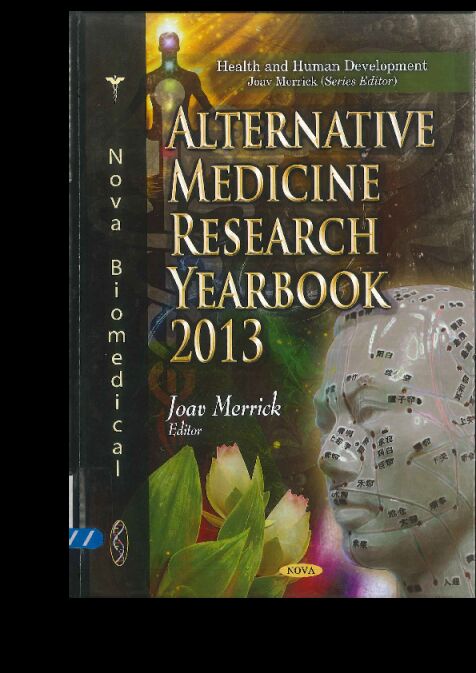
书名:Alternative medicine research yearbook. 2013
ISBN\ISSN:9781633210943,1633210944 2162-3759
出版时间:2014
出版社:Nova Biomedical,
摘要
Introduction - Health and happiness:
Soren Ventegodt, MD, MMedSci, EU-MSc-CAM and Joav Merrick, MD, MMedSci, DMSc.
1 Quality of Life Research Center, Copenhagen, Denmark 2 Research Clinic for Holistic Medicine, Copenhagen, Denmark 3National Institute of Child Health and Human Development, Jerusalem, Israel 4 Office of the Medical Director, Health Services, Division for Intellectual and Developmental Disabilities, Ministry of Social Affairs and Social Services, Jerusalem, Israel 5Kentucky Children's Hospital, University of Kentucky, Lexington, United States Health comes from happiness; happiness comes from stepping into character, knowing all ones talents, and using these talents to create value for other people and oneself. Hippocrates (460-377 BCE).
Well-being or if you call it happiness, satisfaction or meaning of life has for millennia been the sign of the good human life (1). Today we often call this dimension quality of life, especially in medical science. We call it quality of life to let the world know that we acknowledge that it is a complex term (2). It is happiness, but sometimes even the most difficult and unhappy times carry meaning and value, because we learn more about life when difficulties forces us to stop and reflect. This understanding of our self, other human beings and the world at large gained from overcoming our challenges will often lead to future happiness (3,4).
A philosophical difficulty with the concept quality of life is that we are beings in space and time. We are travelers on the journey of our soul. According to the existential philosophers, even personal crises, disease and great looses can contribute to our personal development of wisdom and intimate contact with the life of which we consist (3-6).
Evolution is still going on, and we are all part of the creation of the future human being. Our personal struggles can therefore even be seen as part of the bigger struggle of man to evolve to a species that can inhabit this planet in harmony with all the other species that inhabits it, maybe soon and in the near future. Spiritual and religious people, believing in concepts like karma and divine order, would believe that the universe contains also more subtle energies that just matter, taking also elements from the development of our consciousness into the grand equation of the development of the universe (7).
In this immensely complex universe, of which contemporary science only covers a small corner, we strive for order. We strive to organize our knowledge for the benefit of mankind, to facilitate growth and healing of the unhappy and the ill. A holistic medical science must include as many as possible of all the layers, structures and aspects of the world, without losing simplicity, efficacy and direction (8-12).
We cannot be naive and deny the complexity of the world or of human life. On the other hand we cannot afford to be mysticists if we are to make a medical science that in a simple, rational and efficient way can guide our daily actions. So we need to simplify the world in our description to make it a science,; but we also need to keep our model in accordance with truth, knowing that we always will lose some depth and truths in the process of simplification.
Seen through time, life is Like a cascade. A fertilized egg becomes a conscious being that interprets, makes choices and acts in a complex world. The actions lead to experiences, which leads to re-interpretation of the world, new choices, new actions and so forth. Sometimes we get sick, and sometimes we get better again fast. Other times we lose our health on a continuous basis though time, until we end up and die. Other times again we are close to dying from cancer or a heart condition but on our way down we learn something of extreme importance that allows us to turn the sad development and regain health and happiness. Sometimes we get a bad start, with parents that are sick or dysfunctional. In spite of that we break the evil patterns of the family and lead great lives. Sometimes we come from the most privileged of families, with incredible wealth and unlimited possibilities of doing good, but for some inner reasons we do not appreciate what we have, and end op loosing it all, in abuse of alcohol, sex and drugs.
Life is highly dynamic and it seems that we are creating our own life, future and destiny though our philosophy of life, state of consciousness, strategy of self-realization, and the way we use our character and talents to be fit and able and create value in this world (13). Can the way we create or destroy our own health, happiness and ability be understood in scientific terms? Can we make the dynamic of life a science?
Classical medicine has for millennia been about helping the patient back into happiness, good health and a constructive role in society by helping the patient to increased self-awareness and self-insight. The fruit of realizing your own talents and character is the experience of being of value to one self and other people - being of value in all relationships, private or professional. From the experience of this happy and constructive state of being comes all good things, a positive understanding of life, a positive state of consciousness, a positive state of existence and finally good physical and mental health, high quality of life, and excellent ability of functioning in all areas of Life.
Whether we call this classical medicine, "quality of life as medicine", consciousness-based medicine, character medicine, placebo medicine, holistic medicine or any other equivalent label, it is basically about helping the patient to know him or herself, and to live in accordance with this knowledge.
Life is simple for the wise and complex for the fool. It is difficult for the person who does not understand it, and easy for the person who understands this much: that the good life comes from sharing, giving and contributing.
You could say that the good life is about loving. This might be the simplest way to express the wisdom of Hippocrates and his students; of the Native American shamans, of the African Sangomas, The Australian Aboriginal medicine men, the Celtic druids, and the Same healers. This is also the simple message of all sages at all times and it is the core of all religions.
The good healer loves his patient and this love brings back the patient's ability to love life, self, and other living beings, In principle it is really that simple.
How powerful is quality of life as medicine then? If we go to religion we will hear that everything can be healed, if your faith is strong enough. If we go the most skeptical of the skeptics, you will learn that placebo has no healing power at all - at least in the form it is used in the pharmaceutical randomised clinical tests (14,15).
查看更多
目录
Introduction - Health and happiness xv
SECTION ONE - POSITIVE YOUTH DEVELOPMENT 1
Chapter 1 Prosocial involvement as a positive youth development construct: A conceptual review 3
Chapter 2 Prosocial norms as a positive youth development construct: A conceptual review 15
Chapter 3 Recognition for positive behavior as a critical youth development construct: Conceptual bases and implications on youth service development 27
Chapter 4 Resilience as a positive youth development construct: A conceptual review 39
Chapter 5 Bonding as a positive youth development construct: A conceptual review 55
Chapter 6 Moral competence as a positive youth development construct: A conceptual review 73
Chapter 7 Social competence as a positive youth development construct: A conceptual review 87
Chapter 8 Behavioral competence as a positive youth development construct: A conceptual review 99
SECTION TWO - COMMUNITY SINGING 113
Chapter 9 Using participative community singing program to improve health behaviours in Australian Aboriginal and Torres Strait Islander people 115
Chapter 10 Using community singing as a culturally appropriate approach to prevent depression in Aboriginal and Torres Strait Islander Australians 125
Chapter 11 Community singing program and its effect on improving access to health services in Aboriginal and Torres Strait Islander Australians 133
Chapter 12 Health benefits of Tai Chi 143
Chapter 13 Can community singing program promote social and emotional wellbeing in Aboriginal and Torres Strait Islander Australians? 157
Chapter 14 Arts and culture activity participation for Aboriginal and Torres Strait Islander Australians 165
SECTION THREE - HEALING 175
Chapter 15 Mind-body: Molecular communication and wellness modalities 177
Chapter 16 A SHIP® perspective on creating a healing space for the integration of trauma 201
Chapter 17 Current legal status and research on complementary and alternative medicine in Serbia 219
Chapter 18 Fried: Why you burnout and how to revive 225
Chapter 19 A biography of Terence Evan Carroll: Working-class health care advocate 233
Chapter 20 Cognitive pause-and-unload hypothesis of meditation and creativity 251
Chapter 21 A follow-up study on chronic health complaints in children and adolescents treated with biophoton therapy 271
Chapter 22 Chronic osteonecrosis of jaw bone (NICO): Unknown trigger for systemic disease and a possible new integrative medical approach? 281
Chapter 23 Phytochemistry and antimicrobial potential of Newbouldia laevis leaf extract and its acidic, basic and neutral metabolites 291
Chapter 24 Assessment of the long-term anti-diabetic and anti-hyperlipidaemic effects of aqueous extract of Urena lobata roots in streptozotocin diabetic rats 301
Chapter 25 An integrative model for promoting wellness among mental health consumers 313
Chapter 26 Rapid outcomes observed in a patient with cervicogenic headache following spinal manipulation therapy and massage 325
SECTION FOUR - MANAGED CARE 329
Chapter 27 Managed care in a public setting. Guidelines for planning, organizing, implementing and evaluating comprehensive health care (CHC) 331
Chapter 28 People with a disability in managed care 385
SECTION FIVE - ACKNOWLEDGMENTS 399
Chapter 29 About the Editor 401
Chapter 30 About the National Institute of Child Health and Human Development in Israel 403
Chapter 31 About the book series "Health and human development" 407
Index 411
查看PDF
查看更多
馆藏单位
中国医科院医学信息研究所