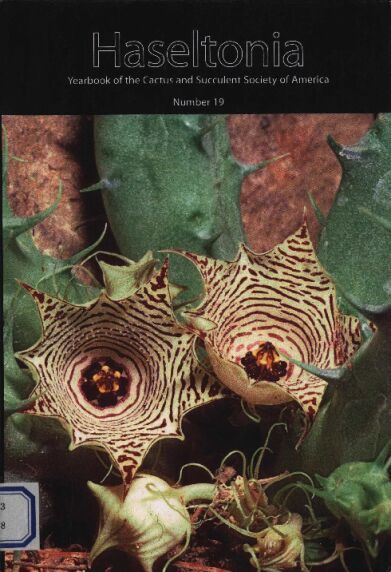
书名:Haseltonia
责任者:Cactus and Succulent Society of America.
出版时间:2014
出版社:Cactus & Succulent Society of America, Inc.,
前言
After a four-year hiatus from Haseltoniay during which Martin Terry did a truly remarkable job, I am returning for a return engagement as editor, hoping to prove that recidivism isn’t as bad as most people think. At the end of 2009, I stepped down as editor to reinvigorate my core research on evolutionary theory of sex, which was starting to languish. The break got me back in the groove of some admittedly non-cactus-and-succu-lent work, such as showing that sex is boring, conservative, and reduces genetic variation (readers should not take this personally). In 2012-2013, my fourth year away from Haseltonia, I accidentally found myself returning to classical botany while on sabbatical from Carleton University. I traveled the globe for the latter half of 2012, with trips to Australia, Thailand and Cambodia, the southwest United States, and Argentina. I saw splendid plants in charming passes, such as Euphorbia antiquorum a meter or two from the Andaman Sea in southern Thailand and carnivorous sundew plants (Drosera sp.) that were climbing sedges——I only noticed these because a solitary flowers was at eye-level, and it looked just like the flowers on our 3 cm tall sundews in Canada——but on spectacular dry red rock outcrops high above the Murchison River in Western Australia. For the first half of 2013, I settled into an old surfing town in central California. The number of cacti and succulents cultivated and sold in that part of the world is stunning. Unexpectedly, this was a reminder that you can still come up with novel ideas and theories by simply looking at cultivated and native plants. Admittedly, it helped living on the beach in California, running the beach every day and stand-up paddle-boarding so long as the swells (open ocean waves) were under 2.5 or 3.0 meters. This helped me recover from incipient nature deficit disorder. As Bill Watterson (1995), the author of Calvin & Hobbes, so astutely re-marked,“I like to sit outside when I write, partly because there are bugs and birds and rocks around that suggest an idea.”
I had forgotten how much fun it is being a botanist. As editor, I have once again been reminded how special it is to correspond with many amazing and amazingly generous academic biologists about cacti and succulents. This not only includes the authors of papers you see here, but also papers that we did not accept, and the many experts who altruistically peer-reviewed these manuscripts.
This volume is divided into four sections (1) anato-my/morphology, (2) ecology, (3) physiology, and (4) taxonomy, each containing two or three papers. We begin with a superlative piece on how much one can infer by taking a close look at seeds in Pereskia. American and European biologists spend endless hours doing high-tech things like sequencing genes. But this leaves open a window for others to do equally important low-budget research using techniques that have proven their value for centuries, such as this study on the oft neglected, but evolutionarily crucial cactus genus Pereskia. Next you will find a perfectly dreadful paper on how exceptions prove the rule, including in cactus architecture. If I were to change careers, one fabulous choice would be to come back as an ecologist. The passion for field ecology shines through in the following pair of papers on Mexican cactus and succulent ecology. The first of these is an elegant treatment of which hummingbirds are pollinating an Echeveria species. The second paper delineates the distribution of the boojum/cirio, Fouquieria columnaris, and conservation implications. Changing gears, physiology is more reductionist than the subjects covered in other papers in this volume, but is nonetheless important. Therefore, you will next read about nutritional composition of a widespread polymorphic prickly pear in Argentina and a review of tissue culture in cacti. Finally, we wrap up with a trio of taxonomy papers, which are often the bread and butter of these pages. Two of these papers describe new succulent monocot species, while the third paper is a review of some succulent asclepiads in Arabia and the Horn of Africa.
The following new combinations are published in Haseltonia 19:
Agave azurea R.H. Webb & G.D. Starr
Aloe ithya T.A. McCoy & L.E. Newton
Huernia baradii Plowes
Huernia delicata Plowes
Huernia sudanensis Plowes
Huernia yemenensis Plowes
Please join me in thanking the following people who brought this volume to fruition. Tim Harvey does all the thankless work as managing editor. In fact, he does far more than me. And he is a renaissance man who can even tell you the difference between fonts and type faces! My immediate predecessor, Martin Terry has not only been a joy to take over from, but also stepped in and handled all of the editorial work for my paper in this volume. Myron Kimnach had the wisdom and foresight to start Haselto-nia, for which we should all be grateful. As in the past, my colleagues across the pond, this time around Graham Charles, have been extraordinarily helpful and supportive. There has never been competition between Haseltonia and Bradleya, only cooperation, which is so refreshing. Thanks to all our authors and reviewers for your priceless contributions. Last but certainly not least, thanks to the board of the Cactus & Succulent Society of America and all of our subscribers, who have supported Haseltonia for two decades.
查看更多
目录
From the Editor 2
Anatomy and Morphology
Embryology and seed development in Pereskia lychnidiflora (Cactaceae)[Karina Jimenez-Duran, Salvador Arias-Montes, Aurea Cortes-Palomec & Judith Marquez-Guzman] 3
Axillary branching of lateral cephalia in Cactaceae is not constrained by tilting of shoot apices [Root Gorelick] 13
Ecology
Morphological and nectar traits in Ecbeveria rosea Lindley (Crassulaceae) linked to hummingbird pollination in central Veracruz, Mexico [H. David Jimeno-Sevilla, Angelica M. Hernandez-Ramirez, Juan Francisco Oroelas & Silvana Marten-Rodnguez] 17
The distribution of cirio {Fouquieria columnaris} in Baja California , Mexico [Robert H. Webb, Mario Salazar-Cesena & Raymond M. Turner] 26
Physiology
Nutritional composition of Opuntia sulphurea G. Don cladodes [Valeria P. Carreira, Julian Padro, Nicolas Mongiardino Koch, Pedro Fontanarrosa, Ignacio Alonso & Ignacio M. Soto] 38
Micropropagation of cacti—a review [Justyna Lema-Rumiriska & Dariusz Kulus] 46
Taxonomy
A new shrubby species of Aloe in the Imatong Mountains, Southern Sudan [Tom McCoy & Leonard E. Newton] 64
The small-flowered Afro-Arabi an species of Huernia [Darrel C. H. Plowes] 66
Agave azurea (Agavaceae), a new species from Baja California Sur, Mexico, with notes on other agaves on the Vizcaino Peninsula [Robert H. Webb& Greg Starr] 89
查看PDF
查看更多
馆藏单位
中国农科院农业信息研究所