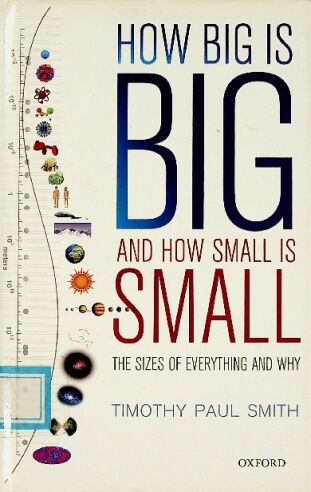
书名:How big is big and how small is small
出版时间:2013
出版社:Oxford University Press
摘要
This book is about how big is the universe and how small are quarks, and what are the sizes of dozens of things between these two extremes. It describes the sizes of atoms and planets, quarks and galaxies, cells and sequoias. It is a romp through forty-five orders of magnitude from the smallest sub-nuclear particles we have measured, to the edge of the observed universe. It also looks at time, from the epic age of the cosmos to the fleeting lifetimes of ethereal particles. It is a narrative that trips its way from stellar magnitudes to the clocks on GPS satellites, from the nearly logarithmic scales of a piano keyboard through a system of numbers invented by Archimedes and on to the measurement of the size of an atom.
Why do some things happen at certain scales? Why are cells a hundred thousandths of a meter across? Why are stars never smaller than about 100 million meters in diameter? Why are trees limited to about 120 meters in height? Why are planets spherical, but asteroids not? Often the size of an object is determined by something simple but quite unexpected. The size of a cell and a star depend in part on the ratio of surface area to volume. The divide between the size of a spherical planet and an irregular asteroid is the balance point between the gravitational forces and the chemical forces in nature.
Most importantly, with a very few basic principles, it all makes sense. The world really is a most reasonable place.
查看更多
目录
List of Figures iv
List of Tables vii
1.From Quarks to the Cosmos - An Introduction 1
2.Scales of the Living World 14
3.Big Numbers; Avogadro's Number 30
4.Scales of Nature 45
5.Little Numbers; Boltzmann's and Planck's Constant 63
6.The Sand Reckoner 78
7.Energy 94
8.Fleeting Moments of Time 110
9.Deep and Epic Time 127
10.Down to Atoms 146
11.How Small is Small 164
12.Stepping Into Space - The Scales of the Solar System 184
13.From the Stars to the Edge of the Universe 205
14.A Little Chapter About Truly Big Numbers 228
15.Forces That Sculpture Nature and Shape Destiny 239
Index 249
查看更多
作者简介
Tim Smith is a Research Professor at Dartmouth College where he teaches Physics and Environmental Studies. Before then he was a Research Scientist at the MIT accelerator where he spent a decade as part of a team building an experiment to measure the arrangement of quarks inside of neutrons and protons. He has written magazine articles about neutrons, wind power and hiking. In this book he gets to explore all that and much more.
查看更多
馆藏单位
中科院文献情报中心