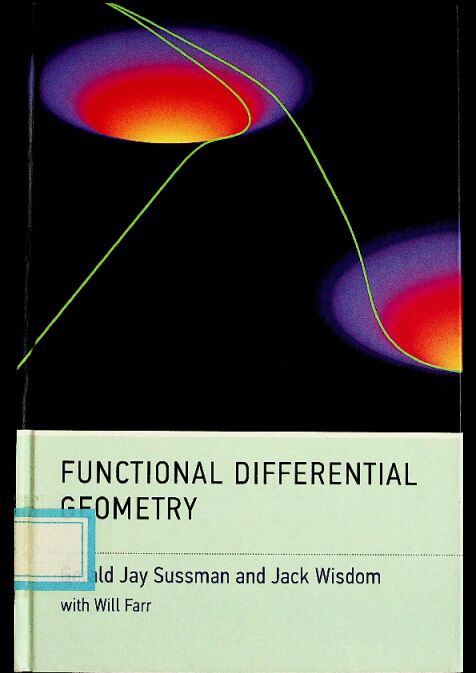
书名:Functional differential geometry
责任者:Gerald Jay Sussman and Jack Wisdom with Will Farr. | Wisdom, Jack. | Farr, Will.
出版时间:2013
出版社:The MIT Press,
前言
Learning physics is hard. Part of the problem is that physics is naturally expressed in mathematical language. When we teach we use the language of mathematics in the same way that we use our natural language. We depend upon a vast amount of shared knowledge and culture, and we only sketch an idea using mathematical idioms. We are insufficiently precise to convey an idea to a person who does not share our culture. Our problem is that since we share the culture we find it difficult to notice that what we say is too imprecise to be clearly understood by a student new to the subject. A student must simultaneously learn the mathematical language and the content that is expressed in that language. This is like trying to read Les Misérables while struggling with French grammar.
This book is an effort to ameliorate this problem for learning the differential geometry needed as a foundation for a deep understanding of general relativity or quantum field theory. Our approach differs from the traditional one in several ways. Our coverage is unusual. We do not prove the general Stokes's Theorem - this is well covered in many other books - instead, we show how it works in two dimensions. Because our target is relativity, we put lots of emphasis on the development of the covariant derivative, and we erect a common context for understanding both the Lie derivative and the covariant derivative. Most treatments of differential geometry aimed at relativity assume that there is a metric (or pseudometric). By contrast, we develop as much material as possible independent of the assumption of a metric. This allows us to see what results depend on the metric when we introduce it. We also try to avoid the use of traditional index notation for tensors. Although one can become very adept at "index gymnastics," that leads to much mindless (though useful) manipulation without much thought to meaning. Instead, we use a semantically richer language of vector fields and differential forms.
But the single biggest difference between our treatment and others is that we integrate computer programming into our explanations. By programming a computer to interpret our formulas we soon learn whether or not a formula is correct. If a formula is not clear, it will not be interpretable. If it is wrong, we will get a wrong answer. In either case we are led to improve our program and as a result improve our understanding. We have been teaching advanced classical mechanics at MIT for many years using this strategy. We use precise functional notation and we have students program in a functional language. The students enjoy this approach and we have learned a lot ourselves. It is the experience of writing software for expressing the mathematical content and the insights that we gain from doing it that we feel is revolutionary. We want others to have a similar experience.
Acknowledgments We thank the people who helped us develop this material, and especially the students who have over the years worked through the material with us. In particular, Mark Tobenkin, William Throwe, Leo Stein, Peter Iannucci, and Micah Brodsky have suffered through bad explanations and have contributed better ones.
Edmund Bertschinger, Norman Margolus, Tom Knight, Rebecca Frankel, Alexey Radul, Edwin Taylor, Joel Moses, Kenneth Yip, and Hal Abelson helped us with many thoughtful discussions and advice about physics and its relation to mathematics.
We also thank Chris Hanson, Taylor Campbell, and the community of Scheme programmers for providing support and advice for the elegant language that we use. In particular, Gerald Jay Sussman wants to thank Guy Lewis Steele and Alexey Radul for many fun days of programming together - we learned much from each other's style.
Matthew Halfant started us on the development of the Scmutils system. He encouraged us to get into scientific computation, using Scheme and functional style as an active way to explain the ideas, without the distractions of imperative languages such as C. In the 1980s he wrote some of the early Scheme procedures for numerical computation that we still use.
Dan Zuras helped us with the invention of the unique organization of the Scmutils system. It is because of his insight that the system is organized around a generic extension of the chain rule for taking derivatives. He also helped in the heavy lifting that was required to make a really good polynomial GCD algorithm, based on ideas we learned from Richard Zippel.
A special contribution that cannot be sufficiently acknowledged is from Seymour Papert and Marvin Minsky, who taught us that the practice of programming is a powerful way to develop a deeper understanding of any subject. Indeed, by the act of debugging we learn about our misconceptions, and by reflecting on our bugs and their resolutions we learn ways to learn more effectively. Indeed, Turtle Geometry [2], a beautiful book about discrete differential geometry at a more elementary level, was inspired by Papert's work on education. [13]
We acknowledge the generous support of the Computer Science and Artificial Intelligence Laboratory of the Massachusetts Institute of Technology. The laboratory provides a stimulating environment for efforts to formalize knowledge with computational methods. We also acknowledge the Panasonic Corporation (formerly the Matsushita Electric Industrial Corporation) for support of Gerald Jay Sussman through an endowed chair.
Jack Wisdom thanks his wife, Cecile, for her love and support. Julie Sussman, PPA, provided careful reading and serious criticism that inspired us to reorganize and rewrite major parts of the text. She has also developed and maintained Gerald Jay Sussman over these many years.
查看更多
目录
Preface xi
Prologue xv
1 Introduction 1
2 Manifolds 11
2.1 Coordinate Functions 12
2.2 Manifold Functions 14
3 Vector Fields and One-Form Fields 21
3.1 Vector Fields 21
3.2 Coordinate-Basis Vector Fields 26
3.3 Integral Curves 29
3.4 One-Form Fields 32
3.5 Coordinate-Basis One-Form Fields 34
4 Basis Fields 41
4.1 Change of Basis 44
4.2 Rotation Basis 47
4.3 Commutators 48
5 Integration 55
5.1 Higher Dimensions 57
5.2 Exterior Derivative 62
5.3 Stokes's Theorem 65
5.4 Vector Integral Theorems 67
6 Over a Map 71
6.1 Vector Fields Over a Map 71
6.2 One-Form Fields Over a Map 73
6.3 Basis Fields Over a Map 74
6.4 Pullbacks and Pushforwards 76
7 Directional Derivatives 83
7.1 Lie Derivative 85
7.2 Covariant Derivative 93
7.3 Parallel Transport 104
7.4 Geodesic Motion 111
8 Curvature 115
8.1 Explicit Transport 116
8.2 Torsion 124
8.3 Geodesic Deviation 125
8.4 Bianchi Identities 129
9 Metrics 133
9.1 Metric Compatibility 135
9.2 Metrics and Lagrange Equations 137
9.3 General Relativity 144
10 Hodge Star and Electrodynamics 153
10.1 The Wave Equation 159
10.2 Electrodynamics 160
11 Special Relativity 167
11.1 Lorentz Transformations 172
11.2 Special Relativity Frames 179
11.3 Twin Paradox 181
A Scheme 185
B Our Notation195
C Tensors 211
References 217
Index 219
查看更多
馆藏单位
中科院文献情报中心