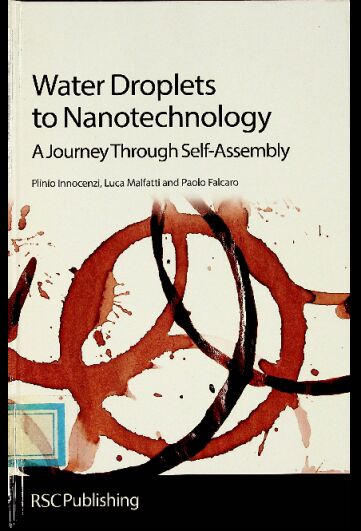
书名:Water droplets to nanotechnology
责任者:Plinio Innocenzi | Luca Malfatti and Paolo Falcaro. | Falcaro, Paolo,
出版时间:2013
出版社:Royal Society of Chemistry
前言
Within the nano-world, self-assembly is the result of a delicate balance among different chemical-physical forces, and one of the most striking properties of the nano-objects is the ability to self-organize into complex structures. Following the consideration that we are all the result of a self-organization process, we should be aware that the complexity of living structures holds the secret to self-assembly.
The self-organization depends on different variables such as composition, shape and dimension of the involved objects, as well as their different physical states.
Liquid systems have exceptional features that make them excellent candidates for self-assembly. Firstly, liquids offer the possibility to dissolve or suspend different species such as copolymers, nanoparticles, biomolecules and biological entities. Secondly, chemical reactions occur homogenously and quickly in the liquid state. Finally, the liquid can be removed, taking advantage of the evaporation process.
Despite evaporation being a common phenomenon in everyday life, it plays a crucial role in the self-organization of systems composed of liquids and nano-objects (colloidal systems). These are either pre- formed solids such as nanoparticles, nanorods of sheets, or supramo- lecular structures formed during the self-assembly process itself. That is the case for surfactants, which are a fascinating class of molecule. Under solvent evaporation surfactants are able to generate a large variety of super-structures from basic to complex shapes.
However, there is a drawback in this business and that is the instability of the process. When evaporation is involved, most of the self-assembly processes are not equilibrium phenomena because they are kinetically controlled.
Achieving organization through non equilibrium sounds like an ambitious task but fortunately it works!
In this book, we have highlighted that evaporation by itself does not create organization; order is indeed driven by the forces that arise during evaporation. These forces can trigger the system to become ordered or disordered. In the latter case, the final material will not exhibit any organization at the nanoscale; only a careful control of the evaporation rate allows dancing on the tightrope of self-assembly.
This book can be treated as a small journey that reveals the secrets of self-assembly occurring during evaporation of a colloidal water droplet; little by little, the journey moves from the mysteries of a coffee stain on glassware to the formation of complex hierarchical systems for advanced multifunctional applications.
查看更多
目录
Author Biographies xiii
Chapter 1 The Coffee Stain: Using a Water Droplet for Self-assembly"
1.1. The coffee-stain effect 1
1.2. Reversing the coffee stain 6
1.3. Self-assembly particle rings 8
1.4. Shape matters 10
1.5. The dimensions also matter 13
1.6. Achieving order at the contact line 18
1.7. References 21
Chapter 2 The Tears of Wine. The Marangoni Effect, a Fluid Phenomenon for Self-Assembly and Organization
2.1. Wine tears and the Marangoni effect 23
2.2. Self-organization during formation of a liquid film via dip-coating and spin-coating 27
2.3. Benard cells and self-assembly 29
2.4. Combining coffee stain and Marangoni effects for the self-assembly of nanoparticles 31
2.5. Lithography using the Marangoni effect 35
2.6. Surfactants and the Marangoni effect 36
2.7. References 39
Chapter 3 The Lord of the Rings: Stick and Slip Motions and Self-Assembly During Coffee-Stain Formation
3.1. Pinning: depinning in an evaporating droplet 41
3.2. Stick and slip in an evaporating colloidal drop 44
3.3. The Lord of the Rings, controlling the stick and slip motion 49
3.4. Rings from colloidal solutions 50
3.5. References 54
Chapter 4 Convective Self-Assembly (CSA)
4.1. Self-assembly by convective flow 57
4.2. Reversing self-assembly 61
4.3. Convective deposition of binary suspensions 63
4.4. Stick and slip again! Getting aligned stripes of nanoparticles from CSA 65
4.5. Not only particles! 67
4.6. References 69
Chapter 5 Using Breath for Nanotechnology
5.1. The nano-shaping breath 71
5.2. The templating machinery 73
5.3. Which parameters control the breath figures templating process? 76
5.4. Shaping pore size and pore organization 79
5.5. Breath figures at work: applications of templated porous materials 80
5.6. Breath figures and superstructures 84
5.7. References 86
Chapter 6 Nanomaterials with Light Shaping Capabilities: Photonic Crystals C2\6.1. Which type of self-assembled photonic crystals? 93
6.2. How to fabricate photonic crystals 95
6.3. Self-assembled photonic crystals 95
6.4. Band gap, opals and inverse opals 97
6.5. Self-assembly of spherical particles driven by solvent evaporation 98
6.6. Spherical particles composition and deposition parameters in evaporative self-assembly 100
6.7. References 102
Chapter 7 Superlattices and Quasicrystals
7.1. Colloidal nanocrystals and superlattices 104
7.2. Again, starting from a droplet 105
7.3. Extending the superlattice domains: charged gold nanoparticles in non-polar solvents 108
7.4. Not only spheres 109
7.5. Not only droplets 110
7.6. Binary nanocrystals 113
7.7. More than crystals... quasicrystals 118
7.8. References 119
Chapter 8 Shaping and Ordering the Porosity Through Self-assembly
8.1. What type of porosity? Escaping from a zeolite trap 121
8.2. We need a template 122
8.3. We need bricks 126
8.4. The race to order 129
8.5. What type of order? 131
8.6. "Crystals" of pores 132
8.7. Designing order: orienting the pores 134
8.8. A living structure 136
8.9. References 139
Chapter 9 Towards the Complex Organization of Matter: Hierarchical Porosity
9.1. Porous hierarchical materials 141
9.2. An easy approach: evaporation-induced self-assembly on pre-patterned substrates 143
9.3. The hierarchical assembly of porous particles 145
9.4. One-pot synthesis with preformed templates 147
9.5. Opal infiltration and micro-moulding 150
9.6. One-pot approach with in situ formation of multiple templates 154
9.7. A hierarchical overview 159
9.8. References 159
Subject Index 162
查看更多
作者简介
Paolo Falcaro is a materials scientist who received his Ph.D. in Material Engineering in 2006 from Bologna University. From 2005 to 2008, he worked as a research scientist in the Nanofabrication Facility (Civen/Nanofab, Venice, Italy) for industrial applications using sol—gel technologies. In 2009, he joined CSIRO (Material Science and Engineering Division, CMSE in Melbourne, Australia) as a Postdoctoral Fellow. He is currently a research scientist at CSIRO and an ARC Discovery Early Career Research Fellow. He is the recipient of several national and international awards, including the Ulrich Award, the Japan—Australia Emerging Leader Award and the CSIRO Julius Award. He investigates self-assembled porous materials preparation and patterning and fabrication techniques to control the formation of functional materials. He also works on functional nanoparticles for sensing applications and biolabelling.
查看更多
馆藏单位
中科院文献情报中心