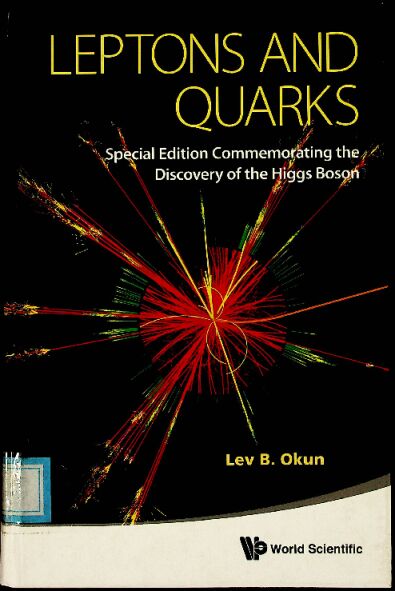
书名:Leptons and quarks
责任者:Lev B. Okun ; V.I. Kisin. | Kisin, V. I.
ISBN\ISSN:9789814603003,9814603007
出版时间:2014
出版社:World Scientific
摘要
The book “Leptons and Quarks” was first published in the early 1980s, when the program of the experimental search for the intermediate bosons W and Z and Higgs boson H was formulated. The aim and scope of the present extended edition of the book, written after the experimental discovery of the Higgs boson in 2012, is to reflect the various stages of this 30+ years search. Along with the text of the first edition of “Leptons and Quarks” it contains extracts from a number of books published by World Scientific and an article from “On the concepts of vacuum and mass and the search for higgs” available from httpWEBLinkworldscinet/mpla or from httpWEBLinkabs/1212.1031. The book is unique in communicating the Electroweak Theory at a basic level and in connecting the concept of Lorenz invariant mass with the concept of the Extended Standard Model, which includes gravitons as the carriers of gravitational interaction. Key Features: ○ The book differs from the competing titles by the unique interpretation of real and virtual particles in the framework of Feynman diagrams and by the unique inclusion of gravitons in the framework of the Extended Standard Model.
查看更多
目录
Preface to the World Scientific Edition of "Leptons and Quarks" v
Preface xv
Preface to the Second Russian Edition Enlaroed and Revised xvii
1. Introduction 1
1.1. Quark currents 3
1.2. On the color of weak currents 4
1.3. Cunems and processes 5
1.4. About the outline of this book 7
2. Structure of weak currents 9
2.1. Left-handed charged currents 1O
2.2. Breaking of P- and C-invariance 12
2.3. Universality of the charged current 12
2 4. The neutral current 13
3. Muon decay 15
3.1. Decay amplitude 15
3.2. Decay probability 17
3.3. Decay of polarized muon 19
3 4. Qualitallve discussion 20
4. Stra11ge11ess-co11serving leptonic decays of hadrons. Properties of the ucl-current 22
4.1. Isotopic properties of the ud-current 23
4.2. Relationship between the vector current ud and the isovector electromagnetic current 23
4.3. Weak charge 24
4.4. Chiral mvanance 25
5. Leptonic decays of pions and nucleons 27
5.1. π → lv decays 27
5.2. π + → 1T0e+ v decay 29
5.3. β decay of the neutron 30
5.4. Vector form factors 31
5.5. Axial form factors 32
5.6. The probability of /3-decay. Angular correlations 35
5.7. +- → Ae = v decays 36
6. Leptonic decays of K-mesons and hyperons 38
6.1. |S| = I and Q = S rules 38
6.2. SU(3) and SU(2) properties of the us current 39
6.3. Kt2 decays 40
6.4. Kt3 decays 41
6.5. Ku decays 42
6.6. Ke4 decays 43
6.7. Leptonic decays of hyperons 44
7. Strangeness-changing non-leptonic interactions 48
7.1. Properties of the bare non-leptonic lagrangian 48
7.2. The inclusion of hard gluons 50
7.3. The gluonic monopole 52
7.4. Effective non-leptonic lagrangian 56
8. Phenomenology of non-leptonic decays of hyperons 58
8.1. Relativistically invariant amplitude 58
8.2. Non-relativistic form of the amplitude 59
8.3. Spin correlations in hyperon decays 59
8.4. Isotopic amplitudes and the T = 1/2 rule 61
8.5. Phases of the S- and P-wave amplitudes 63
8.6. SU(3) relation between amplitudes of hyperon decays 65
9. Dynamics of non-/eptonic decays of hyperons 67
9.1. Quark graphs 67
9.2. Factorization of external diagrams for the decay A0 → pπ 69
9.3. Enhancement of the contribution of right-handed quarks 71
9.4. A0 → nπ0 decay 72
9.5. hyperon decays 74
10. Non-Jeptonic decays of K-mesons 76
10.1. K01 and K02 mesons 76
10.2. Isotopic relations for k → 2π decays 77
10.3. Quark graphs for K +- → π+- π0 decays 79
10.4. K → 3π decays 82
11. Neutral K-mesons in vacuum and in matter 85
11.1. K0 +-+ K 0 transitions and the K?-K mass difference 85
11.2. Glashow-Iliopoulos-Maiani mechanism 88
11.3. Oscillations of strangeness 89
11.4. Regeneration 91
12. Violation of CP invariance 94
12.1. K0L → π+ π- decay 94
12.2. Other observed CP violating effects 95
12.3. Superweak rmxmg 97
12.4. On decays of the K0S meson 98
12.5. Violation of time-reversal invariance and the neutron
dipole moment 99
12.6. Gedanken experiments 101
13. Decays of the T-lepton 103
13.1. vT neutrino 103
13.2. DecaysT → µ- v v and f T- →e-v v 104
13.3. Semi-hadronic decays. General remarks 104
13.4. Decay T → πv 105
13.5. Decay T → ρv 107
13.6. Decays T → v 十 2nπ 110
13.7. Decays T → v + (2n + l )π 114
13.8. Decays T → v + K + nπ 116
13.9. Summary of results 116
14. Decays of charmed particles 117
14.1. Leptonic and non-leptonic decays 117
14.2. The role of virtual gluons 118
14.3. Selection rules for T-,U-, and V-spin 121
15. Weak decays of b- and t-quarks 123
15.1. Unitary n ×n matrix 123
15.2. Angles and phase 8 124
15.3. Metastability of the b-quark 126
15.4. Contribution of t-quarks to K-0 → K0 transitions 127
15.5. Cascade decays of b- and t-hadrons 129
16. Neutrino -electron interactions . I 30
16.1. Kinematics of " + e → "+ e reactions 130
16.2. Cross section of the 1111e → vµ reaction 133
16.3. Cross section of the ιe → vµ- reaction 134
16.4. Elastic 11e and iie scattering induced by charged current 135
16.5. Cross sections of the ve and ve scattering: general formulas 138
16.6. Other effects of the 11e interaction 139
16.7. Creation of muon pairs by neutrinos in the Coulomb field of the nucleus 140
17. Neutrino-nucleon interactions 143
17.1. Kinematics 143
17.2. Quasi-elastic scattering 144
17.3. Partons 145
17.4. Kinematics of lepton-parton collisions 146
17.S. Lepton-parton collision cross sections 147
17.6. Parton distributions 149
17.7. Cross sections of deep-inelastic processes 151
17.8. Production of strange and charmed particles 152
17.9. Phenomenology of deep-inelastic processes 154
17.10. The parton model and quantum chromodynarnics 155
18. Renormalizability 156
18.1. Why do we need renormalizability? 156
18.2. Unitanty limit 157
18.3. Intermediate bosons 158
18.4. Wave function of the vector boson 160
18.S. Digression on the photon mass 161
18.6. Vector boson propagator 162
19. Gauge invariance 164
19.1. Global abelian symmetry U(l) 164
19.2. Global non-abelian symmetry SU(2) 165
19.3. Local abelian symmetry 165
19.4. Digression on baryonic and leptonic photons 166
19.5. Local SU(2) symmetry 167
19.6. Panegyric to Yang-Mills theory 170
19.7. How to take masses into account? 171
20. Spontaneous symmetry breaking 174
20.1. Spontaneous breaking of discrete symmetry 174
20.2. Spontaneous breaking of global U(l) symmetry 177
20.3. Spontaneous breaking of global SU(2) symmetry 179
20.4. Spontaneous breaking of abelian gauge symmetry 180
20.5. On the conservation of electric charge 181
20.6. Spontaneous breaking of local SU(2) symmetry 183
21. Standard model of the electroweak interaction 185
21.1. Main features of the model 185
21.2. Nine terms of the Jagrangian 187
21.3. Masses of W- and Z-bosons 189
21.4. Relation between electric charge and the constants
g and g’ 191
21.5. Relation between the vacuum-expectation value η
and the Fermi constant G 192
21.6. More about the masses of the W- and Z-bosons 193
21.7. Electron mass 194
21.8. Introduction of other leptons and quarks 195
22. Neutral currents 199
22.1. Scattering of vc and iic on the electron 199
22.2. Scattering of v and v on the electron 201
22.3. Annihilation e+ e → µ + µ- 202
22.4. Neutral currents and neutrino-nucleon interaction 206
22.5. Isotopic properties of the neutral current 208
22.6. Parity non-conservation in scattering of electrons by nucleons 209
22.7. Parity non-conservation in atoms 211
22.8. P-odd nuclear forces 213
23. Properties of intermediate bosons 214
23.1. Decays of W-bosons 214
23.2. Decays of Z-bosons 216
23.3. Production of Z-bosons 217
23.4. Production of W-bosons 218
23.5. Colliding beam projects 220
23.6. DUMAND 221
24. Properties of Higgs bosons 223
24.1. On the H-boson mass 223
24.2. The role of H-bosons at high energies 225
24.3. Coupling of H-bosons to heavy quarks 227
24.4. Coupling of H-bosons to gluons 228
24.5. "Higgs charge" of nucleons 230
24.6. Digression on the trace of the energy-momentum operator 231
24.7. Coupling of H-bosons to W- and Z-bosons 232
24.8. Coupling of H-bosons to photons 233
24.9. General remarks on Higgs bosons 235
25. Grand unification 236
25.1. Three generations of fermions 236
25.2. Quintet and decuplet in SU(S) 237
25.3. 24 vector bosons 239
25.4. Running coupling constants 240
25.5. Unstable proton 243
25.6. Grand Higgs bosons 246
25.7. The SO(10) group and other orthogonal groups 248
25.8. The exceptional groups 249
26. Superunification 251
26.1 Supersyrnmetry 251
26.2 Sub-quarks? 252
27. Particles and the universe 254
27.1. Hot universe 254
27.2. Upper bound on the neutrino mass 257
27.3. On the number of possible types of neutrinos 258
27.4. Concentration of relic quarks 260
27.5. On baryonic asymmetry of the universe 261
28. Bibliography 263
28.1. Monographs. Proceedings of conferences 265
28.2. Decays of leptons and hadrons 267
28.3. Neutrino reactions 278
28.4. Weak interactions at high energies 281
28.5. Models of grand and super uni fication 288
28.6. Particles and the universe 290
28.7. Supplementary bibliography (aulll mn 1980) 296
29. App endix (some usef ul fo nnulas) 308
29.1 Pseudo-eucl idean metric 308
29.2. G 1oups 309
29.3. Propenies of Dirac matrices 317
29.4. Rules for the calculation of probabi lities 325
30. Tables of exp erimenral data 329
30.1. Physical and nu merical constants and para meters 330
30.2. Tables of particle properties 332
30.3. Weak 出cays and the 1/2 rule 343
30.4. CP- and CPT-invariances 350
30.5. Conservation of leptonic numbers 352
30.6. Selection rules for the weak current 353
Notable Works of Lev Borisovich Okun published by World Scientific 363
Dust Cover, Preface and Co11rents of the book “The Relations of Particles" WS l991 365
Book Cover, Preface and Co111e11rs of "En ergy and Mass in Relativity Theory" WS 2009 369
Book Cover, Preface and Contems of "ABC of Physics: A Very Brief Guide" WS 2012 377
Joumal Cover and text of rhe article “On the Concepts of Vacuum and Mass and the Search for Higgs" arXiv: 1212.103l 397
About the Author
查看更多
馆藏单位
中科院文献情报中心