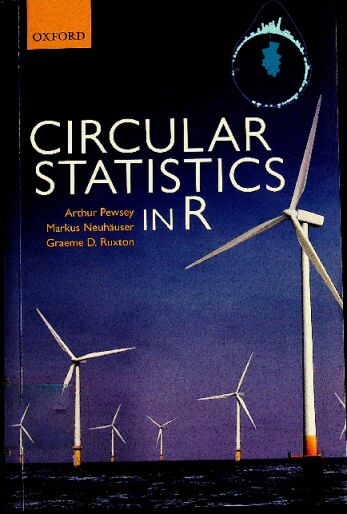
书名:Circular statistics in R
责任者:Arthur Pewsey | Markus Neuhauser | Graeme D. Ruxton.
出版时间:2013
出版社:Oxford University Press
前言
As explained in the appendix, just six books providing indepth treatments of circular statistics have previously been published.There were various motivating factors which prompted us to add this book to that shortlist.First,the last book published on the topic appeared over ten years ago,and much has changed,in statistics in general and circular statistics in particular,in that time.We felt the time was right to offer a book that provided readers with the background to,and the functionality to apply,traditional as well as more recently proposed methods for analysing circular data.In particular,we stress the use of likelihood-based and computer-intensive approaches to inference and modelling,and distributions that are capable of modelling features such as asymmetry and varying levels of kurtosis that are often
查看更多
目录
1Introduction 1
1.1 What is Circular Statistics? 1
1.2WhatisR? 3
1.3 GettingStarted with R 3
1.4R's Circular Package 4
1.5Web-based R Code and the Circ Stats In R Workspace 5
1.6 Circular Statistics in Other Software Environments 6
1.7 Related Types of Data 6
1.8Aims of the Book 7
1.9 The Book's Structure and Use 8
1.10ANoteon Resampling Methods 9
2Graphical Representation of Circular Data 11
2.1 Introduction 11
2.2Raw Circular Data Plots 11
2.3Rose Diagrams 14
2.4 Kernel Density Estimates 15
2.5 Linear Histograms 17
3Circular Summary Statistics 21
3.1 Introduction 21
3.2 Sample Trigonometric Moments 22
3.3 Measures of Location25
3.3.1Sample Mean Direction 25
3.3.2Sample Median Direction 26
3.4 Measures of Concentration and Dispersion 26
3.4.1Sample Mean Resultant Length 26
3.4.2Sample Circular Variance and Standard Deviation 27
3.4.3Other Sample Dispersion Measures 28
3.5 Measures of Skewness and Kurtosis 29
3.6 Corrections for Grouped Data 30
3.7Axial Data 32
4Distribution Theory and Models for Circular Random Variables 35
4.1 Introduction 35
4.2 Circular Distribution Theory 35
4.2.1Circular Distribution and Probability Density Functions 36
4.2.2Circular Characteristic Function,Trigonometric Moments and Fourier Series Expansion 38
4.2.3Basic Population Measures 40
4.2.4Symmetric Distributions 41
4.2.5Large-sample Distribution of Key Circular Summaries 42
4.34.3 Circular Models 44
4.3.1General Approaches for Generating Circular Distributions 44
4.3.2Discrete Circular Uniform Distribution 46
4.3.3Continuous Circular Uniform Distribution 47
4.3.4Cardioid Distribution 48
4.3.5Cartwright's Power-of-Cosine Distribution 50
4.3.6Wrapped Cauchy Distribution 52
4.3.7Wrapped Normal Distribution 54
4.3.8Von Mises Distribution 56
4.3.9Jones-Pewsey Family 58
4.3.10 Unimodal Symmetric Transformation of Argument Families 62
4.3.11Sine-skewed Distributions 65
4.3.12 Unimodal Asymmetric Transformation of Argument Families 67
4.3.13InverseBatschelet Distributions 70
4.3.14 Summary of Continuous Circular Models 74
4.3.15 Other Models for Unimodal Data 75
4.3.16 Multimodal Models 76
4.3.17 Models for Toroidal Data 77
4.3.18 Models for Cylindrical Data 77
5Basic Inference for a Single Sample 79
5.1 Testing for Uniformity 80
5.1.1Testing for Uniformity Against any Alternative 81
5.1.2Testing for Uniformity Against a Unimodal Alternative with a Specified Mean Direction 86
5.2 Testing for Reflective Symmetry 86
5.2.1Large-sample Test for Reflective Symmetry 87
5.2.2Bootstrap Test for Reflective Symmetry 88
5.3 Inference for Key Circular Summaries 90
5.3.1Bias-corrected Point Estimation 90
5.3.2Bias-corrected Confidence Intervals 91
5.3.3Testing for a Specified Mean Direction 96
6Model Fitting for a Single Sample 101
6.1 Introduction 101
6.2FittingavonMises Distribution 102
6.2.1Maximum Likelihood Based Point Estimation 102
6.2.2Confidence Interval Construction 102
6.2.3Goodness-of-fit 103
6.3 Fitting a Jones-Pewsey Distribution 107
6.3.1Maximum Likelihood Point Estimation 107
6.3.2Confidence Interval Construction 108
6.3.3Model Comparison and Reduction 113
6.3.4Goodness-of-fit 115
6.3.5Modelling Grouped Data118
6.4FittinganInverseBatsche let Distribution 123
6.4.1Maximum Likelihood Point Estimation 124
6.4.2Confidence Interval Construction 125
6.4.3Model Comparison and Reduction 127
6.4.4Goodness-of-fit 128
Comparing Two or More Samples of Circular Data 131
7.1 Exploratory Graphical Comparison of Samples 131
7.1.1Multiple Raw Circular Data Plot 131
7.1.2Angular Q-Q Plot 132
7.2 Tests for a Common Mean Direction 134
7.2.1Watson's Large-sample Nonparametric Test 134
7.2.2Bootstrap Version of Watson's Nonparametric Test 135
7.2.3Watson-Williams Test for von Mises Distributions 136
7.3 Tests for a Common Median Direction 137
7.3.1Fisher's Nonparametric Test 137
7.3.2Randomization Version of Fisher's Nonparametric Test 138
7.4 Tests for a Common Concentration 139
7.4.1Wall raff s Nonparametric Test 139
7.4.2Fisher's Test for von Mises Distributions 139
7.4.3Randomization Version of Fisher's Test 141
7.5 Tests for a Common Distribution 142
7.5.1Chi-squared Test for Grouped Data 142
7.5.2Large-sample Mardi a-Watson-Wheeler Test 142
7.5.3Randomization Version of the Mardi a-Watson-Wheeler Test 143
7.5.4Watson's Two-sample Test 144
7.5.5Randomization Version of Watson's Two-sample Test 145
7.6 Moore's Test for Paired Circular Data 146
8Correlation and Regression 149
8.1 Introduction 149
8.2 Linear-Circular Association 149
8.2.1Johnson-We hrly-Mardi a Correlation Coefficient 150
8.2.2Mardi a's Rank Correlation Coefficient 152
8.3 Circular-Circular Association 153
8.3.1Fisher-Lee Correlation Coeff cient for Rotational Dependence 153
8.3.2Fisher-Lee Correlation Coeff cient for Toroidal-Monotonic Association 157
8.3.3Jammalamadaka-Sarma Correlation Coefficient 157
8.3.4Rothman's Test for Independence 158
8.4 Regression for a Linear Response and a Circular Regressor 160
8.4.1Basic Cosine Regression Model 160
8.4.2Extended Cosine Regression Model 162
8.4.3Skew Cosine Regression Model 164
8.4.4Symmetric Flat-Topped and Sharply Peaked Cosine Regression Model 165
8.5 Regression for a Circular Response and Linear Regressors 166
8.6 Regression for a Circular Response and a Circular Regressor 168
8.7 Multivariate Regression with Circular Regressors 170
Appendix Further Reading 171
1 Books on Circular Statistics 171
2 Internet-based Resources 172
References 173
Index 179
查看PDF
查看更多
馆藏单位
中科院文献情报中心