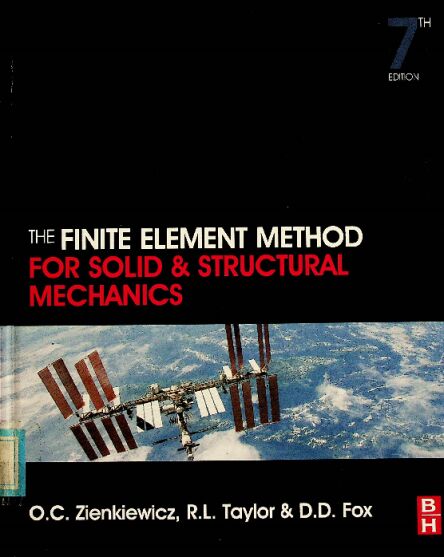
书名:The finite element method for solid and structural mechanics
责任者:O.C. Zienkiewicz | R.L. Taylor | D.D. Fox . | Fox, David.
ISBN\ISSN:9781856176347,1856176347
出版时间:2014
出版社:Elsevier/Butterworth-Heinemann
前言
The present revision of The Finite Element Method was undertaken shortly before the passing in January 2009 of our close friend and co-author Olgierd C. (Olek) Zienkiewicz. His inspiration and guidance has been greatly missed in the intervening years, however, we hope that the essence of his writings is retained in the new work so that current and future scholars can continue to benefit from his insights and many contributions to the field of computational mechanics. The story of his life and works is summarized in International Journal for Numerical Methods in Engineering, 80, 2009, pp. 1–45.
It is 46 years since The Finite Element Method in Structural and Continuum Mechanics was first published. This book, which was the first dealing with the finite element method, provided the basis from which many further developments occurred. The expanding research and field of application of finite elements led to the second edition in 1971, the third in 1977, the fourth as two volumes in 1989 and 1991, and the fifth as three volumes in 2000. The size of each of these editions expanded geometrically (from 272 pages in 1967 to the sixth edition of nearly 1800 pages). This was necessary to do justice to a rapidly expanding field of professional application and research. Even so, much filtering of the contents was necessary to keep these editions within reasonable bounds.
In the present edition we have retained the complete works as three separate volumes, each one capable of being used without the others and each one appealing perhaps to a different audience.
The first volume The Finite Element Method: Its Basis and Fundamentals is designed to cover quite completely all the steps necessary to solve problems represented by linear differential equations. Applications to problems of elasticity, field problems, and plate and shell structural problems form the primary basis from which the finite element steps are enumerated. After a summary of the basic equations in matrix form, chapters on applications to one- to three-dimensional problems are covered. Two methodologies are presented: weak forms (which may be used for any linear differential equation) and variational theorems which are restricted here to steady-state applications. The basic concepts include interpolation of solution variables, numerical integration to evaluate the final matrices appearing in the finite element approximation, and solution of the resulting matrix equations. Both steadystate and transient problems are covered at an early date to permit the methods to be used throughout the volume. The volume also covers the patch test, treatment of constraints arising from near incompressibility and transverse shear deformations in plates and shells, error estimation, adaptivity, and mesh generation.
In this volume we consider more advanced problems in solid and structural mechanics while in a third volume we consider applications in fluid dynamics. It is our intent that the present volume can be used by investigators familiar with the finite element method at the level presented in the first volume or any other basic textbook on the subject. However, the volume has been prepared such that it can stand alone.
The volume has been organized to cover consecutively two main subject areas. In the first part we consider nonlinear problems in solid mechanics and in the second part nonlinear rod and shell problems in structural mechanics.
In Chapters 1–9chapter 1chapter 2chapter 3chapter 4chapter 5chapter 6chapter 7chapter 8chapter 9 we consider nonlinear problems in solid mechanics. In these chapters the special problem of solving nonlinear equation systems is addressed. We begin by restricting our attention to nonlinear behavior of materials while retaining the assumptions on small strain. This serves as a bridge to more advanced studies later in which geometric effects from large displacements and deformations are presented. Indeed, nonlinear applications are of great importance today and of practical interest in most areas of engineering and physics. By starting our study first using a small strain approach we believe the reader can more easily comprehend the various aspects which need to be understood to master the subject matter. We cover in some detail formulations of material models for viscoelasticity, plasticity, and viscoplasticity which should serve as a basis for applications to other material models. In our study of finite deformation problems we present a series of approaches which may be used to solve problems including extensions for multiscale constitutive models, treatment of constraints such as near incompressibility, and rigid and multibody motions.
In the second part of the volume we consider problems in structural mechanics. This part of the book has been rewritten completely and presents an introduction to the mathematical basis used in many recent publications. The presentation is strongly guided by the works of the late Juan Carlos Simo who also influenced works by the second and third authors.
Chapter 10 presents a self-contained development of linear shell theory, which includes a review of mathematical preliminaries necessary for understanding the structural theory and its finite element implementation. Linear shell theory serves as a model problem for the recent trend toward a strong mathematical grounding of the finite element method; linear shell theory is a problem that embodies many important mechanical, geometrical, and numerical analysis concepts that benefit from this modern mathematical perspective. Rounding out the mathematical framework, a comprehensive subset of differential geometry and calculus on manifolds is given in Chapter 11. This chapter gives sufficient mathematical background for understanding the nonlinear continuum mechanics, nonlinear rod theory, and nonlinear shell theory covered in the subsequent chapters.
Chapter 12 summarizes the basic notation and some fundamental concepts in nonlinear three-dimensional continuum mechanics. This chapter revisits the presentation of geometrically nonlinear problems in Chapter 5 within a geometric framework. Specifically, the chapter presents a curvilinear coordinate vector expression of nonlinear continuum mechanics that forms a common departure point for the nonlinear geometrically exact rod and shell theories of Chapters 13 and 14chapter 13chapter 14. The primary goal these chapters is to present geometrically exact models in a way that is optimally suited for numerical implementation. Much of the complexity in rods and shells stems from the nature of the structural analysis (and, hence, is present in linear shell theory) rather than from the nonlinear kinematics or exact geometric treatment of the models. Important details, such as parameterization or the definition of stress resultants, can be isolated from the treatment of large deformation.
The volume concludes with a short chapter on computational methods that describes a companion computer program that can be used to solve several of the problem classes described in this volume.
We emphasize here the fact that all three of our volumes stress the importance of considering the finite element method as a unique and whole basis of approach and that it contains many of the other numerical analysis methods as special cases.
Resources to accompany this book
Complete source code and user manual for program FEAPpv may be obtained at no cost from the author' s web page: www.ce.berkeley.edu/projects/feap.
R.L. Taylor and D.D. Fox
查看更多
目录
List of Figures xvii
List of Tables xxvii
Preface xxix
1 General Problems in Solid Mechanics and Nonlinearity 1
1.1 Introduction 1
1.2 Small deformation solid mechanics problems 5
1.2.1 Strong form of equation: Indicial notation 5
1.2.2 Matrix notation 10
1.2.3 Two-dimensional problems 12
1.3 Variational forms for nonlinear elasticity 14
1.4 Weak forms of governing equations 17
1.4.1 Weak form for equilibrium equation 17
1.5 Concluding remarks 18
References 19
2 Galerkin Method of Approximation: Irreducible and Mixed Forms 21
2.1 Introduction 21
2.2 Finite element approximation: Galerkin method 21
2.2.1 Displacement approximation 23
2.2.2 Derivatives 24
2.2.3 Strain-displacement equations 25
2.2.4 Weak form 25
2.2.5 Irreducible displacement method 26
2.3 Numerical integration: Quadrature 27
2.3.1 Volume integrals 28
2.3.2 Surface integrals 29
2.4 Nonlinear transient and steady-state problems 30
2.4.1 Explicit Newmark method 30
2.4.2 Implicit Newmark method 31
2.4.3 Generalized midpoint implicit form 33
2.5 Boundary conditions: Nonlinear problems 34
2.5.1 Displacement condition 34
2.5.2 Traction condition 37
2.5.3 Mixed displacement/traction condition 38
2.6 Mixed or irreducible forms 39
2.6.1 Deviatoric and mean stress and strain components 40
2.6.2 A three-field mixed method for general constitutive models 40
2.6.3 Local approximation of ρandυ 42
2.6.4 Continuous - approximation 44
2.7 Nonlinear quasi-harmonic field problems 46
2.8 Typical examples of transient nonlinear calculations 48
2.8.1 Transient heat conduction 48
2.8.2 Structural dynamics 51
2.8.3 Earthquake response of soil structures 51
2.9 Concluding remarks 51
References 54
3 Solution of Nonlinear Algebraic Equations 57
3.1 Introduction 57
3.2 Iterative techniques 58
3.2.1 General remarks 58
3.2.2 Newton’ s method 59
3.2.3 Modified Newton’s method 61
3.2.4 Incremental-secant or quasi-Newton methods 61
3.2.5 Line search procedures: Acceleration of convergence 65
3.2.6 “Softening” behavior and displacement control 66
3.2.7 Convergence criteria68
3.3 General remarks: Incremental and rate methods 70
References 72
4 Inelastic and Nonlinear Materials 75
4.1 Introduction 75
4.2 Tensor to matrix representation 76
4.3 Viscoelasticity: History dependence of deformation 77
4.3.1 Linear models for viscoelasticity 77
4.3.2 Isotropic models 79
4.3.3 Solution by analogies 88
4.4 Classical time-independent plasticity theory 88
4.4.1 Yield functions 89
4.4.2 Flow rule (normality principle) 90
4.4.3 Hardening/softening rules 91
4.4.4 Plastic stress-strain relations 93
4.5 Computation of stress increments 96
4.5.1 Explicit methods 96
4.5.2 Implicit methods: Return map algorithm 97
4.6 Isotropic plasticity models 100
4.6.1 Isotropic yield surfaces 101
4.6.2 J2 model with isotropic and kinematic hardening (Prandtl-Reuss equations) 103
4.6.3 Plane stress 106
4.7 Generalized plasticity 107
4.7.1 Nonassociative case: Frictional materials 108
4.7.2 Associative case: J2 generalized plasticity 110
4.8 Some examples of plastic computation 111
4.8.1 Perforated plate: Plane stress solutions 112
4.8.2 Perforated plate: Plane strain solutions 114
4.8.3 Steel pressure vessel 115
4.9 Basic formulation of creep problems 115
4.9.1 Fully explicit solutions 117
4.10 Viscoplasticity: A generalization 118
4.10.1 General remarks 118
4.10.2 Implicit solution 120
4.10.3 Creep of metals 121
4.10.4 Soil mechanics applications 121
4.11 Some special problems of brittle materials 124
4.11.1 The no-tension material 124
4.11.2 “Laminar” material and joint elements 127
4.12 Nonuniqueness and localization in elasto-plastic deformations 129
4.13 Nonlinear quasi-harmonic field problems 133
4.14 Concluding remarks 136
References 136
5 Geometrically Nonlinear Problems: Finite Deformation 147
5.1 Introduction 147
5.2 Governing equations 148
5.2.1 Kinematics and deformation 148
5.2.2 Stress and traction for reference and deformed states 15`
5.2.3 Equilibrium equations 152
5.2.4 Boundary conditions153
5.2.5 Initial conditions 154
5.2.6 Constitutive equations: Hyperelastic material 154
5.3 Variational description for finite deformation 155
5.3.1 Reference configuration formulation 156
5.3.2 First Piola-Kirchhoff formulation 161
5.3.3 Current configuration formulation 163
5.4 Two-dimensional forms 166
5.4.1 Plane strain 166
5.4.2 Plane stress 167
5.4.3 Axisymmetric with torsion 167
5.5 A three-field, mixed finite deformation formulation 168
5.5.1 Finite element equations: Matrix notation 170
5.6 Forces dependent on deformation: Pressure loads 173
5.7 Concluding remarks 175
References 176
6 Material Constitution for Finite Deformation 179
6.1 Introduction 179
6.2 Isotropic elasticity 179
6.2.1 Isotropic elasticity: Formulation in invariants 179
6.2.2 Isotropic elasticity: Formulation in modified invariants 185
6.2.3 Isotropic elasticity: Formulation in principal stretches 188
6.2.4 Plane stress applications 191
6.3 Isotropic viscoelasticity 193
6.4 Plasticity models 194
6.5 Incremental formulations 196
6.6 Rate constitutive models 198
6.7 Numerical examples 200
6.7.1 Necking of circular bar 200
6.7.2 Adaptive refinement and localization (slip-line) capture 202
6.8 Concluding remarks 211
References 211
7 Material Constitution Using Representative Volume Elements 215
7.1 Introduction 215
7.2 Coupling between scales 216
7.2.1 RVE with specified boundary displacements 217
7.2.2 Kirchhoff and Cauchy stress forms 219
7.2.3 Periodic boundary conditions 221
7.2.4 Small strains 223
7.3 Quasi-harmonic problems 224
7.4 Numerical examples 225
7.4.1 Linear elastic properties 225
7.4.2 Uniformly loaded plate: Cylindrical bending 227
7.4.3 Moment-curvature: Elastic-plastic response 229
7.5 Concluding remarks 230
References 231
8 Treatment of Constraints: Contact and Tied Interfaces 235
8.1 Introduction 235
8.2 Node-node contact: Hertzian contact 237
8.2.1 Geometric modeling 237
8.2.2 Contact models 238
8.3 Tied interfaces 242
8.3.1 Surface-surface tied interface 245
8.4 Node-surface contact 246
8.4.1 Geometric modeling 246
8.4.2 Contact modeling: Frictionless case 250
8.4.3 Contact modeling: Frictional case 257
8.5 Surface-surface contact 263
8.5.1 Frictionless case 264
8.6 Numerical examples 266
8.6.1 Contact between two disks 266
8.6.2 Contact between a disk and a block 266
8.6.3 Frictional sliding of a flexible disk on a sloping block 268
8.6.4 Upsetting of a cylindrical billet 270
8.7 Concluding remarks 270
References 271
9 Pseudo-Rigid and Rigid-Flexible Bodies 277
9.1 Introduction 277
9.2 Pseudo-rigid motions 277
9.3 Rigid motions 279
9.3.1 Equations of motion for a rigid body 280
9.3.2 Construction from a finite element model 281
9.3.3 Transient solutions 282
9.4 Connecting a rigid body to a flexible body 283
9.4.1 Lagrange multiplier constraints 283
9.5 Multibody coupling by joints 286
9.5.1 Translation constraints 287
9.5.2 Rotation constraints 288
9.5.3 Library of joints 289
9.6 Numerical examples 289
9.6.1 Rotating disk 289
9.6.2 Beam with attached mass 291
9.6.3 Biofidelic rear impact dummy 291
9.6.4 Sorting of randomly sized particles 293
9.7 Concluding remarks 293
References 294
10 Background Mathematics and Linear Shell Theory 297
10.1 Introduction 297
10.2 Basic notation and differential calculus 298
10.2.1 Calculus in several variables 299
10.2.2 Differential calculus: Frechet derivative 301
10.2.3 Tangent spaces and tangent maps 303
10.2.4 Parameterizations, curvilinear coordinates, and the Jacobian transformation 306
10.3 Parameterized surfaces in R3 316
10.3.1 Surfaces and tangent vectors 316
10.3.2 First fundamental form and arc length 320
10.3.3 Surface area measure 321
10.4 Vector form of three-dimensional linear elasticity 322
10.4.1 Notation 323
10.4.2 Three-dimensional linear elasticity 323
10.4.3 Cartesian vector expressions for linear elasticity 325
10.4.4 Curvilinear vector expressions for linear elasticity 326
10.5 Linear shell theory 330
10.5.1 Shell description and parameterization 331
10.5.2 Shell resultant momentum balance equations 333
10.5.3 Component expressions, balance of angular momentum, and the effective resultants 341
10.5.4 Shell kinematic assumption 344
10.5.5 Linear shell boundary value problem 345
10.5.6 Stress power theorem and the shell strain measures 348
10.5.7 Elastic shells 353
10.5.8 Variational formulation of the linear shell equations 361
10.6 Finite element formulation 366
10.6.1 Interpolation of the reference geometry 366
10.6.2 Galerkin approximation: Element interpolations for the displacements and variations 370
10.6.3 Discrete weak form and matrix expressions 372
10.6.4 Treatment of membrane strain 377
10.6.5 Transverse shear treatment 381
10.7 Numerical examples 385
10.7.1 Cylindrical bending of a strip 385
10.7.2 Barrel vault 387
10.7.3 Spherical cap 389
10.8 Concluding remarks 390
References 391
11 Differential Geometry and Calculus on Manifolds 393
11.1 Introduction 393
11.2 Differential calculus on manifolds 393
11.2.1 Differentiable manifolds and coordinate charts 393
11.2.2 Tangent spaces: Tangent map 398
11.3 Curves in : Some basic results 404
11.3.1 Basic definitions: Tangent map 404
11.3.2 The Frenet-Serret frame 407
11.3.3 The Gauss equation: Linear connection on a surface 412
11.3.4 Parallel vector fields along a curve 416
11.3.5 Geodesics 417
11.3.6 Curvature 418
11.4 Analysis on manifolds and Riemannian geometry 420
11.4.1 Vector fields and Lie bracket 420
11.4.2 Linear connections on a manifold 421
11.4.3 Tangent vectors to a curve, parallel vectors, and geodesics 422
11.4.4 Riemannian manifolds 425
11.5 Classical matrix groups: Introduction to Lie groups 428
11.5.1 Notation and basic concepts 428
11.5.2 The orthogonal group 436
11.5.3 The special orthogonal group 439
References 446
12 Geometrically Nonlinear Problems in Continuum Mechanics 449
12.1 Introduction 449
12.2 Bodies, configurations, and placements 449
12.3 Configuration space parameterization 451
12.4 Motions: Velocity and acceleration fields 460
12.5 Stress tensors: Momentum equations 461
12.6 Concluding remarks 465
References 465
13 A Nonlinear Geometrically Exact Rod Model 467
13.1 Introduction 467
13.2 Restricted rod model: Basic kinematics 467
13.2.1 Mathematical model 468
13.2.2 Motions: Basic kinematic relations 471
13.2.3 Velocity and acceleration fields 472
13.3 The exact momentum equation in stress resultants 476
13.3.1 Parameterization: Cross-sections and normal fields 476
13.3.2 Stress resultants and stress couples: Definitions from the three-dimensional theory 480
13.3.3 Stress power and conjugate strain measures: Basic kinematic assumption 482
13.3.4 Balance laws and constitutive equations 484
13.3.5 Hyperelastic constitutive equations 489
13.3.6 Particular forms of the balance equations: Basic kinematic assumption 497
13.4 The variational formulation and consistent linearization 500
13.4.1 Space of kinematically admissible variations 501
13.4.2 Variational form of the momentum balance equations 502
13.4.3 Consistent linearization: Tangent operator 503
13.5 Finite element formulation 507
13.5.1 Configuration and stress update algorithm 509
13.6 Numerical examples 511
13.6.1 Circular ring 511
13.6.2 Cantilever L-beam 513
13.6.3 Cantilever beam with co-linear end force and couple 513
13.7 Concluding remarks 515
References 516
14 A Nonlinear Geometrically Exact Shell Model 519
14.1 Introduction 519
14.2 Shell balance equations 520
14.2.1 Geometric description of the shell 520
14.2.2 Deformation, velocity fields, and linear and angular momenta 521
14.2.3 Shell momentum balance equations 523
14.2.4 Three-dimensional derivation and parameterized form of the shell balance equation 525
14.2.5 Balance of angular momentum and the effective stress resultants 531
14.2.6 Stress power and the shell strain measure 532
14.3 Conserved quantities and hyperelasticity 535
14.3.1 Conservation laws: Momentum maps 535
14.3.2 Hyperelastic constitutive equations 538
14.3.3 Hamiltonian formulation and conservation of energy 542
14.4 Weak form of the momentum balance equations 544
14.4.1 Variations and the weak form of the momentum equations 545
14.4.2 Momentum conservation and the weak form 546
14.4.3 Multiplicative decomposition of the director field and invariance under drill rotation 547
14.4.4 Component and matrix formulation of the weak form 556
14.5 Finite element formulation 558
14.5.1 Galerkin approximation: Element interpolations for the configuration and variations 560
14.5.2 Discrete weak form and matrix expressions 562
14.5.3 Interpolation and configuration updates 566
14.5.4 Linearization: Tangent operator 571
14.5.5 Treatment of membrane strain 573
14.5.6 Transverse shear treatment 578
14.6 Numerical examples 581
14.6.1 L-beam: Shell model 581
14.6.2 Pinched hemisphere 583
14.6.3 Buckling of skin-stringer panel 583
14.6.4 Car crash 583
References 586
15 Computer Procedures for Finite Element Analysis 589
15.1 Introduction 589
15.2 Solution of nonlinear problems 590
15.3 Eigensolutions 591
15.4 Restart option 593
15.5 Concluding remarks 594
References 594
Appendix A Isoparametric Finite Element Approximations 597
Appendix B Invariants of Second-Order Tensors 605
Author Index 611
Subject Index 617
查看更多
馆藏单位
中科院文献情报中心