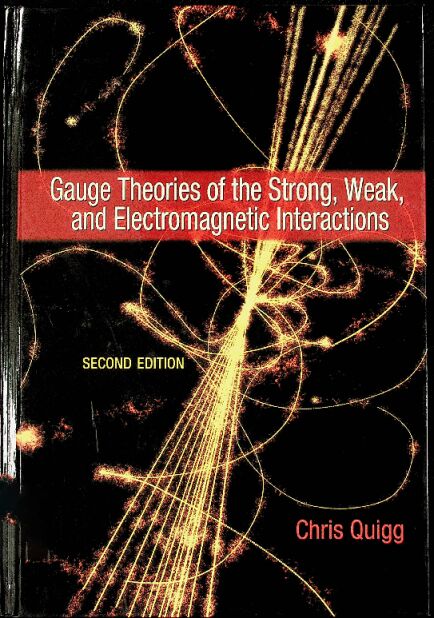
书名:Gauge theories of the strong, weak, and electromagnetic interactions
ISBN\ISSN:9780691135489,0691135487
出版时间:2013
出版社:Princeton University Press
前言
My purpose in writing this book has been to present a straightforward introduction to the idea of gauge theories and to two new laws of nature—quantum chromodynamics and the electroweak theory.By straightforward,I mean that little effort will be expended on field-theoretic technicalities and that correspondingly little formal sophistication will be demanded of the reader. The physical situations dealt with are, however,"advanced"topics of current interest in theoretical and experimental research.An assiduous reader will,I hope, come to understand the logic of local gauge symmetries and gauge theories, acquire the ability to compute the consequences of these theories, and gain a perspective on the body of experimentalevidence and today's open questions. In particular, the reader should be fully prepared to take part in the great wave of exploration led by experiments at the Large Hadron Collider.
The idea of gauge theories is rooted in the classic investigations of Hermann Weyl in the 1920s, and the notion that symmetries generate interactions was given full expression in the work of Yang and Mills aquarter-century later.More recently, the principle of local gauge invariance has blossomed into a unifying theme that seems capable of embracing and even synthesizing all the elementary interactions. The emergence of gauge theories has been coupled with the recognition that a fundamental description of the subnuclear particles must be based upon the idea that the strongly interacting particles,or hadrons,are composed of quarks.Together with leptons, such as the electron and neutrino, quarks seem to be the elementary particles—structureless and indivisible—at least at the present limits of resolution.
Thus we possess today a coherent point of view and a single language appropriate for the description of all subnuclear phenomena. This development, which is the work of many hands, has not only made of particle physics a much more unified subject, it has also helped us to perceive common interests and to make common cause with other specialties, notably astrophysics and cosmology, condensed-matter physics, atomic physics, and nuclear physics.
Experimental support for the new paradigm of quarks and leptons with inter- actions prescribed by gauge symmetries is impressive in its consistency, diversity, and strength. The case for quarks consists in the spectroscopy of hadrons, the evidence for pointlike constituents within hadrons, the v// and Y families of heavy measons with their quasi-atomic spectra,and more. In support of gauge theories and the unification of elementary interactions, we may cite the triumphs of the unified theory of weak and electromagnetic interactions with its implication of neutral weak currents and corollary prediction of charm, its prediction of the electroweak gauge bosons W+ and Z,and a host of quantitative successes. The theory of strong interactions, quantum chromodynamics, has been validated in many particulars: the scale dependence of the strong coupling(known as asymptotic freedom),precise perturbative calculations,and a deepening understanding of the low-energy regime in which the strong interactions are,indeed, strong. The similarity among quarks and leptons and the mathematical resemblance among the gauge theories of the fundamental interactions motivate an audacious program of"grand unification"in which the strong, weak,and electromagnetic interactions are different manifestations of a single, underlying symmetry.
This book has grown out of graduate courses given at the University of Chicago, IUniversité de Paris, Cornell University,and Princeton University; lecture series presented at Fermilab and CERN; and courses taught in summer schools around the world.Experience with diverse audiences has persuaded me both of the need for a nontechnical treatment for specialists in elementary particle physics and of the desirability that the gauge theory perspective be part of the education of every physics graduate student.In preparing this new edition, I have kept in mind three sorts of readers:1. Graduate students in physics who have completed (at least)a graduate course in quantum mechanics,including a study of relativistic quantum mechanics and the rudiments of Feynman diagrams.2. Experimental physicists working in particle physics and neighboring fields. 3. Physicists who have not specialized in high-energy physics but wish to gain an appreciation of the essential ideas of gauge theories and the"standard model" of particle physics.
The book is intended to serve as a text for a special topics course for advanced graduate students and as a monograph for reference and self-study.It may also be used, selectively,to supplement a course on relativistic quantum mechanics.
I have developed the subject as a logical whole, while bearing in mind that it should be possible to open the book at random and make sense of what is written. There is both a coherence and a progression, in that issues raised in early chapters are recalled,amplified, refined,and—in some cases—resolvedlater in the text.There is an accompanying evolution of the physical concepts and mathematical techniques.
I have stressed the essential interplay between theory and experiment, with respect to qualitative phenomena, symmetries,and specific numbers.Not least because of the mutual stimulation of observation and abstraction,I have included in the text detailed calculations of experimental observables and have posed a number of similarly explicit problems. Among the fondest memories of my physics infancy are those of a summer vacation during which Icameupon Heitler'sclassic treatise on the quantum theory of radiation and Feynman's two slender volumes on quantum electrodynamics and the theory of fundamental procsses and began to understand how to compute and how tolearn fromexperiment. Not every beginning reader will experience a similar epiphany,but Ihavesought to provide the opportunity. There is another reason for undertaking explicit calculations, which is to be struck by some of the consequences of gauge invariance.This can be done only by witnessing at first hand the miraculous cooperation among Feynman diagrams that leads,among other things, to an acceptable high-energy behavior of the weak interactions.
At the end of each chapter,I have provided an extensive reading list.These annotated bibliographies offer amplification of points of conceptual or technical interest, introduce further applications,or guide the reader to alternative presenta- tions of the text material. It should not be necessary to consult the documents cited in order to master the contents of the chapter.Rather,they are intended as a selective guide to optional further study.
Although a detailed description of the topics covered in this book can be found in the table of contents, it is appropriate to present a brief overview here. The opening chapter contains a capsule review of elementary-particle phenomenology and a preview of issues to be elaborated later, including the importance of the 1-TeVscale. Chapters 2-5 develop the basic theoretical concepts, proceeding from the elementary implications of symmetry principles through electrodynamics, non- Abelian gauge theories,and the notion of spontaneously broken symmetries.The emphasis in this part of the book is on conceptual matters, but applications are not entirely neglected. The last four chapters are devoted to the gauge theories that describe the strong, weak, and electromagnetic interactions. Two chapters are concerned with the electroweak theory—its successes, the search for the agent that hides the electroweak symmetry,and indications that the electroweak theory cannot be the last word. Quantum chromodynamics, the theory of the strong interactions, is the subject of chapter 8. The final chapter deals with the program of unifying the fundamental interactions, the principal ideas and consequences of which are studied in the context of the minimal SU(5)model. A brief epilogue highlights some open questions for experiment and theory. Matters of convention and other technical issues are relegated to three appendices. Additional material relating to this book can be found at http://press.princeton.edu/titles/10156.html.
It is a pleasure to express my appreciation to many people and institutions for their contributions to this work. In the course of preparing this volume,I have enjoyed the warm hospitality of a number of institutions, including CERN(the European Laboratory for Particle Physics), the Institute for Theoretical Particle Physics in Karlsruhe,Ludwig-Maximilians University and the Technical University of Munich, NIKHEF(the Dutch National Institute for Subatomic Physics),and the Laboratoire de Physique Theorique de IEcole Normale Supérieure, Paris. My visits to German institutions were generously underwritten by an Alexander von Humboldt Foundation Senior Scientist Award.I thank Luis Alvarez-Gaumé, Gerhard Buchalla, Andrzej Buras,Johann Kühn,Eric Laenen,and Ulrich Nierste for welcoming me to their institutions.Iam immensely grateful to generations of leaders of the Fermi National Accelerator Laboratory and to my Fermilab colleagues for the imulating environment I have enjoyed there for many years. I thank the Office of Science of the U.S.Department of Energy for a long season of research support. Many physicists have contributed to my understanding of gauge theories, and the reactions and questions of students have influenced my presentation of the material.Iowe special thanks to Carl Albright, Bill Bardeen, Chris Bouchard, Mu- Chun Chen, Estia Eichten,Keith Ellis,Chris Hill,Ian Hinchliffe,Andreas Kronfeld, Ken Lane,Joe Lykken, Olga Mena,Jon Rosner,and Hank Thacker.Many of the figures were executed using Jos Vermaseren's AXODRAw.I am grateful to Ingrid Gnerlich, Samantha Hasey,Karen Carter,Linda Thompson, and the Princeton University Press team for making this book a reality.
Finally,I thank my wife Elizabeth and our children David and Katherine for their encouragement, support, and kindness. CHRIS QuIGG Batavia, 2013
查看更多
目录
Preface xi
One Introduction 1
1.1Elements of the Standard Model of Particle Physics 4
1.2 Leptons 6
1.3 Quarks 7
1.4 The Fundamental Interactions 15
Problems 18
For Further Reading 21
References 23
Two Lagrangian Formalism and Conservation Laws 25
2.1Hamilton's Principle 26
2.2Free Field Theory Examples 28
2.3 Symmetries and Conservation Laws 30
Problerns 33
For Furtber Reading 35
References 37
Three The ldea of Gauge Invariance 38
3.1Historical Preliminaries 38
3.2Gauge Invariance in Classical Electrodynamics 40
3.3Phase Invariance in Quantum Mechanics 42
3.4 Significance of Potentials in Quantum Theory 44
3.5 Phase Invariance in Field Theory 46
3.6Feynman Rules for Electromagnetism 50
Problerns 52
For Further Reading 53
References 56
Four Non-Abelian Gauge Theories 57
4.1Motivation 57
4.2Construction 58
4.3Some Physical Consequences 63
4.4 Assessment 66
Problerns 66
For Furtber Reading 69
References 70
Five Hidden Symmetries 71
5.1 The ldea of Spontaneously Broken Symmetries 72
5.2 Spontaneous Breaking of Continuous Symmet 76
5.3 Spontaneous Breaking of a Gauge Symmetry 78
5.4 The Sigma Model 81
5.5 Spontaneous Breaking of aNon-Abelian Symmetry 86
5.6 Prospx Probles 87
For Fiurtber Reading 91
References 94
Six Electroweak Interactions of Leptons 95
6.1 An Effective Lagrangian for the Weak Interactions 96
6.2Intermediate Vector Bosons: A First Look 110
6.3 The Standard Electroweak Theory of Leptons 120
6.4 Neutral-Current Interactions among Leptons 135
6.5 The Higgs Boson: A First Look 146
6.6 The Higgs Boson,Asymptotic Behavior, and the 1-TeV Scale 151
6.7 Neutrino Mixing and Neutrino Mass 156
6.8 Renormalizability of the Theory 166
6.9 Interim Assessment 170
Problems 171
For Furtber Reading 177
References 183
Seven Electroweak Interactions of Quarks 187
7.1The Standard Electroweak Theory: Preliminaries 188
7.2Electroweak Gauge Bosons 194
7.3 Electron-Positron Annihilations 198
7.4 Deeply Inelastic Lepton-Hadron Scattering 205
7.5 Hadron-Hadron Interactions 223
7.6 Further Tests of the Electroweak Theory 229
7.7 A Brief Look at Quantum Correction 231
7.8 The Scale of Fermion Masses 236
7.9 Search for the Higgs Boson 237
7.10 Incompleteness of the Electroweak Theory 241
7.11 The Hierarchy Problem 244
7.12 The Vacuum Energy Problem 246
7.13 Reflections 247
Problems 249
For Furthber Reading 258
References 263
Eight Strong Interactions among Quarks 269
8.1 A Color Gauge Theory 270
8.2 Charge Renormalization in Electrodynamics 281
8.3 The Running Coupling Constant in QCD 294
8.4 Perturbative QCD: A First Example 303
8.5 QCD Corrections to Deeply Inelastic Scattering 308
8.6 Jets in Hadron-Hadron Collisions 325
8.7 Two-Photon Processes and the Photon-Structure Function 328
8.8 Color Confinement 336
8.9 QCD-induced Electroweak Symmetry Breaking 341
8.10 The 1/N Expansion 345
8.11 Strong-Interaction Symmetries 352
8.12 Assessment 356
Problems 358
For Further Reading 369
References 381
Nine Unified Theories 387
9.1 Why Unify? 389
9.2 The SU(5) Model 391
9.3 Coupling-Constant Unification 402
9.4 Nucleon Decay 408
9.5 The Baryon Number of the Universe 410
9.6 The Problem of Fermion Masses 414
9.7 Assessment 416
Problems 418
For Further Reading 423
References 427
Epilogue 430
Appendix A Notations and Conventions 433
A.1 Four-Vectors and Scalar Product 433
A.2 Dirac Matrices 434
A.3 Trace Theorems and Tensor Contractions 436
A.4 Dirac Equation and Dirac Spinors 437
A.5 Color Algebra 440
A.6 Weyl-van der Waerden Spinors 444
References 445
Appendix B Observables and Feynman Rules 447
B.1 Phase-Space Formulas: Decay Rates and Cross Sections 447
B.2 Feynman Rules: Generalities 448
B.3 Feynman Integrals 450
B.4 Regularization Procedures 452
B.5 Feynman Rules: Electrodynamics 453
For Furtber Reading 454
References 456
Appendix C Physical Constants 457
For Further Reading 457
Author Index 459
Subject Index 475
查看PDF
查看更多
馆藏单位
中科院文献情报中心