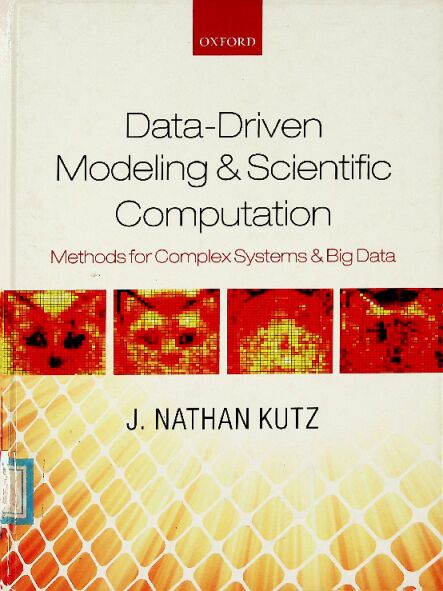
书名:Data-driven modeling & scientific computation
ISBN\ISSN:9780199660339,0199660336,9780199660346,0199660344
出版时间:2013
出版社:Oxford University Press
分类号:自动化技术、计算机技术
版次:1st ed..
摘要
The burgeoning field of data analysis is expanding at an incredible pace due to the proliferation of data collection in almost every area of science. The enormous data sets now routinely encountered in the sciences provide an incentive to develop mathematical techniques and computational
algorithms that help synthesize, interpret and give meaning to the data in the context of its scientific setting. A specific aim of this book is to integrate standard scientific computing methods with data analysis. By doing so, it brings together, in a self-consistent fashion, the key ideas from:
DT statistics,
DT time-frequency analysis, and
DT low-dimensional reductions
The blend of these ideas provides meaningful insight into the data sets one is faced with in every scientific subject today, including those generated from complex dynamical systems. This is a particularly exciting field and much of the final part of the book is driven by intuitive examples from it,
showing how the three areas can be used in combination to give critical insight into the fundamental workings of various problems.
Data-Driven Modeling and Scientific Computation is a survey of practical numerical solution techniques for ordinary and partial differential equations as well as algorithms for data manipulation and analysis. Emphasis is on the implementation of numerical schemes to practical problems in the
engineering, biological and physical sciences.
An accessible introductory-to-advanced text, this book fully integrates MATLAB and its versatile and high-level programming functionality, while bringing together computational and data skills for both undergraduate and graduate students in scientific computing.
查看更多
目录
Prolegomenon xiii
How to Use This Book xv
About MATLAB xviii
PART I Basic Computations and Visualization
1 MATLAB Introduction 3
1.1 Vectors and Matrices 3
1.2 Logic, Loops and Iterations 9
1.3 Iteration: The Newton-Raphson Method 13
1.4 Function Calls, Input/Output Interactions and Debugging 18
1.5 Plotting and Importing/Exporting Data 23
2 Linear Systems 31
2.1 Direct Solution Methods for A x=b 31
2.2 Iterative Solution Methods for A x=b 35
2.3 Gradient(Steepest) Descent for A x=b 39
2.4 Eigenvalues, Eigenvectors and Solvability 44
2.5 Eigenvalues and Eigenvectors for Face Recognition 49
2.6 Nonlinear Systems 56
3 Curve Fitting 61
3.1 Least-Square Fitting Methods 61
3.2 Polynomial Fits and Splines 65
3.3 Data Fitting with MATLAB 69
4 Numerical Differentiation and Integration 77
4.1 Numerical Differentiation 77
4.2 Numerical Integration 83
4.3 Implementation of Differentiation and Integration 87
5 Basic Optimization 93
5.1 Unconstrained Optimization (Derivative-Free Methods) 93
5.2 Unconstrained Optimization (Derivative Methods) 99
5.3 Linear Programming 105
5.4 Simplex Method 110
5.5 Genetic Algorithms 113
6 Visualization 119
6.1 Customizing Plots and Basic 2D Plotting 119
6.2 More 2D and 3D Plotting 125
6.3 Movies and Animations 131
PART II Differential and Partial Differential Equations
7 Initial and Boundary Value Problems of Differential Equations 137
7.1 Initial Value Problems: Euler, Runge-Kutta and Adams Methods 137
7.2 Error Analysis for Time-Stepping Routines 144
7.3 Advanced Time-Stepping Algorithms 149
7.4 Boundary Value Problems: The Shooting Method 153
7.5 Implementation of Shooting and Convergence Studies 160
7.6 Boundary Value Problems: Direct Solve and Relaxation 164
7.7 Implementing MATLAB for Boundary Value Problems 167
7.8 Linear Operators and Computing Spectra 172
8 Finite Difference Methods 180
8.1 Finite Difference Discretization 180
8.2 Advanced Iterative Solution Methods for A x=b 186
8.3 Fast Poisson Solvers: The Fourier Transform 186
8.4 Comparison of Solution Techniques for A x=b: Rules of Thumb 190
8.5 Overcoming Computational Difficulties 195
9 Time and Space Stepping Schemes: Method of Lines 200
9.1 Basic Time-Stepping Schemes 200
9.2 Time-Stepping Schemes: Explicit and Implicit Methods 205
9.3 Stability Analysis 209
9.4 Comparison of Time-Stepping Schemes 213
9.5 Operator Splitting Techniques 216
9.6 Optimizing Computational Performance: Rules of Thumb 219
10 Spectral Methods 225
10.1 Fast Fourier Transforms and Cosine/Sine Transform 225
10.2 Chebychev Polynomials and Transform 229
10.3 Spectral Method Implementation 233
10.4 Pseudo-Spectral Techniques with Filtering 235
10.5 Boundary Conditions and the Chebychev Transform 240
10.6 Implementing the Chebychev Transform 244
10.7 Computing Spectra: The Floquet-Fourier-Hill Method 249
11 Finite Element Methods 256
11.1 Finite Element Basis 256
11.2 Discretizing with Finite Elements and Boundaries 261
11.3 MATLAB for Partial Differential Equations 266
11.4 MATLAB Partial Differential Equations Toolbox 271
PART III Computational Methods for Data Analysis
12 Statistical Methods and Their Applications 279
12.1 Basic Probability Concepts 279
12.2 Random Variables and Statistical Concepts 286
12.3 Hypothesis Testing and Statistical Significance 294
13 Time-Frequency Analysis: Fourier Transforms and Wavelets 301
13.1 Basics of Fourier Series and the Fourier Transform 301
13.2 FFT Application: Radar Detection and Filtering 308
13.3 FFT Application: Radar Detection and Averaging 316
13.4 Time-Frequency Analysis: Windowed Fourier Transforms 322
13.5 Time-Frequency Analysis and Wavelets 328
13.6 Multi-Resolution Analysis and the Wavelet Basis 335
13.7 Spectrograms and the Gabor Transform in MATLAB 340
13.8 MATLAB Filter Design and Wavelet Toolboxes 346
14 Image Processing and Analysis 358
14.1 Basic Concepts and Analysis of Images 358
14.2 Linear Filtering for Image Denoising 364
14.3 Diffusion and Image Processing 369
15 Linear Algebra and Singular Value Decomposition 376
15.1 Basics of the Singular Value Decomposition (SVD) 376
15.2 The SVD in Broader Context 381
15.3 Introduction to Principal Component Analysis (PCA) 387
15.4 Principal Components, Diagonalization and SVD 391
15.5 Principal Components and Proper Orthogonal Modes 395
15.6 Robust PCA 403
16 Independent Component Analysis 412
16.1 The Concept of Independent Components 412
16.2 Image Separation Problem 419
16.3 Image Separation and MATLAB 424
17 Image Recognition: Basics of Machine Learning 431
17.1 Recognizing Dogs and Cats 431
17.2 The SVD and Linear Discrimination Analysis 436
17.3 Implementing Cat/Dog Recognition in MATLAB 445
18 Basics of Compressed Sensing 449
18.1 Beyond Least-SquareFitting: The L1 Norm 449
18.2 Signal Reconstruction and Circumventing Nyquist 456
18.3 Data (Image) Reconstruction from Sparse Sampling 464
19 Dimensionality Reduction for Partial Differential Equations 472
19.1 Modal Expansion Techniques for PDEs 472
19.2 PDE Dynamics in the Right (Best) Basis 478
19.3 Global Normal Forms of Bifurcation Structures in PDEs 482
19.4 The POD Method and Symmetries/In variances 492
19.5 POD Using Robust PCA 499
20 Dynamic Mode Decomposition 506
20.1 Theory of Dynamic Mode Decomposition (DMD) 506
20.2 Dynamics of DMD Versus POD 510
20.3 Applications of DMD 515
21 Data Assimilation Methods 521
21.1 Theory of Data Assimilation 521
21.2 Data Assimilation, Sampling and Kalman Filtering 526
21.3 Data Assimilation for the Lorenz Equation 529
22 Equation-Free Modeling 537
22.1 Multi-Scale Physics: An Equation-Free Approach 537
22.2 Lifting and Restricting in Equation-Free Computing 542
22.3 Equation-Free Space-Time Dynamics 547
23 Complex Dynamical Systems: Combining Dimensionality Reduction,Compressive Sensing and Machine Learning 551
23.1 Combining Data Methods for Complex Systems 551
23.2 Implementing a Dynamical Systems Library 556
23.3 Flow Around a Cylinder: A Prototypical Example 564
PART IV Scientific Applications
24 Applications of Differential Equations and Boundary Value Problems 573
24.1 Neuroscience and the Hodgkin-Huxley Model 573
24.2 Celestial Mechanics and the Three-Body Problem 577
24.3 Atmospheric Motion and the Lorenz Equations 581
24.4 Quantum Mechanics 585
24.5 Electromagnetic Waveguides 588
25 Applications of Partial Differential Equations 590
25.1 The Wave Equation 590
25.2 Mode-Locked Lasers 593
25.3 Bose-Einstein Condensates 600
25.4 Advection-Diffusion and Atmospheric Dynamics 604
25.5 Introduction to Reaction-Diffusion Systems 611
25.6 Steady State Flow Over an Airfoil 616
26 Applications of Data Analysis 620
26.1 Analyzing Music Scores and the Gabor Transform 620
26.2 Image Denoising through Filtering and Diffusion 622
26.3 Oscilating Mass and Dimensionality Reduction 625
26.4 Music Genre Identification 626
References 629
Index of MATLAB Commands 634
Index 636
查看更多
作者简介
J. Nathan Kutz, Professor of Applied Mathematics, University of Washington PA\Professor Kutz is the Robert Bolles and Yasuko Endo Professor of Applied Mathematics at the University of Washington. Prof. Kutz was awarded the B.S. in physics and mathematics from the University of Washington (Seattle, WA) in 1990 and the PhD in Applied Mathematics from Northwestern University (Evanston, IL) in 1994. He joined the Department of Applied Mathematics, University of Washington in 1998 and became Chair in 2007. PA\Professor Kutz is especially interested in a unified approach to applied mathematics that includes modeling, computation and analysis. His area of current interest concerns phenomena in complex systems and data analysis (dimensionality reduction, compressive sensing, machine learning), neuroscience (neuro-sensory systems, networks of neurons), and the optical sciences (laser dynamics and modelocking, solitons, pattern formation in nonlinear optics).
查看更多
馆藏单位
中科院文献情报中心