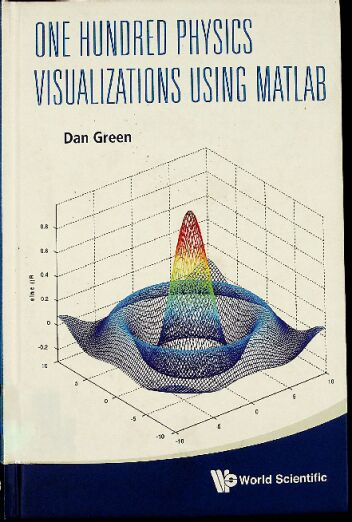
书名:One hundred physics visualizations using MATLAB
责任者:Dan Green. | Green, Dan,
ISBN\ISSN:9789814518437,9814518433,9789814518444,9814518441
出版时间:2014
出版社:World Scientific
前言
"Computers are useless. They can only give you answers."-Pablo Picasso"The purpose of computing is insight, not numbers."Richard Hamming
There are only a very few solvable problems in physics. They are extremely useful because the equations for the solutions can be plot- ted and the parameters defining the solutions can be varied in order to explore the dependence of the solutions on the variables of the problem. In that way the student can build up an intuition about the Kepler problem, for example.
However,this can only be done in a few cases and even then the effort needed is tedious. For the others,numericalmethods are needed and the computation becomes somewhat cumbersome. As a result,it is more difficult to vary the inputs to the problem numerically rather than symbolically and develop an intuition about the dependence of the solution on those parameters. In particular time development is often obscure and"movies"can be a welcome tool in improving physical intuition.Nevertheless,the advent of powerful personal computing has considerably reduced the difficulties. Indeed,the aim of this book is to use the ensemble of symbolic and numeric tools available in the MATLAB suite of programs to illustrate representative numer- ical solutions to more than one hundred problems spanning several physics topics. The student typically works through the demonstra- tion and alters the inputs through a memu driven script.In that way the user driven menu allows for parametric variation.
MATLAB is a good vehicle for the computational tasks. It has a compiler,editor and debugger which are very useful and user friendly.The HELPutility is very extensive. The MATLAB language is similar to a modern C++language and it is vectorial/matrix which makes coding simpler than older languages such as FORTRAN.Data is easily imported and exported in a variety of formats.
MATLAB contains many special functions. Matrices and linear algebra are covered well. Curve fitting, polynomials and fast Fourier transforms are supplied. Numerical integration packages are avail- able. Differential equations, symbolic, ordinary and partial, as well as numerical solutions are available for both initial value and boundary value versions.
As an additional package, MATLAB has symbolic mathematics. Within that package,calculus,linear algebra,algebraic equations and differential equations are covered. It is easy to combine a symbolic treatment of a problem with a numerical display of the solution when that is desirable. In this way converting from symbols to numbers is easily achieved.
Finally, and very importantly, MATLAB has an extensive suite of display packages. One can make bar, pie, histogram and simple data plots. There are several contour and surface plots which are possible. The time evolution of solutions can be made into"movies" that illustrate the speed of a process. These extensive visualization tools are crucial in that the student can plot,vary and then re-plot. There are two- and three-dimensional plots of all types available. Complex as well as real data can be shown.
The aim of using these tools is to create intuition, not to solve a specific problem or to complete a specific number crunching exercise. Indeed, the aim of the text is not to teach physics but to give the user a sense of how the solutions of a given physics problem depend on the parameters of that problem and to show the connections between, say, wave optics and quantum mechanics
The script for these demonstrations is made available. Using that material the student can write his/her own additions and explo- rations with the supplied scripts as jumping off points. In this way, a path is available to extend well beyond the specific demonstrations enclosed in the book itself, making the search for further possible insights open ended.
查看更多
目录
Preface vii
1. Symbolic Mathematics and Math Tools 1
1.1 MATLAB Functions 1
1.2Symbolic Differentiation 2
1.3 Symbolic Integration 3
1.4 Taylor Expansion 5
1.5 Series Summation 7
1.6Polynomial Factorization 7
1.7 Equation Solving 7
1.8 Inverse Functions 9
1.9 Matrix Inversion 10
1.10 Matrix Eigenvalues 10
1.11 Ordinary Differential Equations 10
1.12 Fourier Series 12
1.13 Data Fitting 16
1.14 MATLAB Utilities 21
2. Classical Mechanics 23
2.1Simple Harmonic Oscillator 23
2.2 Coupled Pendulums 28
2.3 Triatomic Molecule 30
2.4 Scattering Angle and Force Laws 31
2.5 Classical Hard Sphere Scattering 36
2.6 Ballistics and Air Resistance 39
2.7Rocket Motion — Symbolic and Numerical 39
2.8 Taking the Free Subway 45
2.9 Large Angle Oscillations —Pendulum 46
2.10 Double Pendulum 48
2.11 Coriolis Force 50
2.12 Kepler Orbits —Numerical 51
2.13 Analytic Kepler Orbits — Energy Considerations 53
2.14 Stable Orbits and Perihelion Advance 59
3. Electromagnetism 63
3.1 Electric Potential for Point Charges 63
3.2 Image Charge for a Grounded Sphere65
3.3Magnetic Current Loop 67
3.4Helmholtz Coil 69
3.5 Magnetic Shielding 71
3.6 Potentials and Complex Variables 72
3.7 Numerical Solution —Laplace Equation 74
3.8 Numerical Solution — Poisson Equation 77
3.9Light Pressure and Solar Sailing 79
3.10 Motion in Electric and Magnetic Fields 83
3.11 The Cyclotron 85
3.12 Dipole Radiation 87
4. Waves and Optics 90
4.1 Adding Waves 90
4.2Damped and Driven Oscillations 91
4.3 A Plucked String 94
4.4 A Circular Drum 96
4.5 Diffraction by Slits and Apertures 97
4.6Edge Diffraction 100
4.7Doppler Shift and Cerenkov Radiation 103
4.8 Reflection and Transmission at an Interface 105
4.9 A Spherical Mirror 107
4.10 A Spherical Lens 109
4.11 A Magnetic Quadrupole Lens System 110
5. Gases and Fluid Flow 116
5.1 The Atmosphere 116
5.2 An Ideal Gas Model in Two Dimensions 119
5.3Maxwell-Boltzmann Distributions 120
5.4 Fermi-Dirac and Bose-Einstein Distributions 123
5.5 Chemical Potential, Bosons 125
5.6Chemical Potential, Fermions 127
5.7Critical Temperature for He 128
5.8Exact Fermion Chemical Potential 130
5.9Complex Variables and Flow 132
5.10 Complex Variables and Airfoils 133
5.11 Complex Variables and Sources of Flow 135
5.12 Viscosity Model 137
5.13 Transport and Viscosity 139
5.14 Fluid Flow in a Pipe 140
5.15 Heat and Diffusion 142
6. Quantum Mechanics 145
6.1Preliminaries — Planck Distribution 145
6.2Bound States — Oscillating or Damped 147
6.3 Hydrogen Atom 148
6.4 Periodic Table — Ionization Potential and Atomic Radius 151
6.5Simple Harmonic Oscillator 154
6.6Other Force Laws 156
6.7Deep Square Well 156
6.8 Shallow Square Well 158
6.9 Wave Packets 159
6.10 Numerical Solution for Bound States 162
6.11 Scattering off a Potential Step 164
6.12 Scattering Off a Potential Well or Barrier 167
6.13 Wave Packet Scattering on a Well or Barrier 169
6.14 Born Approximation — Scattering and Force Laws 171
6.15 Spherical Harmonics-3D 174
6.16 Free Particle in 3D 176
6.17 Radioactive Decay — Fitting 178
7.Special and General Relativity 181
7.1 Time Dilation 181
7.2 Relativistic Travel 182
7.3The Relativistic Rocket 185
7.4Charge in an Electric Field 187
7.5Charge in Electric and Magnetic Fields 188
7.6 Relativistic Scattering and Decay 191
7.7 Electric Field of a Moving Charge 194
7.8 Minimum Ionizing Particle 194
7.9 Range and Energy Loss 197
7.10 Relativistic Radiation 198
7.11 Compton Scattering 199
7.12 Photoelectric Effect 202
7.13 Electrons and Muons in Materials 203
7.14 Radial Geodesics 205
7.15 Inspiraling Binary Stars 210
7.16 Gravity Wave Detector 211
8. Astrophysics and Cosmology 216
8.1 Gravity and Clustering 216
8.2Fermi Pressure and Stars 217
8.3 Uniform Density Star 222
8.4 Stellar Differential Equations 222
8.5Radiation and Matter in the Universe 224
8.6 Element Abundance and Entropy 230
8.7 Dark Matter 233
8.8 Dark Energy 236
Appendix — Script for Classical Mechanics 240
2.1Simple Harmonic Oscillator 240
2.2Coupled Pendula 244
2.3Triatomic Molecule 247
2.4Scattering Angle and Force Laws 250
2.5Classical Hard Sphere Scattering 253
2 .6 Ballistics and Air Resistance 256
2.7Rocket Motion — Symbolic 260
2.8Rocket Motion — Numerical 263
2.9 Taking the Free Subway 267
2.10 Large Angle Oscillations — Pendulum 269
2.11 Double Pendulum 272
2.12 Coriolis Force 274
2.13 Kepler Orbits — Numerical 276
2.14 Analytic Kepler Orbits — Energy Considerations 280
2.15 Stable Orbits and Perihelion Advance 285
References 289
Index 291
查看PDF
查看更多
馆藏单位
中科院文献情报中心