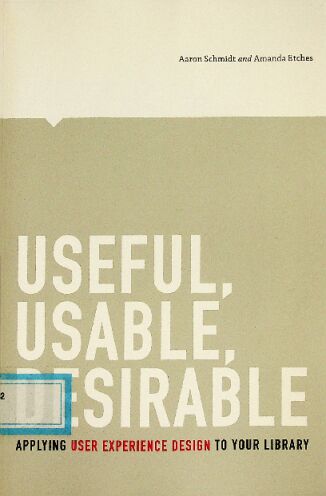
书名:Useful, usable, desirable
责任者:Aaron Schmidt and Amanda Etches. | Etches, Amanda,
ISBN\ISSN:9780838912263,0838912265
出版时间:2014
出版社:ALA Editions, an imprint of the American Library Association
分类号:文化、科学、教育、体育
版次:1st ed.
摘要
Useful, useable, desirable: like three legs of a stool, if your library is missing the mark on any one of these it's bound to wobble. Every decision you make affects how people experience your library. In this useful primer, user experience (UX) librarians Schmidt and Etches identify 19 crucial touchpoints such as the library website, email, furniture, parking lot, events, and newsletters. They explain why each is important to your library's members and offer guidance on how to make improvements. From library administrators to public relations and marketing staff, anyone concerned with how members experience your library will benefit from this book's.
Easy to dip into as the need arises, this book points the way towards ensuring that your library is a welcoming space for everyone.
查看更多
目录
1 Introducing Library User Experience 1
1.1 What Is User Experience Design? 1
1.2 Why UX for Libraries? 2
1.3 The Trinity of Good UX 3
1.4 The Principles of Library User Experience Design 4
1.5 How to Use This Book 8
1.6 A Note on Terminology 10
2 User Research Techniques in This Book 13
2.1 Attitudinal and Behavioral Research 13
2.2 Other User Research Techniques 17
2.3 Additional Reading 19
3 Physical Space 21
3.1 The Library Building Is Clean and Functions as Intended 21
3.2 The Library Building Is Free from Clutter 23
3.3 Furniture Adequately Supports Member Needs 27
3.4 The Building Supports Diverse Behaviors 30
3.5 Members Have Easy Access to Power Outlets 32
4 I Service Points 35
4.1 Members Readily Approach Service Desks 36
4.2 Service Desks Adjust to Changing Needs 38
4.3 Members Receive Assistance When and Where They Need It 41
4.4 Members Receive the Kind of Assistance They Need 44
4.5 Additional Reading 47
5 Policies and Customer Service 49
5.1 Your Library Has a Service Philosophy 49
5.2 Your Staff Members Know and Live Your Service Philosophy 52
5.3 There Is as Little Policy as Possible 55
5.4 Library Policies Empower Staff 56
5.5 Staff Members Are Friendly and Genuinely Want to Help 60
5.6 Service Is Consistent across Departments and Modalities 63
5.7 Service Is Consistent across the Organization 67
6 Signage and Wayfinding 71
6.1 Your Library Has a Brand Manual That Is Consistent with the Principles of Graphic Design 71
6.2 All Signage Uses the Same Visual Language 81
6.3 Different Types of Signs Are Visually Distinct 82
6.4 There Are as Few Signs as Possible 84
6.5 There Are No Paper Signs Taped to Walls, Doors, Tables, Computers, or Any Other Surfaces 85
6.6 Regulatory Signs Are Written in a Plain, Polite, and Friendly Manner 86
6.7 Library Cards Contain Useful Information and Employ the Library's Visual Language 88
6.8 First-Time Visitors Can Easily Locate All Parts of the Library 89
6.9 Additional Reading 90
7 Online Presence 93
7.1 Members Can Easily Search for Library Items and Place Holds 93
7.2 Members Can Easily Accomplish Critical Tasks 95
7.3 The Size of Your Website Is Commensurate with the Amount of Effort You Can Devote to It 100
7.4 Web Content Is Engaging 103
7.5 Content Is Written for the Web 107
7.6 Website Employs Web Design Conventions 113
7.7 Home Page Clearly Expresses What People Can Do on Your Site 116
7.8 Website Is Easy to Use on All Devices 120
7.9 Website Employs the Library's Visual Language 122
7.10 You Use Social Media Tools in Meaningful Ways 123
7.11 Additional Reading 125
8 Using the Library 127
8.1 The Technology in Your Library Is Relevant, Useful, and Usable 127
8.2 Collections Are Relevant to Member Needs 131
8.3 Marketing Materials Are Relevant to Member Needs 135
8.4 You Merchandize Your Materials 138
8.5 Library Services and Programs Solve Problems 140
8.6 Additional Reading 145
9 I Wrapping Up: Philosophy, Process, and Culture 147
9.1 Whole Library Thinking 147
9.2 The Design Process 150
9.3 Your Organizational Culture 154
9.4 Parting Words 158
Appendix: Keeping Score 159
Index 165
查看PDF
查看更多
作者简介
Aaron Schmidt has been a circulation clerk, reference librarian, and library director. He has published articles in Library Journal, School Library Journal, Library High Tech News, ONLINE, and other journals. He has presented on the topic of library technology and usability throughout the United States and in Canada, the United Kingdom, the Netherlands, and Spain. In 2005, Schmidt was named a Library Journal Mover & Shaker. Currently he is a principal at INFLUX Library Users Experience Consulting and maintains Walking Paper, a library and website usability blog. PA\Amanda Etches is the Head of Discovery & Access at the University of Guelph Library, where she spends her time guiding teams and projects that are all about making the overall library experience better for users, both in-person and online. Prior to her current role, she was the User Experience Librarian at McMaster University Library. She is also part of Influx, a user experience consultancy that works with libraries. Her research interests include human–computer interaction, information architecture, and web/interaction/UX/service design, and she frequently writes and presents on web design, usability, and user experience practices and trends. Amanda blogs at etc.
查看更多
馆藏单位
中科院文献情报中心