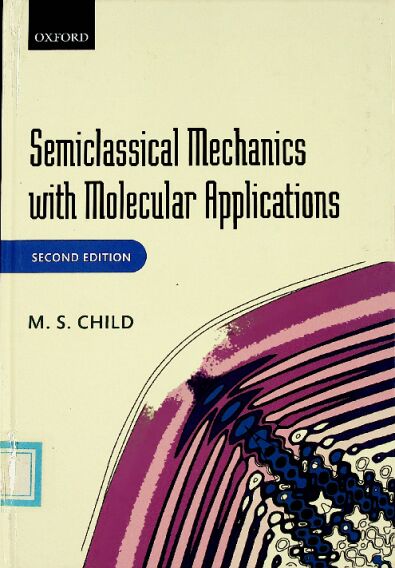
书名:Semiclassical mechanics with molecular applications
责任者:Mark S. Child. | Child, M. S.
ISBN\ISSN:9780199672981,0199672989
出版时间:2014
出版社:Oxford University Press
摘要
The second edition of an established graduate text, this book complements the material for a typical advanced graduate course in quantum mechanics by showing how the underlying classical structure is reflected in quantum mechanical interference and tunnelling phenomena, and in the energy and angular momentum distributions of quantum mechanical states in the moderate to large (10-100) quantum number regime. Applications include accurate quantization techniques for a variety of tunnelling and curve-crossing problems and of non-separable bound systems; direct inversion of molecular scattering and spectroscopic data; wavepacket propagation techniques; and the prediction and interpretation of elastic, inelastic and chemically reactive scattering.
The main text concentrates less on the mathematical foundations than on the global influence of the classical phase space structures on the quantum mechanical observables. Further mathematical detail is contained in the appendices and worked problem sets are included as an aid to the student.
查看更多
目录
1 Introduction 1
1.1 Classical and quantum mechanical structures 1
1.2 Historical perspectives 3
1.3 Scope and organization of the text 5
2 Phase integral approximations 8
2.1 The JWKB approxi mation 8
2.2 Turning point behaviour 13
2.3 Uniform approximations 18
2.4 Higher-order phase integral approximations 26
2.5 Problems 30
3 Quantization 33
3.1 Boh r-Sommerfeld quantization 33
3.2 Semiclassical connection formulae 41
3.3 Dou ble minimu m potentials and inversion doubling 46
3.4 Restricted rotation 50
3.5 Shape resonances or tunnelling preclissociation 53
3.6 Preclissociation by curve crossing 57
3.7 Problems 61
4 Angle-action variables 64
4.1 The Iinear oscillator 64
4.2 The degenerate harmonic oscillator 69
4.3 Angular momentum 73
4.4 The hydrogen atom 76
4.5 Symmetric and asymmetric tops 81
4.6 Quantum monodromy 90
4.7 Problems 95
5 Matr ix elements 99
5.1 Semiclassical normalization 99
5.2 Matrix elements and Fourier components: the Heisenberg correspondence 103
5.3 Franck-Condon and curve-crossing matrix elements 109
5.4 Matrix elements for non-curve-crossing situatwn 117
5.5 Problem 121
6 Semiclassical inversion methods 123
6.1 The RKR method 123
6.2 Inversion of predissociation linewiclth and intensity data 129
6.3 LeRoy-Bernstei n extrapol ation to dissociation limits 135
6.4 Inversion of elastic scattering data 137
6.5 Problems 141
7 Non-separable bound motion 142
7.1 Phase space structures 142
7.2 Einstein-Brillouin-Keller quantization 148
7.3 Uniform quantization at a resonance 153
7.4 Fourier representation of the torus 158
7.5 Classical perturbation theory 162
7.6 Adiabatic switching 168
7.7 Periodicorbit quantization 172
7.8 Problems 179
8 Wavepackets 182
8.1 The free-motion Gaussian wavepacket 183
8.2 Gaussian wavepackets and coherent harmonic oscillator states 185
8.3 Seeded Gaussian wavefunctions and spectral quantization 194
8.4 Franck-Condon transitions 198
8.5 The Herman-Kluk propagator 201
8.6 Problems 208
9 Atom-atom scattering 210
9.1 The classical and quantum mechanical limits 210
9.2 Rainbow scattering and diffraction oscillations 217
9.3 The i ntegral cross-section 229
9.4 Two-state non-adiabatic transitions 233
9.5 Problems 239
10 The classical S matrix 242
10.1 The integral repr臼entation 243
10.2 Stationary phase and uniform approximations 248
10.3 Classically forbidden events 255
10.4 Rρtational rainbows and higher interference structu res 259
10.5 Condon reflection principles 263
10.6 Problems 266
11 Reactive scattering 26
11.1 Definitions and working identities 26
11.2 Nearsicle--farside interpretation of differential cross-sect ions 270
11.3 The i nfluence of geometric phase on reactive scattering 276
11.4 Instanton theory of deep tunnelling 283
11.5 Problems 296
Appendix A Phase integral techniques 299
A.1 The Stokes phenomenon 299
A.2 Isolated turning poi nts 301
A.3 Barrier penetration 303
A.4 The linear oscillatorix 308
A.5 Cu rve crossing 312
Append ix B Uniform approximations and diffraction integrals 322
B.1 The u n i form Ai ry approx imation 322
B.2 Waves and catastrophes 326
B.3 Higher catastrophe-based uni form approxi mations 333
B.4 Non-generic u ni form approxi mations: Bessel and harmonic approximations 339
Appendixc Transformations in classical and quant um mechanics 344
C.1 Classical and semiclassicalt ransformations 344
C.2 Energy-time and angle-action representations 34
C.3 Dynamical transformations and the classical Smatrix 353
C.4 The semiclassical Green’s function 360
C.5 A ngular momentum coupling coefficients 362
Appendix D The onset of chaos 374
D.1 Breaking the separatrix 374
D.2 Henon map and the separatrix algorithm 37
Appendix E Angle-action transformations 381
E.1 Harmonic osci llator 381
E.2 Morse oscillator
E.3 Degenerate harmonic oscillator 381
E.4 Angular momentum
E.5 Hydrogenatom
Appendix F The monod romy matrix 386
Appendix G Solutions to problems 389
G.1 Introduction 389
G.2 Phase integral approximations 389
G.3 Quantization 391
G.4 Angle-action va riables 393
G.5 Matrix elements 396
G.6 Semiclassical inversion methods 399
G.7 Non-separable bou nd mot ion 400
G.8 Wavepackets 402
G.9 Atom-atom scattering 403
G.10 The classical Smatrix 405
G.11 Reactive scattering 407
References 410
Author index 422
Subject index 427
查看更多
馆藏单位
中科院文献情报中心