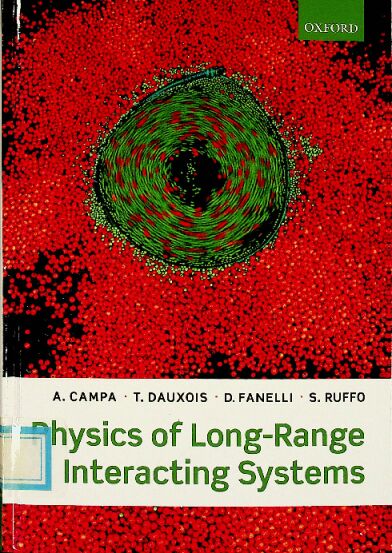
书名:Physics of long-range interacting systems
责任者:A. Campa | T. Duxois | D Fanelli and S. Ruffo. | Fanelli, D. | Ruffo, S.
ISBN\ISSN:9780199581931,0199581932
出版时间:2014
出版社:Oxford University Press
前言
Physical systems for which the interaction potential decays as a power of the inverse interparticle distance with an exponent smaller than the dimension of the embedding space are called long-range interacting systems. Although different aspects of these systems have been tackled in the past in specific scientific communities, notably astro�physics and plasma physics, this has not constituted immediately a seed for more general theoretical studies. However, in the past 15 years, it has become progressively clear that the ubiquitous presence of long-range forces needs an approach that inte�grates different methodologies. This observation stimulated a renewed and widespread interest in long-range systems throughout numerous research groups, leading now�adays to a much better understanding of both their equilibrium and out-of-equilibrium properties.
In this book, we will focus on the statistical physics of such systems. For a long time, the application of methods and tools borrowed from statistical mechanics to long-range systems has been questioned, mainly due to the lack of additivity that descends from the specific nature of the interaction. In fact, although gravitation and electromagnetism are central topics, covered in Bachelor's and Master's courses in physics, they are not discussed in statistical mechanics classes and in the very large majority of textbooks de�voted to this field. It is now well understood that non-additivity does not hinder a formal statistical mechanics treatment. However, it is at the root of basic facts and concepts that at first appeared odd, like ensemble inequivalence, negative specific heat, negative susceptibility and ergodicity breaking. These are all feamres that called for an extended statistical mechanics description, beyond its standard domain of applications. Moreover, the great richness of the out-of-equilibrium properties of systems with long-range inter�actions, and especially the presence of long relaxation times towards equilibrium and of anomalous diffusion, resonate with the current emphasis on non-equilibrium statistical mechanics in general.
Having moved onto a more mature period, this field, besides strengthening its foun�dations, has incorporated methods and tools originally developed in other disciplines. General perspectives of this evolution have been presented in several proceedings of workshops and schools (Dauxois et al.} 2002a, 2009; Campa et al., 2008b). Moreover, several interesting reviews have been recently published. Some of them concentrate more on models (Campa et al., 2009; Boucher et 2010; Levin et al.} 2014), while others deal with specific physical systems: gravitation (Padmanabhan, 1990; Chavanis, 2006a), Coulomb systems (Brydges and Martin, 1999) and hydrodynamics (Bouchet and Ve- naille, 2012). In this book, we present the material at a more introductory level than all these very useful references have done. Moreover, we emphasize the interdisciplinary aspects and the applications in several branches of physics.
查看更多
目录
Part I Static and Equilibrium Properties
1 Basics of Statistical Mechanics of Short-Range Interacting Systems 3
1.1The Microcanonical Ensemble 4
1.2 The Canonical and the Grand-Canonical Ensembles 8
1.2.1 The canonical ensemble 8
1.2.2 The grand-canonical ensemble 11
1.3 Equivalence of Ensembles for Short-Range Interactions 13
1.3.1 Concave functions 14
1.3.2 The Legendre-Fenchel transform (LFT) 15
1.3.3 Stable and tempered potentials 16
1.3.4 Ensemble equivalence 20
1.3.5 Equivalence in presence of phase transition: the Maxwell construction 23
1.4 Lattice Systems 26
1.5 Microstates and Macrostates 28
1.6 A Summary of the Most Relevant Points 29
2 Equilibrium Statistical Mechanics of Long-Range Interactions 30
2.1 Non-additivity 30
2.1.1 Definition of long-range interactions 30
2.1.2 Extensivity vs additivity 31
2.1.3 Non-additivity and the lack of convexity in thermodynamic parameters 33
2.1.4 Non-additivity and the canonical ensemble 34
2.2 Ensemble Inequivalence and Negative Specific Heat 35
2.3 An Analytical Solvable Example: The Mean-Field Blume-Emery-Griffiths (BEG) Model 38
2.3.1 Qualitative remarks 38
2.3.2 The solution in the canonical ensemble 39
2.3.3 The solution in the microcanonical ensemble 42
2.3.4 Inequivalence of ensembles 45
2.4 Entropy and Free Energy Dependence on the Order Parameter 48
2.4.1Basic definitions 48
2.4.2 Maxwell construction in the microcanonical ensemble 51
2.4.3 Negative susceptibility 54
2.5The Min-Max Procedure 55
3 The Large Deviations Method and Its Applications 61
3.1 Introduction 61
3.2 The Computation of the Entropy for Long-Range Interacting Systems 62
3.2.1 The method in three steps 62
3.2.2 The computation of the entropy of the different macrostates 63
3.3 The Three-States Potts Model: An Illustration of the Method 65
3.4 The Solution of the BEG Model Using Large Deviations 68
4 Solutions of Mean Field Models 71
4.1 The Hamiltonian Mean-Field (HMF) Model 71
4.1.1The canonical solution 72
4.1.2 The microcanonical solution 75
4.1.3 The min-max solution 80
4.2The Generalized XY Model 81
4.2.1 Statistical mechanics via large deviations method 81
4.2.2 Parameter space convexity 85
4.2.3 Phase diagram in the microcanonical ensemble 88
4.2.4 Equilibrium dynamics 91
4.3 The phi-4 Model 93
4.4 The Self-Gravitating Ring (SGR) Model 97
4.4.1 Introduction of the model 97
4.4.2 Inequivalence of ensemble 100
5 Beyond Mean-Field Models 105
5.1Ising Model 106
5.1.1Introduction 106
5.1.2 The solution in the canonical ensemble 107
5.1.3 The solution in the microcanonical ensemble 110
5.1.4 Equilibrium dynamics: breaking of ergodicity 113
5.2 α-Ising Model 114
5.3 XY Model with Long- and Short-Range Couplings 118
5.3.1 Introduction 118
5.3.2 Solutions in the canonical and microcanonical ensembles 119
5.3.3 Ergodicity breaking 122
5.4 α-HMF Model 124
5.5 Dipolar Interactions in a Ferromagnet 128
5.5.1 Simplified Hamiltonian in elongated ferromagnets 129
5.5.2 Dynamical effects in layered ferromagnets 133
6 Quantum Long-Range Systems 139
6.1Introduction 139
6.2 Classical Coulomb Systems 141
6.3 The Problem of Stability of Quantum Coulomb Systems 143
6.3.1 Systems without exclusion principle 143
6.3.2 Systems with exclusion principle 146
6.4The Thermodynamic Limit of Coulomb Systems 148
Part II Dynamical Properties
7 BBGKY Hierarchy, Kinetic Theories and the Boltzmann Equation 153
7.1 The BBGKY Hierarchy 154
7.2 The Boltzmann Equation and the Rapid Approach to Equilibrium due to Collisions 160
7.2.1 The derivation of the Boltzmann equation 160
7.2.2 The H-theorem 165
7.2.3 H-theorem and irreversibility 167
8 Kinetic Theory of Long-Range Systems: Klimontovich, Vlasov and Lenard-Balescu Equations 169
8.1Derivation of the Klimontovich Equation 170
8.2 Vlasov Equation: Collisionless Approximation of the Klimontovich Equation 172
8.3 The Lenard-Balescu Equation 175
8.4 The Boltzmann Entropy and the Mean-Field Approximation 182
8.5 The Kac's Prescription in Long-Range Systems 183
9 Out-of-Equilibrium Dynamics and Slow Relaxation 185
9.1 Numerical Evidence of Quasi-stationary States 185
9.2 Fokker-Planck Equation for the Stochastic Process of a Single Particle 190
9.3 Long-Range Temporal Correlations and Diffusion 195
9.4 Lynden-Bell's Entropy 199
9.4.1 The principle 199
9.4.2 Application to the HMF model 201
9.5 Lynden-Beirs Entropy: Beyond the Single Water-Bag Case Study 206
9.6 The Core-Halo Solution 213
Part III Applications
10 Gravitational Systems 219
10.1 Equilibrium Statistical Mechanics of Self-Gravitating Systems 221
10.2 Self-Gravitating Systems in Lower Dimensions 226
10.3 From General Relativity to the Newtonian Approximation 234
10.4 The Cosmological Problem 238
10.5 Particle Dynamics in Expanding Coordinates 240
10.6 The Vlasov Equation for an Expanding Universe 242
10.7 From Vlasov-Poisson Equations to the Adhesion Model 243
10.8 The One-Dimensional Expanding Universe 245
10.9 Numerical Simulations in 3D 248
11 Two-Dimensional and Geophysical Fluid Mechanics 250
11.1 Introduction 251
11.1.1 Elements of fluid dynamics 251
11.1.2 Illustration of the non-additivity property 254
11.2 The Onsager Point Vortex Model 255
11.2.1 The model 255
11.2.2 Negative temperatures 256
11.2.3 The statistical mechanics approach 257
11.2.4 Deficiencies of the point vortex model 259
11.3 The Robert-Sommeria-Miller Theory for the 2D Euler Equation 260
11.3.1 Introduction 260
11.3.2 The two levels approximation 262
11.3.3 The generalization to the infinite number of levels 263
11.3.4 Ensemble inequivalence 264
11.4 The Quasi-Geostrophic (QG) Model for Geophysical Fluid Dynamics 264
11.4.1 The quasi-geostrophic model 264
11.4.2 The range of the interaction in the quasi-geostrophic model 267
11.4.3 The statistical mechanics of the quasi-geostrophic model 268
12 Cold Coulomb Systems 270
12.1 Introduction 270
12.2 The Main Parameters in Coulomb Systems 271
12.3 A Classification of Coulomb Systems 275
12.4 Strongly Coupled Plasmas 280
12.5 Wigner Crystals 283
13 Hot Plasma 287
13.1 Temperature, Debye Shielding and Quasi-neutrality 287
13.2 Klimontovich's Approach for Particles and Waves: Derivation of the Vlasov-Maxwell Equations 291
13.3 The Case of Electrostatic Waves 295
13.4 Landau Damping 297
13.5 Non-linear Landau Damping: An Heuristic Approach 300
13.6 The Asymptotic Evolution: BGK Modes 302
13.7 Case-Van Kampen Modes 306
14 Wave-Particles Interaction 308
14.1 Hamiltonian Formulation of Vlasov-Maxwell Equations 308
14.2 Interaction between a Plane Wave and a Co-propagating Beam of Particles 309
14.2.1 Canonical formulation of the Hamiltonian and reduction to a one-dimensional system 309
14.2.2 Studying the dynamics in the particles-field phase frame 312
14.2.3 Resonance condition and high-gain amplification 314
14.3 Alternative Derivation of the Wave-Particles Hamiltonian from the Microscopic Equations 316
14.4 Free Electron Lasers (FEL) 318
14.4.1 Introduction 318
14.4.2 Storage ring FEL 318
14.4.3 Single-pass FEL 322
14.4.4 On the dynamical evolution of the single-pass FEL 326
14.5 Large Deviations Method Applied to the Colson-Bonifacio Model 329
14.5.1 Equilibrium solution of the Colson-Bonifacio model 329
14.5.2 Mapping the Colson-Bonifacio model onto HMF 332
14.6 Derivation of the Lynden-Bell Solution 333
14.7 Comparison with Numerical Results 336
14.7.1 The single-wave model 336
14.7.2 The case of two harmonics 339
14.8 Analogies with the Traveling Wave Tube 342
14.9 Collective Atomic Recoil Laser (CARL) 344
15 Dipolar Systems 349
15.1 Introduction 349
15.2 The Demagnetizing Field 353
15.2.1 Uniformly magnetized bodies 354
15.2.2 The magnetostatic energy 358
15.3 The Thermodynamic Limit for Dipolar Media 359
15.3.1Some useful relations 360
15.3.2 The lower bound 362
15.3.3 The upper bound 363
15.3.4 The thermodynamic limit 366
15.3.5 Further remarks 368
15.4 The Physical Consequences of the Existence of the Thermodynamic Limit 369
15.4.1 he computation of the dipolar energy 370
15.4.2 The large-scale structure of the magnetization profile: domains and curling 373
15.4.3 Isotropic and anisotropic ferromagnets 374
15.5 Experimental Studies of Dipolar Interactions 376
15.5.1 Spin ice systems 376
15.5.2 2D optical lattices 377
15.5.3 Bose-Einstein condensates 378
Appendix A Features of the Main Models Studied throughout the Book 381
Appendix B Evaluation of the Laplace Integral Outside the Analyticity Strip 382
Appendix C The Equilibrium Form of the One-Particle Distribution Function in Short-Range Interacting Systems 384
Appendix D The Differential Cross-Section of a Binary Collision 387
Appendix E Autocorrelation of the Fluctuations of the One-Particle Density 390
Appendix F Derivation of the Fokker-Planck Coefficients 392
References 397
Index 407
查看更多
馆藏单位
中科院文献情报中心