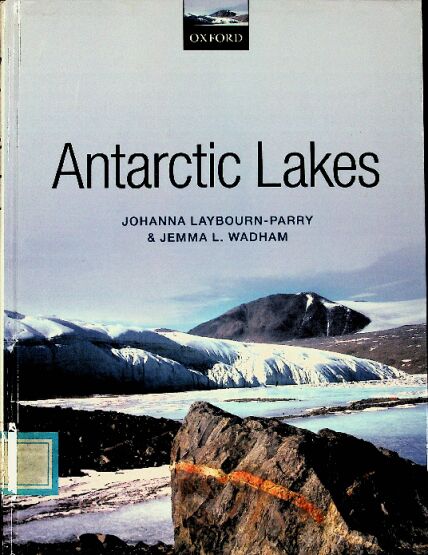
书名:Antarctic lakes
责任者:Johanna Laybourn-Parry and Jemma L. Wadham. | Wadham, Jemma L.
ISBN\ISSN:9780199670499,0199670498,9780199670505,0199670501
出版时间:2014
出版社:Oxford University Press
前言
The above comments were among the first lim-nological observations made in Antarctica. The ear-lier British Discovery Expedition, in 1901—1903, alsoled by Robert Falcon Scott, made the first measure-ments of lake level in Lake Bonney and measuredthe distance across the narrows between its eastand west lobes. These were important data againstwhich present water levels can be compared. Infact there has been a very significant increase inthe depth of the McMurdo Dry Valleys lakes since1903, indicating that ablation does not balance in-flows from the glaciers. These observations weremade during the age of Antarctic exploration. Itwas not until the International Geophysical Year(1957—1958), the establishment of the InternationalCommittee on Antarctic Research (SCAR), and theestablishment of permanent research stations in the1950s and 1960s, that Antarctic limnology reallystarted to gain momentum.
Antarctica contains the most diverse range oflakes on the planet. There are many freshwater andbrackish to hypersaline lakes in the ice-free areas,but there are also freshwater epishelf lakes that ei-ther overlie seawater or have a connection to thesea and are therefore tidal, cryolakes on glaciers, iceshelf ponds and lakes, and most remarkable of all,a vast network of subglacial lakes under the conti-nental ice sheet, of which lake Vostok, Whillans, andEllsworth are the best known. The latter confrontscientists endeavouring to unravel their secrets withmajor challenges, and effectively represent the mod-ern equivalent of the age of exploration.
There are a number of excellent books that dealwith the limnology of specific areas of Antarctica,for example Ecosystem Dynamics in a Polar Desertedited by John Priscu and The Schirmacher Oasisedited by Peter Bormann and Diedrich Fritzsche,but there is no single volume that pulls togetherthe data for the entire continent. Our aim was toproduce a book that would be of general interestto those with a limited knowledge of Antarcticlakes, as well as a reference book for experiencedresearchers in the field. The first chapter is intendedas an introduction to Antarctic lakes, while subse-quent chapters provide an in-depth considerationof specific lake types. The final chapter considersfuture directions.
There are still major gaps in our knowledge ofAntarctic limnology, as this volume will show, butnonetheless the expanding database provides uswith a clear picture of the formation and ecologyof some of the most extreme water bodies on ourplanet. Antarctic lakes are usually depauperate sys-tems and are characterized by truncated microbi-ally dominated food webs. Moreover, unlike manylakes at lower latitudes that suffer the direct im-pacts of Man's industrial and agricultural activities,Antarctic lakes are pristine. However, they are sub-ject to the indirect anthropogenic effects of globalclimate change and enhanced UV radiation. Polarlakes, both in the Arctic and Antarctic, are widelyrecognized as sentinels of local and global climatechange. We have not included a specific chapter onthis important issue, but embedded informationthroughout the book.
Ice is an important factor in polar limnology.Lakes are either covered by it, in the case of sub-glacial lakes by up to a 4 km thickness, or they arelocated on glaciers or ice shelves. Within Antarcticlakes research traditional limnologists have workedwith glaciologists, and the boundary between whatwere traditionally two distinct disciplines hasblurred. The study of Antarctic lakes exemplifiesthe need for a multi-disciplinary approach which isparticularly well illustrated by the McMurdo LongTerm Ecosystem Research Program.
We are indebted to colleagues and friends world-wide who have kindly given us access to their pho-tographs. We thank our editors Ian Sherman andLucy Nash and the many other people who havecontributed to the production of this volume. Par-ticular thanks go to Simon Powell at Bristol Uni-versity for his excellent work on the illustrations.Lastly we would like to thank the US, Australian,New Zealand, and British Antarctic programmesand acknowledge funding from a wide range Ofbodies, both national and international, that hassupported our own research in Antarctica.
查看更多
目录
1 An introduction to Antarctic lakes 1
1.1 Introduction 1
1.2 History of Antarctic limnology and logistics 3
1.3 Climatic conditions in Antarctica 4
1.4 Glaciological history of Antarctica 7
1.5 Diversity of lakes 11
1.6 Lake types and geochemical conditions 15
1.6.1 Salinity 15
1.6.2 Redox conditions 17
1.6.3 Nutrient and organic carbon supply 19
1.6.4 Geochemical indicators of lake history 22
1.7 Geomorphology of Antarctic lakes 23
1.8 Antarctic lake biota 27
1.8.1 Archaea and Bacteria 29
1.8.2 Viruses 30
1.8.3 Protozoa 31
1.8.4 Alges 34
1.8.5 Rotifers 35
1.8.6 Crustaceans 36
1.8.7 Other invertebrates 37
1.9 Habitats in Antarctic lakes 38
2 Freshwater lakes 41
2.1 Introduction 41
2.2 Formation of freshwater lakes 49
2.3 Temperature and stratification 60
2.4 Water chemistry 62
2.5 The planktonic biota of freshwater lakes 64
2.5.1 Heterotrophic bacteria 64
2.5.2 Viruses 66
2.5.3 Protozoa 68
2.5.4 The phytoplankton 72
2.5.5 The zooplankton 73
2.6 Carbon cycling in the planktonic environment 75
2.6.1 Primary production 75
2.6.2 Bacterial production 78
2.6.3 Heterotrophic grazing 80
2.7 The benthic communities 83
2.7.1 Phototrophic benthic communities 83
2.7.2 Heterotrophic benthic communities 87
2.7.3 Carbon cycling in the benthos 88
3 Saline lakes 91
3.1 Introduction 91
3.2 Distribution of saline lakes in Antarctica 94
3.3 Formation of saline lakes 97
3.4 Patterns of stratification and temperature 101
3.5 Water chemistry 102
3.6 The planktonic biota of saline lakes 105
3.6.1 Heterotrophic Bacteria and Archaea 106
3.6.2 Photosynthetic bacteria 110
3.6.3 Viruses 112
3.6.4 Protozoa 114
3.6.5 Algae 121
3.6.6 Zooplankton 122
3.7 Carbon cycling in the plankton 123
3.7.1 Primary production 123
3.7.2 Bacterial production 125
3.7.3 Heterotrophic grazing and carbon cycling 125
3.8 The biota of saline lake ice covers 129
3.9 The benthic community 130
3.10 Carbon cycling in the benthos 131
3.11 A unique Antarctic lake—Lake Vida 132
4 Epishelf lakes 134
4.1 Introduction 134
4.2 Formation and physico/chemical characteristics of epishelf lakes 135
4.2.1 Geomorphology 135
4.2.2 Physico/chemical characteristics 137
4.3 The planktonic biota of epishelf lakes 140
4.4 Carbon cycling in the plankton of epishelf lakes 143
4.5 The benthic communities of epishelf lakes 144
5 Lakes and ponds on glaciers and ice shelves 147
5.1 Introduction 147
5.2 Supraglacial lakes 148
5.2.1 Types of cryolakes 148
5.2.2 The physical/ chemical environment and biology of cryolakes 150
5.3 Ice shelf ponds and lakes 152
6 Subglacial lakes 156
6.1 Introduction 156
6.2 Distribution and physiographic characteristics of subglacial lakes in Antarctica 157
6.3 Detailed studies of subglacial lakes 159
6.3.1 Lake Vostok 159
6.3.2 Lake Ellsworth 159
6.3.3 Lake Whillans 162
6.3.4 Hodgson Lake 163
6.4 Formation of subglacial lakes and hydrological conditions 163
6.5 Geochemical conditions in subglacial lakes 166
6.6 The biota of subglacial lakes 170
7 Conclusions and future directions 174
7.1 Antarctic lakes in a global context 174
7.2 Inter-annual variations and longer-term trends 175
7.3 The gaps in the data—the way forward 176
7.4 Future directions 177
Glossary 181
References 187
Index 211
查看更多
馆藏单位
中科院文献情报中心