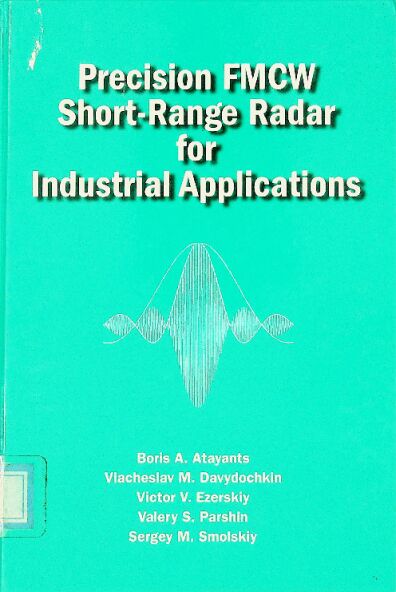
书名:Precision FMCW short-range radar for industrial applications
ISBN\ISSN:9781608077380,1608077381
出版时间:2014
出版社:Artech House
摘要
This book describes methods for making accurate radar measurements of short distances in applications where physical contact with materials is impractical. Sources of error are identified, and methods of reducing these errors are described. Practical test procedures for measuring instruments are also provided. Much of the book is dedicated to providing radar engineers with practical applications, detailing the conditions, equipment, and approach of experimental estimation. With the help of computer simulation, the achievable advantages in accuracy of radar range measurement with various approaches are revealed and quantitatively estimated. Readers are also provided with methods of random process theory and mathematical statistics, along with functional analysis and optimization.
查看更多
前言
The idea for this book came about as the result of years of experience in the investigation, development, and production of one class of radar systems: radar level-meters. Our research began at the Ryazan plant TEPLOPRIBOR (located in the center of Russia)in cooperation with the scientists of the Ryazan Radio Engineering Institute and the Institute of Telemechanics and Automatics of Soviet Academy of Sciences during the 1970s and 1980s. The following contributors have participated in this development: B. V. Lunkin, A. S. Sovlukov, A. I. Kiyashey, A. G. Miasnikov, F. Z. Rosenfeld, B. V. Kagalenko, B. A. Atayants, V. M. Izrailson, M. P. Marfin, and many others. During the past fifteen years, this research has been continued by the authors at the company JSC Contact-1 in the development, modernization, and serial production of the level-meter's family of BARS-3XX. In this engineering field, intensive investigations have been carried out in different countries around the world into creating devices that permit continuous checking and measuring of the filling level of various technological reservoirs automatically and with high accuracy and reliability. Besides this narrow but useful applica-tion area of radar technology, there are a whole series of industrial applications of short-range systems with similar requirements in terms of their functionality and cost-effectiveness. All these applications can be successfully implemented us-ing frequency-modulated continuous wave (FMC W)radar. In our opinion, a new direction has been taken in traditional short-range radar technology for different applications (including military): precision FMCW radar technology that is ori-ented to the development, creation, and production of this new class of promising, short-range systems.
Many worldwide manufacturers of these devices have achieved rather highly desirable results. However, market pressures including speed to market rarely allow developers to disclose in detail the operation principles of new devices and algo-rithms of signal processing with high accuracy and operation reliability. Therefore, we should note that in many cases classical methods of radio signal generation and processing are built into the operation of these devices, but with some modifications characterizing the peculiarities of these applications. Of course, the application of new approaches to radio signal generation and processing for short-range measur-ing radar systems brings forth new results, which is why we decided to present our own theoretical and practical results along with the information available in patent and engineering publications with the hope that this book will help further innova-tion in the field of short-range precision radar technology.
We sincerely appreciate the team at JSC Contact -1 for their understanding, help, perpetual supply of new problems to tackle and the subsequent practical, interesting discussions of the results and their applications in new developments.
It is impossible to mention all our colleagues promoting our research, but we espe-cially note I. V. Baranov, V. A. Bolonin, V. S. Gusev, S. V. Miroshin, D. Y. Nagorny, and V. A. Pronin, whose contributions were most significant.
Discussions of some of our dissertations from seminars at the Radio Control and Communication Department at the Ryazan State Radio Engineering University, which form the basis of this book, were promoted to improve the presentation of materials and results. Signifcant contributions to these discussions were made by Professor S. N. Kirillov, the head of Radio Engineering Radio Control and Com-munication Department, Professor V. I. Koshelev, the head of Radio Engineering Systems Department, and Professor Y. N. Parshin, the head of Radio Engineering Devices Department.
We express much gratitude to the head of Radio Engineering Systems of National Research University, Moscow Power Engineering Institute, Professor A. I. Perov, for the time-consuming work of reviewing as well as for providing useful feedback and advice.
We especially appreciate recommendations and very valuable comments made by the anonymous reviewer at Artech House Publishers for his attention and desire to improve our material.
B. Atayants, V. Davydochk in, V. Ezerskiy, and V. Parshin express their admira-tion, sincere respect, and gratitude to their colleague S. M. Smolskiy, who worked on the translation of the text into English.
We are also grateful to all interested readers for remarks and suggestions regarding this book's contents; comments can be sent to Artech House Publishers or to the Russian company CONTACT-1 (e-mail: market@kontakt-1.ru).
查看更多
目录
Preface xv
Introduction xvii
CHAPTER 1 Counting Method of Estimation of Difference Frequency 1
1.1 Introduction 1
1.2 Main Calculation Relations 1
1.3 The Traditional Counting Method of Range Measurement 5
1.4 Sources of Range Measurement Errors by the FMC W Range-Finder 7
1.5 Adaptive Control of Frequency Modulation Parameters 8
1.6 Truncation Error of Range Measurement at Adaptive Frequency Modulation 13
1.6.1 The Fixed Measuring TimeInterval 13
1.6.2 The Measuring TimeInterval Multiple to the Modulation Half-Period 16
1.6.3 Calculation of the Range Result Correction 20
1.7 The Range Determination Error Caused by the Inaccuracy of Modulation Adaptation 23
1.8 Noise Influence on the Accuracy of the Range Determination Using the Additive Counting Method 25
1.9 Conclusions 31
References 31
CHAPTER 2 Weighting Method for the Difference Frequency Averaging 33
2.1 Introduction 33
2.2 The Truncation Error of the Weighting Method of Difference Frequency Averaging 36
2.3 Truncation Error Minimization at the Weighting Average Method of Difference Frequency by Optimization of Weighting Function Parameters 45
2.4 Truncation Error Minimization of the Weighting Averaging Method of the Difference Frequency by Optimization of the FM Parameters 50
2.4.1 Application of Additional Slow-Frequency Modulation 50
2.4.2 Opti nization of the FM Sweep 53
2.4.3 Combined Optimization 55
2.4.4 The Combined Procedure of Error Minimization 56
2.5 Noise Influence on the Error of the Weighting Method of Difference Frequency Averaging 56
2.5.1 The Measurement Error for the Weighting Function in the Form of the Trigonometric Series 58
2.5.2 The Measurement Error for the Kaiser-Bessel Weighting Function 62
2.6 Conclusions 64
References 64
CHAPTER 3 Estimation of the Difference Frequency by the Position of the Spectrum Maximum 67
3.1 Introduction 67
3.2 Algorithms of Difference Frequency Estimation 68
3.3 Estimation of the Difference Frequency on the Basis of the Maximum Position of the Spectral Density of Difference Frequency Signal 71
3.3.1 Analytical Estimation of the Truncation Error of Range Measurement 71
3.3.2 The Truncation Error of the Difference Frequency Estimation at the Weighting Functions of Dolph-Chebyshev and Kaiser-Bessel 74
3.3.3 Minimization of the Measurement Error on the Basis of the FM Parameter Optimization 77
3.3.4 Error Minimization on the Basis of Optimization of Weighting Function Parameters 80
3.3.5 Minimization of the Truncation Error Using Adaptable Weighting Functions 86
3.3.6 Algorithms of Frequency Estimation Using Adaptable Weighting Functions 86
3.4 Average Weighted Estimation of the Difference Frequency 88
3.4.1 The Truncation Error of the Average Weighted Estimation 88
3.5 Systematic Inaccuracy of Frequency Estimation for the Algorithm with Correction Coefficients 91
3.6 Influence of Noise Interference on the Error of Range Measurement 92
3.6.1 Statistical Characteristics of Estimation of the Spectral Density of DFS and Noise Sum 92
3.6.2 Influence of Noise on Accuracy of the Central Frequency Estimation 94
3.7 Conclusions 103
References 104
CHAPTER 4 The Maximal Likelihood Method for Range Estimation According to the Difference Frequency Signal 107
4.1 Introduction 107
4.2 Range Estimation Based on the Difference Frequency Signal 108
4.3 Peculiarities of Delay Time Estimation Using the Maximal Likelihood Method 113
4.4 Main Factors Affecting the Measurement Error of Time Delay 116
4.5 Estimation of the Phase Characteristic of FMC WRF 121
4.6 Simulation of the Range Estimation Algorithm 130
4.6.1 Simulation Results at a Known Phase Characteristic 131
4.6.2 Simulation Results at the Unknown Phase Characteristic: The Approach to Practical Estimation of the Phase Characteristic 131
4.6.3 Reduction of the Noise Influence on the Accuracy of the Phase Characteristic Estimation 134
4.7 Conclusions 135
References 136
CHAPTERS 5 Effects of FM Nonlinearity 137
5.1 Introduction 137
5.2 The Mathematical Model of the Modulation Characteristic 137
5.3 Effects of FM Nonlinearity for the Counting Method of Frequency Measurement 141
5.3.1 The Quadratic Modulation Characteristic 142
5.3.2 The Oscillating Modulation Characteristic 144
5.3.3 The Quadratic Modulation Characteristics with the Oscillating Component 147
5.4 Effects of FM Nonlinearity for the Weighting Method of Difference Frequency Averaging 147
5.5 Connection of the Correction Coefficient with Nonlinearity Parameters of the MC 151
5.5.1 Quadratic Nonlinearity of Modulation Characteristics 151
5.5.2 Oscillating Nonlinearity of the Modulation Characteristic 151
5.5.3 Quadratic and Oscillating Nonlinearity of the Modulation Characteristic 152
5.6 Estimation of the Correction Coefficient According to the Operating Difference-Frequency Signal 153
5.6.1 The Algorithm Sequence 153
5.6.2 Simulation Conditions 154
5.7 Compensation of Modulation Characteristic Nonlinearity 155
5.8 Consideration of Modulation Characteristic Nonlinearity at Range Calculation 160
5.8.1 Estimation of Extreme Period Parts 161
5.8.2 Approximation of the Time Function of Signal Periods 162
5.9 Conclusions 164
References 165
CHAPTER 6 Analysis of the Range Measurement Error at the Interference Presence 167
6.1 Introduction 167
6.2 The Error Caused by the Single Spurious Signal of the Difference Frequency 170
6.2.1 Error Estimation According to DFS Spectrum Maximum Position 170
6.2.2 Error Estimation at Signal Processing in the Time Domain 172
6.3 The Error Caused by the Influence of Spurious Reflectors in the Antenna-Waveguide Path and in the Operating Zone of the FMC W Range-Finder 174
6.3.1 Influence of the Frequency-Independent Spurious Reflectors in the AWP and in the Operating Zone of the FMCW RF 174
6.3.2 Influence of the Spurious Reflection of the Pulse Character 177
6.4 The Error Caused by the Signal Reflection from the Corner Formed by the Reservoir Vertical Wall and the Liquid Surface 181
6.5 Influence of the Edge Modes Caused by the Restricted Sizes of the Probing Object 184
6.6 Influence of Reflected Waves on the Measurement Error of the FM Range-Finder 187
6.6.1 Influence of Echo Signals on the Operating Mode of the SHF Oscillator 187
6.6.2 Influence of the Wave Reflected from the Useful Reflector on the Range Measurement Error 188
6.6.3 Simultaneous Influence of Waves Reflected from the Useful and Spurious Reflectors on the Range 190
6.7 Influence of Combination Components in the Mixer of the FMCWRF on the Measurement Error 192
6.7.1 Virtual Reflectors 192
6.7.2 Influence of Virtual Clutter on the Range Estimation Error 193
6.8 Conclusions 194
References 195
CHAPTER 7 Reduction of the Measurement Error at Interference Presence Using Adaptable Weighting Functions 197
7.1 Introduction 197
7.2 Estimation of the Interference Situation 198
7.3 Error Minimization of Frequency and Amplitude Estimation of the Weak Signal on the Background of Resolvable Single Interference 204
7.3.1 Introduction 204
7.3.2 Minimization of the Range Measurement Error for Weakly Reflecting Liquids 204
7.3.3 Action Sequence at the Level Measurement of the Weakly Reflecting Material Near an Antenna 206
7.3.4 Range Measurement on the Background of Strong Reflection from the Reservoir Bottom 210
7.4 Error Reduction of Difference Frequency Estimation of the Signal Received on the Background of Non resolvable Interference 210
7.4.1 The Situations Most Often Met in Practice 210
7.4.2 The Method of Error Decrease 211
7.4.3 The Algorithm of Estimation Error Reduction: The Sequence of Actions to Decrease the Range Estimation Errors 216
7.5 Error Decrease Caused by the Virtual Reflector 217
7.5.1 Action Sequence for the Influence Reduction of the Virtual Reflector 218
7.5.2 Measures Providing a Decrease of the Error Caused by an Echo Signal 220
7.6 Conclusions 221
References 222
CHAPTER 8 Parametric al Methods and Algorithms for Increasing the Measurement Accuracy at the Interference Presence 223
8.1 Introduction 223
8.2 Cancellation of Spurious Reflections 223
8.2.1 Using the Complex Spectral Density for Cancellation 226
8.2.2 Using Spectral Power Density for Cancellation 228
8.3 Reduction of Spurious Reflector Influence on the Accuracy of the Range Estimation by the Maximal Likelihood Method 232
8.3.1 The Tracking Range Measuring System 232
8.3.2 Main Stages of the Tracking Procedure After the Local Extreme 236
8.3.3 Tracking Modes 237
8.3.4 Influence of the Phase Characteristic Estimation Error on the Operation of the Tracking Measurer 239
8.3.5 Determination of the Conditions at which the Tracking Loss Occurs 240
8.3.6 Range Measurement at the Presence of the Spurious Reflectors of Small Intensity 242
8.4 Frequency Measurement Using Methods of the Parametric Spectral Analysis 244
8.4.1 The Algorithm of the Frequency Measurement on the Basis of Eigenvector Analysis in the Noise Subspace 244
8.4.2 The Frequency Measurement Algorithm by the Pro ny Method of Least Squares 247
8.5 Range Prediction on the Basis of Consideration of the Movement Speed 250
8.5.1 Uniform Velocity of the Useful Reflector Movement 250
8.5.2 The Nonuniform Velocity of the Useful Reflector Movement 253
8.6 Conclusions 255
References 256
CHAPTER 9 Testing of Precision Measuring Systems of FM Short-Range Radar and Areas of Its Practical Application 257
9.1 Introduction 257
9.2 Equipment and Approach for the Experimental Estimation of the FM RF Characteristics 257
9.2.1 Synthesis of Radar Reflectors for Precision Measurements 259
9.2.2 The TestBench for the Measurement of the FM RF Parameters 264
9.2.3 The Procedure of Carrying Out Measurements 266
9.3 Experimental Reduction of the Error Caused by Virtual Interference 266
9.3.1 The Waveguide-Measuring TestBench 266
9.3.2 Experimental Research of the Possibility of Reducing Virtual Interference Influence 267
9.3.3 Influence of Radiated Power Level on the Distance Estimation Error Caused by Virtual Interference Influence 269
9.4 Results of the Experimental Reduction of the Distance Measurement Error by the Control of the Adaptable Weighted Function Parameters 269
9.5 Testing Results of the Parametric Algorithms of the Distance Measurement in the Measuring TestBench 272
9.5.1 Algorithms Based on the Methods of Parametric Spectral Analysis 272
9.5.2 The Algorithm Based on the Maximal Likelihood Method 274
9.5.3 Testing of the Tracking Distance Meter 275
9.5.4 Testing Results of the Algorithm "Prediction" 275
9.6 Areas of Practical Application of the FMCW Radar 277
9.6.1 Radio Altimeters for Small and Medium Attitudes 278
9.6.2 Radio Proximity Fuses 279
9.6.3 Navigation Radar 279
9.6.4 Transport Radar 280
9.6.5 Level-Meters 281
9.6.6 Ice and Snow Blanket Thickness Meters 281
9.6.7 FM Geo-Radar 282
9.6.8 Atmosphere Sensing Radar 283
9.6.9 Range Finders for Geodesic Research 283
9.6.10 Birds' Observation Radar 283
9.6.11 Small Displacement Meters 284
9.6.12 Guarding Systems 284
9.6.13 Robotic Navigation and Mapping Systems 285
9.7 Conclusions 286
References 286
Conclusion 289
Appendix: Weighting Functions for Harmonic Analysis and Adjacent Problems 291
List of Acronyms 315
About the Authors 317
Index 321
查看更多
作者简介
Sergey M. Smolskiy is a professor in the radio receiver department at Moscow Power Engineering Institute. He earned his Ph.D. from Moscow Power Engineering Institute.
查看更多
馆藏单位
中科院文献情报中心