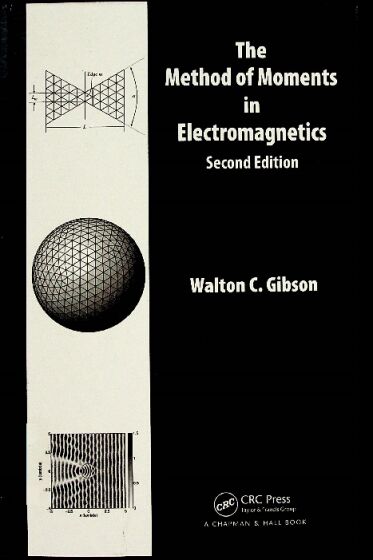
书名:The method of moments in electromagnetics
出版时间:2015
出版社:Taylor & Francis
前言
The Method of Moments in Electromagnetics, Second Edition explains the solution of electromagnetic integral equations via the method of moments (MOM). While the first edition exclusively focused on integral equations for conducting problems, this edition extends the integral equation framework to treat objects having conducting as well as dielectric parts.
New to the Second Edition
·Expanded treatment of coupled surface integral equations for conducting and composite conducting/dielectric objects, including objects having multiple dielectric regions with interfaces and junctions
·Updated topics to reflect current technology
·More material on the calculation of near fields
·Reformatted equations and improved figures
Providing a bridge between theory and software implementation, the book incorporates sufficient background material and offers nuts-and-bolts implementation details. It first derives a generalized set of surface integral equations that can be used to treat problems with conducting and dielectric regions. Subsequent chapters solve these integral equations for progressively more difficult problems involving thin wires, bodies of revolution, and two- and three-dimensional bodies. After reading this book, students and researchers will be well equipped to understand more advanced MOM topics.
查看更多
目录
Preface to the Second Edition xv
Preface xvii
Acknowledgments xxi
About the Author xxiii
1 Computational Electromagnetics 1
1.1 CEM Algorithms 1
1.1.1 Low-FrequencyMethods 2
1.1.1.1 Finite Difference Time Domain Method 2
1.1.1.2 Finite Element Method 2
1.1.1.3 Method of Moments 3
1.1.2 High-FrequencyMethods 3
1.1.2.1 Geometrical Theory of Diffraction 3
1.1.2.2 Physical Optics 3
1.1.2.3 Physical Theory of Diffraction 4
1.1.2.4 Shooting and Bouncing Rays 4
References 4
2 The Method of Moments 7
2.1 Electrostatic Problems 7
2.1.1 Charged Wire 8
2.1.1.1 Matrix Element Evaluation 10
2.1.1.2 Solution 10
2.1.2 Charged Plate 13
2.1.2.1 Matrix Element Evaluation 14
2.1.2.2 Solution 14
2.2 The Method of Moments 17
2.2.1 Point Matching 18
2.2.2 Galerkin’s Method 19
2.3 Common 2D Basis Functions 19
2.3.1 Pulse Functions 19
2.3.2 Piecewise Triangular Functions 20
2.3.3 Piecewise Sinusoidal Functions 21
2.3.4 Entire-Domain Functions 22
2.3.5 Number of Basis Functions 22
References 23
3 Radiation and Scattering 25
3.1 Maxwell’s Equations 25
3.2 Electromagnetic Boundary Conditions 26
3.3 Formulations for Radiation 26
3.3.1 Three-Dimensional Green’s Function 28
3.3.2 Two-Dimensional Green’s Function 29
3.4 Vector Potentials 31
3.4.1 Magnetic Vector Potential 31
3.4.1.1 Three-Dimensional Magnetic Vector Potential 32
3.4.1.2 Two-Dimensional Magnetic Vector Potential 32
3.4.2 Electric Vector Potential 32
3.4.2.1 Three-Dimensional Electric Vector Potential 33
3.4.2.2 Two-Dimensional Electric Vector Potential 33
3.4.3 Total Fields 33
3.4.4 Comparison of Radiation Formulas 34
3.5 Near and Far Field 37
3.5.1 Three-Dimensional Near Field 37
3.5.2 Two-Dimensional Near Field 39
3.5.3 Three-Dimensional Far Field 41
3.5.4 Two-Dimensional Far Field 43
3.6 Formulations for Scattering 44
3.6.1 Surface Equivalent 44
3.6.2 Surface Integral Equations 50
3.6.2.1 Interior Resonance Problem 51
3.6.2.2 Discretization and Testing 52
3.6.2.3 Modification of Matrix Elements 54
3.6.3 Enforcement of Boundary Conditions 56
3.6.3.1 EFIE-CFIE-PMCHWT Approach 56
3.6.4 Physical Optics Equivalent 57
References 58
4 Solution of Matrix Equations 61
4.1 Direct Methods 61
4.1.1 Gaussian Elimination 61
4.1.1.1 Pivoting 63
4.1.2 LU Decomposition 63
4.1.3 Condition Number 65
4.2 Iterative Methods 66
4.2.1 Conjugate Gradient 66
4.2.2 Biconjugate Gradient 68
4.2.3 Conjugate Gradient Squared 69
4.2.4 Biconjugate Gradient Stabilized 70
4.2.5 GMRES 71
4.2.6 Stopping Criteria 73
4.2.7 Preconditioning 73
4.3 Software for Linear Systems 74
4.3.1 BLAS 74
4.3.2 LAPACK 75
4.3.3 MATLAB R ? 75
References 75
5 Thin Wires 79
5.1 Thin Wire Approximation 79
5.2 Thin Wire Excitations 81
5.2.1 Delta-Gap Source 82
5.2.2 Magnetic Frill 82
5.2.3 Plane Wave 83
5.3 Hallén’s Equation 84
5.3.1 Symmetric Problems 86
5.3.1.1 Solution Using Pulse Functions and Point Matching 87
5.3.2 Asymmetric Problems 88
5.3.2.1 Solution Using Pulse Functions and Point Matching 89
5.4 Pocklington’s Equation 89
5.4.1 Solution Using Pulse Functions and Point Matching 90
5.5 Thin Wires of Arbitrary Shape 91
5.5.1 Method of Moments Discretization 91
5.5.2 Solution Using Triangle Basis and Testing Functions 92
5.5.2.1 Non-Self Terms 93
5.5.2.2 Self Terms 93
5.5.3 Solution Using Sinusoidal Basis and Testing Functions 94
5.5.3.1 Self Terms 94
5.5.4 Lumped and Distributed Impedances 96
5.6 Examples 97
5.6.1 Comparison of Thin Wire Models 97
5.6.1.1 Input Impedance 97
5.6.1.2 Induced Current Distribution 101
5.6.2 Half-Wavelength Dipole 104
5.6.3 Circular Loop Antenna 107
5.6.4 Folded Dipole Antenna 111
5.6.5 Two-Wire Transmission Line 113
5.6.6 Yagi Antenna for 146 MHz 117
References 122
6 Two-Dimensional Problems 125
6.1 Conducting Objects 125
6.1.1 EFIE: TM Polarization 125
6.1.1.1 Solution Using Pulse Functions 126
6.1.1.2 Solution Using Triangle Functions 128
6.1.2 Generalized EFIE: TM Polarization 132
6.1.2.1 MOM Discretization 132
6.1.2.2 Solution Using Triangle Functions 132
6.1.3 EFIE: TE Polarization 133
6.1.3.1 Pulse Function Solution 135
6.1.4 Generalized EFIE: TE Polarization 140
6.1.4.1 MOM Discretization 140
6.1.4.2 Solution Using Triangle Functions 141
6.1.5 nMFIE: TM Polarization 142
6.1.5.1 Solution Using Triangle Functions 143
6.1.6 nMFIE: TE Polarization 144
6.1.6.1 Solution Using Triangle Functions 145
6.1.7 Examples 146
6.1.7.1 Conducting Cylinder: TM Polarization 146
6.1.7.2 Conducting Cylinder: TE Polarization 152
6.2 Dielectric and Composite Objects 158
6.2.1 Basis Function Orientation 158
6.2.2 EFIE: TM Polarization 159
6.2.2.1 MOM Discretization 160
6.2.3 MFIE: TM Polarization 160
6.2.3.1 MOM Discretization 160
6.2.4 nMFIE: TM Polarization 161
6.2.4.1 MOM Discretization 161
6.2.5 EFIE: TE Polarization 162
6.2.5.1 MOM Discretization 162
6.2.6 MFIE: TE Polarization 162
6.2.6.1 MOM Discretization 162
6.2.7 nMFIE: TE Polarization 162
6.2.7.1 MOM Discretization 162
6.2.8 Numerical Stability 163
6.2.9 Examples 163
6.2.9.1 Dielectric Cylinder 163
6.2.9.2 Dielectric Cylinder: TM Polarization 164
6.2.9.3 Dielectric Cylinder: TE Polarization 170
6.2.9.4 Coated Cylinder 175
6.2.9.5 Coated Cylinder: TM Polarization 175
6.2.9.6 Coated Cylinder: TE Polarization 179
6.2.9.7 Effect of Number of Segments per Wavelength on Accuracy 180
References 184
7 Bodies of Revolution 185
7.1 BOR Surface Description 185
7.2 Expansion of Surface Currents 186
7.3 EFIE 187
7.3.1 L Operator 188
7.3.1.1 L Matrix Elements 188
7.3.2 K Operator 191
7.3.2.1 K Matrix Elements 191
7.3.3 Excitation 193
7.3.3.1 Plane Wave Excitation 193
7.4 MFIE 197
7.4.1 Excitation 197
7.4.1.1 Plane Wave Excitation 197
7.5 Solution 198
7.5.1 Plane Wave Solution 198
7.5.1.1 Currents 199
7.5.2 Scattered Field 200
7.5.2.1 Scattered Far Fields 200
7.6 nMFIE 203
7.6.1 n × L Operator 203
7.6.1.1 nL Matrix Elements 204
7.6.2 n × K Operator 204
7.6.2.1 n K Matrix Elements 204
7.6.3 Excitation 205
7.6.3.1 Plane Wave Excitation 205
7.6.3.2 Plane Wave Solution 206
7.7 Numerical Discretization 206
7.8 Notes on Software Implementation 209
7.8.1 Parallelization 209
7.8.2 Convergence 209
7.9 Examples 210
7.9.1 Spheres 210
7.9.1.1 Conducting Sphere 211
7.9.1.2 Stratified Sphere 217
7.9.1.3 Dielectric Sphere 219
7.9.1.4 Coated Sphere 220
7.9.2 EMCC Benchmark Targets 231
7.9.2.1 EMCC Ogive 231
7.9.2.2 EMCC Double Ogive 231
7.9.2.3 EMCC Cone-Sphere 233
7.9.2.4 EMCC Cone-Sphere with Gap 234
7.9.3 Biconic Reentry Vehicle 239
7.10 Treatment of Junctions 243
7.10.1 Orientation of Basis Functions 243
7.10.1.1 Longitudinal Basis Vectors 243
7.10.1.2 Azimuthal Basis Vectors 244
7.10.2 Examples with Junctions 245
7.10.2.1 Dielectric Sphere with Septum 245
7.10.2.2 Coated Sphere with Septum 245
7.10.2.3 Stratified Sphere with Septum 246
7.10.2.4 Monoconic Reentry Vehicle with Dielectric Nose 248
References 251
8 Three-Dimensional Problems 253
8.1 Modeling of Three-Dimensional Surfaces 254
8.1.1 Facet File 254
8.1.2 Edge-Finding Algorithm 256
8.1.2.1 Shared Nodes 257
8.2 Expansion of Surface Currents 258
8.2.1 Divergence of the RWG Function 259
8.2.2 Assignment and Orientation of Basis Functions 259
8.3 EFIE 260
8.3.1 L Operator 260
8.3.1.1 Non-Near Terms 261
8.3.1.2 Near and Self Terms 261
8.3.2 K Operator 270
8.3.2.1 Non-Near Terms 270
8.3.2.2 Near Terms 271
8.3.3 Excitation 274
8.3.3.1 Plane Wave Excitation 274
8.3.3.2 Planar Antenna Excitation 274
8.4 MFIE 275
8.4.1 Excitation 276
8.4.1.1 Plane Wave Excitation 276
8.5 nMFIE 276
8.5.1 n × K Operator 277
8.5.1.1 Non-Near Terms 277
8.5.1.2 Near Terms 277
8.5.2 n × L Operator 277
8.5.2.1 Non-Near Terms 278
8.5.2.2 Near and Self Terms 278
8.5.3 Excitation 279
8.5.3.1 Plane Wave Excitation 279
8.6 Enforcement of Boundary Conditions 279
8.6.1 Classification of Edges and Junctions 279
8.6.1.1 Dielectric Edges and Junctions 280
8.6.1.2 Conducting Edges and Junctions 280
8.6.1.3 Composite Conducting-Dielectric Junctions 281
8.6.2 Reducing the Overdetermined System 282
8.6.2.1 PMCHWT at Dielectric Edges and Junctions 282
8.6.2.2 EFIE and CFIE at Conducting Edges and Junctions 283
8.6.2.3 EFIE and CFIE at Composite Conducting-Dielectric Junctions 283
8.7 Notes on Software Implementation 284
8.7.1 Pre-Processing and Bookkeeping 285
8.7.1.1 Region and Interface Assignments 285
8.7.1.2 Geometry Processing 285
8.7.1.3 Assignment and Orientation of Basis Functions 285
8.7.2 Matrix and Right-Hand Side Fill 286
8.7.3 Parallelization 287
8.7.3.1 Shared Memory Systems 287
8.7.3.2 Distributed Memory Systems 287
8.7.4 Triangle Mesh Considerations 288
8.7.4.1 Aspect Ratio 288
8.7.4.2 T-Junctions 289
8.8 Examples 290
8.8.1 Serenity 290
8.8.2 Test System 290
8.8.3 Spheres 291
8.8.3.1 Conducting Sphere 291
8.8.3.2 Dielectric Sphere 296
8.8.3.3 Coated Sphere 302
8.8.4 EMCC Plate Benchmark Targets 308
8.8.4.1 Wedge Cylinder 309
8.8.4.2 Wedge-Plate Cylinder 309
8.8.4.3 Plate Cylinder 310
8.8.4.4 Business Card 310
8.8.5 Strip Dipole Antenna 315
8.8.6 Bowtie Antenna 316
8.8.7 Archimedean Spiral Antenna 318
8.8.8 Monoconic Reentry Vehicle with Dielectric Nose 321
8.8.9 Summary of Examples 325
References 325
9 The Fast Multipole Method 329
9.1 Matrix-Vector Product 330
9.2 Addition Theorem 332
9.2.1 Wave Translation 333
9.2.1.1 Complex Wavenumbers 335
9.3 FMM Matrix Elements 335
9.3.1 EFIE 335
9.3.1.1 L Operator 335
9.3.1.2 K Operator 336
9.3.2 MFIE 337
9.3.3 nMFIE 337
9.3.3.1 ˆ n × K Operator 337
9.3.3.2 ˆ n × L Operator 338
9.3.4 Unit Sphere Decomposition 339
9.4 One-Level Fast Multipole Algorithm 339
.4.1 Grouping of Basis Functions 340
9.4.1.1 Classification of Near and Far Groups 341
9.4.1.2 Near Matrix 341
9.4.2 Number of Multipoles 343
9.4.2.1 Limiting L for Transfer Functions 344
9.4.2.2 L for Complex Wavenumbers 344
9.4.3 Integration on the Sphere 344
9.4.3.1 Spherical Harmonic Representation 345
9.4.3.2 Total Bandwidth 346
9.4.3.3 Transfer Functions 346
9.4.3.4 Radiation and Receive Functions 347
9.4.4 Matrix-Vector Product 347
9.4.4.1 Near Product 347
9.4.4.2 Far Product 347
9.4.5 Computational Complexity 348
9.5 Multi-Level Fast Multipole Algorithm (MLFMA) 349
9.5.1 Spatial Subdivision via Octree 349
9.5.2 Near Matrix 350
9.5.3 Sampling Rates 350
9.5.4 Far Product 351
9.5.4.1 Upward Pass (Aggregation) 351
9.5.4.2 Downward Pass (Disaggregation) 354
9.5.5 Interpolation Algorithms 356
9.5.5.1 Statement of the Problem 356
9.5.5.2 Global Interpolation by Spherical Harmonics 357
9.5.5.3 Global Interpolation by FFT 358
9.5.5.4 Local Interpolation by Lagrange Polynomials 358
9.6 Preconditioners 359
9.6.1 Diagonal Preconditioner 360
9.6.2 Block Diagonal Preconditioner 360
9.6.3 Incomplete LU (ILU) Preconditioners 361
9.6.4 Sparse Approximate Inverse (SAI) 361
9.6.4.1 Dense QR Factorization 362
9.7 Examples 364
9.7.1 Test System 364
9.7.2 Spheres 364
9.7.2.1 Conducting Sphere 364
9.7.2.2 Dielectric Sphere 365
9.7.2.3 Coated Sphere 365
9.7.3 EMCC Benchmark Targets 371
9.7.3.1 NASA Almond 371
9.7.3.2 EMCC Ogive 376
9.7.3.3 EMCC Double Ogive 376
9.7.3.4 EMCC Cone-Sphere 376
9.7.3.5 EMCC Cone-Sphere with Gap 376
9.7.3.6 Monoconic Reentry Vehicle with Dielectric Nose 382
9.7.4 Summary of Examples 387
9.7.5 Initial Guess in Iterative Solution 388
9.7.6 Preconditioner Performance 390
9.8 Notes on Software Implementation 393
9.8.1 Parallelization 393
9.8.1.1 Single Right-Hand Side Solve 393
9.8.1.2 Multiple Right-Hand Side Solve 394
9.8.2 Vectorization 394
References 394
10 Integration 397
10.1 One-Dimensional Integration 397
10.1.1 Centroidal Approximation 397
10.1.2 Rectangular Rule 398
10.1.3 Trapezoidal Rule 399
10.1.3.1 Romberg Integration 400
10.1.4 Simpson’s Rule 401
10.1.4.1 Adaptive Simpson’s Rule 402
10.1.5 One-Dimensional Gaussian Quadrature 403
10.2 Integration over Triangles 404
10.2.1 Simplex Coordinates 404
10.2.2 Radiation Integrals with a Constant Source 406
10.2.2.1 Special Cases 408
10.2.3 Radiation Integrals with a Linear Source 408
10.2.3.1 General Case 409
10.2.3.2 Special Cases 409
10.2.4 Gaussian Quadrature on Triangles 410
10.2.4.1 Comparison with Analytic Solution 411
References 413
A Scattering Using Physical Optics 415
A.1 Field Scattered at a Conducting Interface 415
A.2 Plane Wave Decomposition at a Planar Interface 416
A.3 Field Scattered at a Dielectric Interface 418
A.4 Layered Dielectrics over Conductor 419
References 421
Index 423
查看更多
馆藏单位
中科院文献情报中心