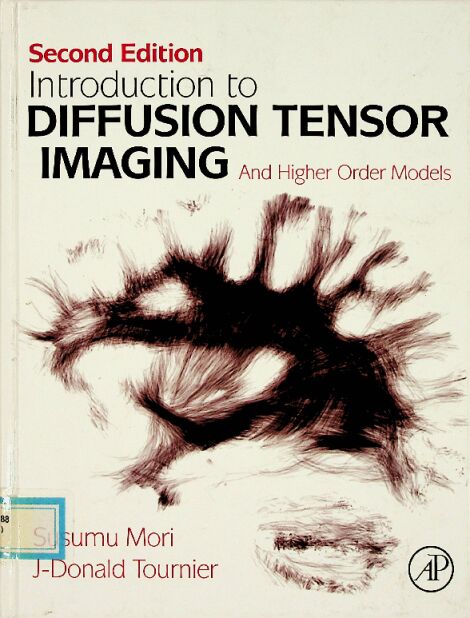
书名:Introduction to diffusion tensor imaging and higher order models
责任者:Susumu Mori and J-Donald Tournier. | Tournier, J-Donald.
ISBN\ISSN:9780123983985,0123983983
出版时间:2014
出版社:Academic Press
前言
The root of diffusion tensor imaging dates back to 1965, when Drs. Stejskal and Tanner measured the diffusion constant of water molecules using nuclear magnetic resonance (NMR) and magnetic field gradient systems. Compared to diffusion measurement using chemical tracers, the NMR-based method has several unique aspects. First, it is noninvasive. Second, it measures molecular motion along an arbitrary, predetermined axis; we can measure water diffusion along right–left, fore–aft, up–down, or any oblique angle we wish. If we are measuring freely diffusing water, this unique capability does not mean much, because measurements along any orientation give the same result. This is what we call isotropic diffusion. However, the situation changes when we study biological tissues such as muscle and brain, which consist of fibers with coherent orientations. In such systems, water tends to diffuse along the fiber, and diffusion becomes anisotropic. This means that the results of diffusion measurements are not the same if they are measured along different orientations. When diffusion is measured along, for example, muscle fiber, the diffusion constant becomes largest, it becomes smallest when measured perpendicular to the fiber.
We are interested in diffusion anisotropy because we can deduce the anatomy of the sample from it. For muscle tissue, we usually have a priori knowledge about the fiber anatomy, such that we can measure diffusion along or perpendicular to the fiber. However, what if we do not know the fiber orientation? In theory, we should be able to determine the fiber orientation by measuring diffusion constants along many orientations. The fiber should align to the measurement orientation with the largest diffusion constant. One such clear example is the measurement of the brain’s diffusion anisotropy. We know that the brain contains axonal fibers, but their structures are highly complicated, and we sometimes do not fully understand them. It would be of great benefit, therefore, if we could measure diffusion anisotropy in the brain, from which we could deduce fiber structures. This is, however, a difficult challenge. Unlike a piece of muscle tissue, which consists of fibers of uniform orientation, different regions of the brain have different fiber orientations. Unless we cut out a small piece of the brain, the brain structure is too complicated to be described by simple diffusion constant measurements. We cannot, of course, remove pieces of brain tissues from a living human at will, but we can solve this problem by combining the diffusion measurements with magnetic resonance imaging (MRI), from which we can measure diffusion constants at each pixel with a resolution of a few millimeters. This technique is called diffusion MRI. In the late 1980s, application of this technique was started in brain studies using human and animal models. Soon, evidence of diffusion anisotropy in the brain began to surface.
Diffusion MRI provided a way of estimating brain fiber structures, using water diffusion properties as a probe. However, there was still a hurdle to overcome: how could we obtain useful quantitative parameters to describe diffusion anisotropy and fiber orientations from a series of diffusion measurements? If we have infinite scanning time, we can measure diffusion along thousands of orientations, from which we can identify the axis with the largest diffusion constant. However, scanning times are often limited and so is the number of measurement orientations. We needed a mathematical model to take this limited number of measurements and quantify such properties as fiber angles and the extent of anisotropy. In the early 1990s, various attempts were made, and a model based on tensor calculation emerged as one of the most widely adopted. The diffusion MRI based on this model is called diffusion tensor imaging or DTI (for one of the first papers, please see references #2 and #3 of this section).
Our cerebral hemispheres consist of approximately 100 billion neurons and 10 to 50 times more astrocytes. Almost all the neurons reside in the gray matter, which is rich in vasculatures and has complicated architectures with various types of neuronal cell bodies, dendrites, and axons. Neurons can communicate with other neurons via their dendrites for local communication and via axons that extend much further than the dendrites. One neuron has only one axon, but the axon may branch to communicate with multiple regions. Axons with similar destinations often form a huge bundle, called white matter tracts. Some of the prominent bundles such as the corpus callosum can easily be seen in post mortem brain dissections or conventional MRI. The brain white matter consists of these axonal bundles. These bundles are named according to their destinations. For example, those connecting two cortical regions are called U-fiber (between adjacent gyri), association fibers (between different lobes), or commissural fibers (between right and left hemispheres). Those connecting cortex and deep-brain regions (e.g., the cortex and thalamus or cortex and spinal cord) are called projection fibers.
When we perform DTI, image resolution is typically about 2 mm. If the observation window is of this size, it is understandable that the fiber structure of the gray matter looks incoherent and water diffusion looks isotropic because of its structural complexity. On the other hand, many regions in the white matter have axonal bundles larger than 2 mm. In these regions, water diffusion is anisotropic, with one preferential axis to diffuse. It is important to understand that low-diffusion anisotropy does not mean lack of fibers (the gray matter is full of fibers). It means lack of coherent fiber organization within the pixel size.
There are two reasons why DTI is an important imaging modality. First, conventional MRI cannot reveal detailed anatomy of the white matter. Conventional MRI based on relaxation time relies on differences in chemical composition for their contrasts. For T1- and T2-weighted images, the amount of myelin plays a major role in differentiating the gray and white matter. However, the white matter looks quite homogeneous because it is homogeneous in terms of the chemical composition. In contrast, DTI can generate contrasts that are sensitive to fiber orientations. As an example, a color-coded fiber orientation map is shown in Fig. 1B. This image carries rich information about intra-white-matter axonal anatomy, which cannot be seen in the T1-weighted image (Fig. 1A). By comparing with an existing anatomic atlas, we can identify where, for example, the so called ‘‘corona radiata” and ‘‘superior longitudinal fasciculus” are. The second reason is that, even after decades of anatomical studies of the human brain, our understanding of its connectivity is far from complete. There are many pathological conditions in which abnormalities in specific connections are suspected, but are difficult to delineate. It is anticipated that DTI may provide new information about human brain connectivity.
Figure 1. Comparison between a conventional MRI (T1-weighted image) and a DTI-based map (color map). In the color map, color represents fiber orientations; red, green, and blue represent fibers running along the right–left, anterior–posterior, and superior–inferior orientations.
One of the purposes of this book is to explain how DTI works. To this end, it is important to know that there are two steps in DTI where we rely on models (i.e., in which we make assumptions and simplifications) (Fig. 2). The first step is when we calculate diffusion constants. Since the only information we can obtain from MRI scanners is grayscale images and the intensity at each pixel is determined by many factors such as proton density (water concentration), T1 and T2 relaxation, and water diffusion properties, the pixel intensity does not tell us what the diffusion constant is at each pixel. Chapters 1 to 3 Chapter 1 Chapter 2 Chapter 3 explain how we can convert pixel intensities to a diffusion constant based on the Gaussian diffusion model. In the second step, we extract fiber anatomy information from a set of diffusion constant measurements based on the tensor model. This step is explained in Chapters 4 and 5Chapter 4Chapter 5. In both steps, we need multiple MR images with different experimental conditions and fit the raw intensity information to the models. It is very important to understand how the mere grayscale information from MR scanners is converted to fiber anatomy.
Figure 2. Structure of this book with its relationship to the flow of diffusion tensor imaging.
In this second edition, Chapter 8 was revised significantly to incorporate recent progress in non-tensor analysis of diffusion data. Based on high angular resolution data acquisition, information about water diffusion properties “beyond DTI” can be estimated. Based on this analysis, description about more advanced 3D tract reconstruction techniques are also covered in Chapter 9.
Other chapters are dedicated to data acquisition (Chapter 6), visualization (Chapter 7), non-tensor approaches (Chapter 8), 3D tract reconstruction (Chapter 9), quantification (Chapter 10), and applications (Chapter 11) as shown in Fig. 2.
查看更多
目录
Preface ix
Acknowledgments xii
1.Basics of Diffusion Measurement 1
1.1. NMR Spectroscopy and MRI Can Detect Signals from Water Molecules 1
1.2 What is Diffusion? 1
1.3 How to Measure Diffusion? 3
2. Anatomy of Diffusion Measurement 11
2.1 A Set of Unipolar Gradients and Spin-Echo Sequence is Most Widely Used for Diffusion Weighting 11
2.2 There are Four Parameters that Affect the Amount of Signal Loss 13
2.3 There are Several Ways of Achieving a Different Degree of Diffusion Weighting 15
3. Mathematics of Diffusion Measurement 17
3.1 We Need to Calculate Distribution of Signal Phases by Molecular Motion 17
3.2 Simple Exponential Decay Describes Signal Loss by Diffusion Weighting 21
3.3 Diffusion Constant Can be Obtained from the Amount of Signal Loss But Not from the Signal Intensity 22
3.4 From Two Measurements, We Can Obtain a Diffusion Constant 23
3.5 If There are More Than Two Measurement Points, Linear Least-Square Fitting is Used 24
References and Suggested Readings 25
4. Principle of Diffusion Tensor Imaging 27
4.1 NMR/MRI Can Measure Diffusion Constants Along an Arbitrary Axis 27
4.2 Diffusion Sometimes has Directionality 27
4.3 Six Parameters are Needed to Uniquely Define an Ellipsoid 27
4.4 Diffusion Tensor Imaging Characterizes the Diffusion Ellipsoid from Multiple Diffusion Constant Measurements Along Different Directions 29
4.5 Water Molecules Probe Microscopic Properties of their Environment 31
4.6 Human Brain White Matter has High Diffusion Anisotropy 32
References and Suggested Readings 32
5. Mathematics of Diffusion Tensor Imaging 33
5.1 Our Task is to Determine the Six Parameters of a Diffusion Ellipsoid 33
5.2 We Can Obtain the Six Parameters from Seven Diffusion Measurements 34
5.3 Determination of the Tensor Elements from a Fitting Process 36
References and Suggested Readings 37
6. Practical Aspects of Diffusion Tensor Imaging 39
6.1 Two Types of Motion Artifacts: Ghosting and Coregistration Error 39
6.2 We Use Echo-Planar Imaging to Perform Diffusion Tensor Imaging 40
6.3 The Amount of Diffusion-Weighting is Constrained by the Echo Time 42
6.4 There are Various k-Space Sampling Schemes 42
6.5 Parallel Imaging is Good News for DTI 44
6.6 Image Distortion by Eddy Current Needs Special Attention 45
6.7 DTI Results may Differ if Spatial Resolution and SNR have been Changed 48
6.8 Selection of b-Matrix 49
References and Suggested Readings 51
7. New Image Contrasts from Diffusion Tensor Imaging: Theory, Meaning, and Usefulness of DTI-Based Image Contrast 53
7.1 Two Scalar Maps (Anisotropy and Diffusion Constant Maps) and Fiber Orientation Maps are Important Outcomes Obtained from DTI 53
7.2 Scalar Maps (Anisotropy and Diffusion Constant Maps) and Fiber Orientation Maps are Two Important Images Obtained from DTI 53
7.3 There are Tubular and Planar Types of Anisotropy 55
7.4 DTI has Several Disadvantages 57
7.5 There are Multiple Sources that Decrease Anisotropy 58
7.6 Anisotropy may Provide Unique Information 59
7.7 Color-Coded Maps are a Powerful Visualization Method to Reveal White Matter Anatomy 59
References and Suggested Readings 64
8. Moving Beyond DTI: High Angular Resolution Diffusion Imaging (HARDI) 65
8.1 Limitations of Diffusion Tensor Imaging 65
8.2 Concepts for Dealing With Crossing Fibers 69
8.3 Practical Approaches to Dealing With Crossing Fibers 71
8.4 Can HARDI Provide More Information than just the Fiber Orientations? 76
References 77
9. Fiber-Tracking: 3-Dimensional Tract Reconstruction 79
9.1 Fiber Orientations can be Used to Delineate White Matter Pathways 79
9.2 There are Many Limitations to Fiber-Tracking Methods 85
9.3 Addressing the Issue of Crossing Fibers: Using HARDI Approaches 88
9.4 Addressing the Uncertainty Issue: Probabilistic Approaches 88
9.5 Modern Approaches to Fiber-Tracking: Putting it All Together 91
9.6 Interpretation of Fiber-Tracking Results is Not Straightforward 92
9.7 Conclusion 95
References 95
10. Quantification Approaches 97
10.1 Improvement of Conventional Quantification Approaches 97
10.2 Quantification of Anisotropy and Tract Sizes by DTI 99
References 113
11. Application Studies 115
11.1 Background of Application Studies of DTI 115
11.2 Examples of Application Studies 116
11.3 Future Applications 122
References 123
Index 125
查看更多
馆藏单位
中科院文献情报中心