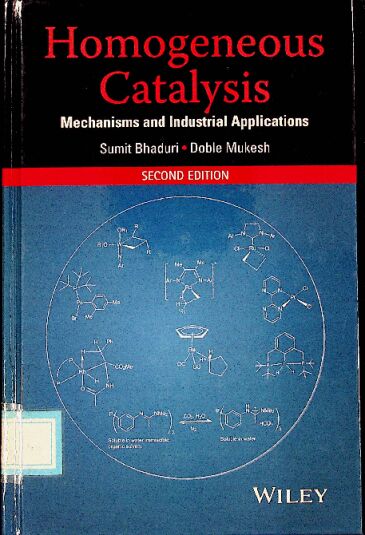
书名:Homogeneous catalysis
责任者:Sumit Bhaduri | Doble Mukesh.
分类号:化学
版次:Second edition.
摘要
Over the last decade, the area of homogeneous catalysis with transition metal has grown in great scientific interest and technological promise, with research in this area earning three Nobel Prizes and filing thousands of patents relating to metallocene and non-metallocene single site catalysts, asymmetric catalysis, carbon-carbon bond forming metathesis and cross coupling reactions.
This text explains these new developments in a unified, cogent, and comprehensible manner while also detailing earlier discoveries and the fundamentals of homogeneous catalysis. Serving as a self-study guide for students and all chemists seeking to gain entry into this field, it can also be used by experienced researchers from both academia and industry for referring to leading state of the art review articles and patents, and also as a quick self-study manual in an area that is outside their immediate expertise. The book features:
- Topics including renewable feed stocks (biofuel, glycerol), carbon dioxide based processes (polycarbonates), fluorous solvents, ionic liquid, hydroformylation, polymerization, oxidation, asymmetric catalysis, and more
- Basic principles of organometallic chemistry, homogeneous catalysis, and relevant technological issues
- Problems and answers, industrial applications (case studies), and examples from proven industrial processes with clear discussions on environmental and techno-commercial issues
- Extensive references to cutting edge research with application potential and leading patents
- Tables and illustrations to help explain difficult concepts.
查看更多
目录
Preface xi
1. Chemical Ind ustry and Homogeneous Catalysis 1
1.1 Feedstocks, Fuels, and Catalysts, 2
1.2 Crude Oi l to Gasoline and Basic Bui lding Blocks by Heterogeneous Catalysts, 3
1.2.1 Cracking Reactions, 5
1.2.2 Hydrodesu l fu rization Reactions, 5
1.3 Basic Bui lding Blocks to Downstream Products by Homogeneous Catalysis, 6
1.4 Comparison among Different Type of Catalysis, 8
1.5 Catalyst Recovery, 12
1.6 Environ mental Issues, 13
1.6.1 Backgrou nd, 14
1.6.2 Biofuel, Ethanol, and Glycerol , 15
1.6.3 Biodegradable Plastics, 17
1.6.4 Hydrogen and Carbon Dioxide, 17
Problems, I8
Bibliography, 20
2. Basic Chemical Concepts 23
2.1 Ligands, 26
2.1.1 Types of Ligands, 26
2.1.2 Donor and Acceptor Properties of Ligands, 28
2.1.3 CO,R2C=CR2 other π acids, and H- as Ligands, 30
2.1.4 Phosphines and Related Ligands, 34
2.1.5 Alkyl , Aryl, Alkylidene, and Related Ligands、36
2.1.6 Cyclopentadienyl, Allyl, and Related Ligands, 38
2.1.7 Chiral Ligands, 40
2.2 Metals, 43
2.2.1 Oxidation State, 43
2.2.2 Electron Counting, 44
2.2.3 Coordinative Unsaturation, 47
2.2.4 Lanthanides and Actin ides, 49
2.3 Important Reaction Types, 50
2.3.1 Oxidative Addition and Reductive El imination, 50
2.3.2 Insertion and Elimjnation Reactions, 52
2.3.3 Meta]lacycle Formation, 55
2.3.4 Attack on a Coordinated Ligand, 56
2.3.5 Activation of Alkanes, 57
2.3.6 Activation of Dinitrogen, 60
2.3.7 Activation of Dioxygen (02), 61 Problems, 63
Bibliography, 65
3. Methods of Investigation 67
3.1 Catalytic Cycle and Internediates, 68
3.2 Spectroscopic Studies, 72
3.2.1 In Situ Spectroscopy, 73
3.2.2 Infrared Spectroscopy, 74
3.2.3 NMR Spectroscopy, 76
3.2.4 Advanced N扣1R Spectroscopy, 79
3.2.5 Other Spectroscopic Methods, 82
3.3 Ki netic Studies, 84
3.4 Model Compounds, 86
3.5 Computational Methods, 87
3.6 Asymmetric Catalysis, 89 Problem s, 92
Bibliography, 94
4. Carbonylation and Related Reactions 95
4.1 Introduction , 96
4.2 Carbonylation and Manufacture of Acetic Acid, 96
4.2.1 Cobalt Process, 97
4.2.2 Rhodium Cycle, 99
4.2.3 Iridium Process, 100
4.2.4 Mechanistic Studies and Differences, 101
4.3 Carbonylation of Other Alcohols, 103
4.4 Carbonylation of Methyl Acetate, I 04
4.5 Carbonylation of Alkynes, 106
4.6 Other Carbony lation and Hydrocarboxylation Reactions, 110
4.7 C1 Chemistry, 116
4.7.1 Water Gas Shift Reaction, 118
4.7.2 Fischer-Tropsch Reaction, 119
4.7.3 Utilization of C02, 121
4.7.4 Polycarbonates from C02, 122
4.8 Engineeri ng Aspects, 125
Problems, 126
Bibliography, 128
5. Hyd rogenation and Other Hydrogen-Based Catalytic Reactions 13
5.1 Hydrogenation, 132
5.1.1 Mechani sms and Catalytic Cycles, 133
5.1.2 Asymmetric Hydrogenation, 134
5.2 Hydroformylation , 141
5.2.1 Ligands and Selectivity, 142
5.2.2 Mechanistic Studies, 143
5.2.3 Water-Soluble Phosphines and Catalyst Recovery, 148
5.2.4 Other Method s for Catalyst Recovery, 149
5.3 Other Hydroformylation Reactions, 150
5.4 Asymmetric Hydroformylation, 151
5.5 Hydrosilylation, 152
5.6 Hydrocyanation , 154
5.6.1 Catalysts and Mechani stic Studies, 155
5.6.2 Asymmetric Hydrocyanation , 160
5.7 Hydroarnination, 161
Problems, 164
Bibliography, 165
6. Polymerization and Selective Oligomerization of Alkenes 167
6.1 Introduction, 168
6.1.1 Polyethylene, 168
6.1.2 Polypropylene, 169
6.1.3 Polybutadiene, 171
6.2 Early Catalysts for PE and PP, 172
6.3 Modern Ziegler-Natta Catalyst, 174
6.4 Mechanistic Studies, 178
6.5 Single-Site Catalysts, 179
6.5.1 Metallocenes and Methyl Aluminoxane, 179
6.5.2 NonmetaJlocene Catalysts, 181
6.5.3 Mechanistic Studies, 183
6.6 Ethylene Polymerization with Polar Comonomers, 187
6.7 Polymers of Other Alkenes, 190
6.8 Oligomerization of Ethylene, 191
6.8.1 Shell Higher Olefin Process, 192
6.8.2 Mechanistic Studies and Metallacycles, 193
6.9 Engineering Aspects, 195 Problems, 196
Bibliography, 198
7. Selective C-C Bond-Forming Reactions with Alkenes 20
7.1 Introduction, 202
7.2 Di-,Tri-, Tetramerization and Codime1;zation Reactions, 202
7.2.1 Dimerization of Ethylene and Propylene, 204
7.2.2 Tri- and Tetramerization of Ethylene, 205
7.2.3 Mechanistic Studies, 207
7.2.4 Di- and Trimerization of Butadiene, 208
7.2.5 Codimerization of Butadiene and Ethylene, 210
7.3 Metathesis Reactions, 21 l
7.3.1 Types of Metathesis, 2l 2
7.3.2 Mechanistic Studies, 213
7.3.3 Applications of Metathesis, 218
7.4 Pd-Catalyzed Cross-Coupling Reactions, 222
7.4.1 Mechanistic Studies, 223
7.4.2 Appl ications, 228
7.5 Metal-Catalyzed Cyclopropanation and Cycloaddition , 229
7.5.1 Mechanisms, 231
7.5.2 Applications, 232
Problems, 233
Bibliography, 236
8. Oxidation 239
8.1 Introduction, 240
8.2 Wacker Oxidation, 241
8.2.1 Backgrou nd Chemistry, 241
8.2.2 Catalytic Cycle and Mechan ism, 242
8.3 Metal-Cata lyzed Liquid-Phase Auto-oxidation , 244
8.3.1 Mechanism of Auto-ox idation, 245
8.3.2 Special Features of Cyclohexane and p-Xy lene Ox idations, 247
8.4 Polymers from Auto-oxidation Products, 250
8.5 Selective Oxidations, 252
8.5.1 Oxidat ions of Alcohols, 252
8.5.2 Ox idations of Alkenes, 255
8.5.3 Asymmetric Epoxidation and Kinetic Resol ution, 259
8.5.4 Asymmetric Alkene Dihydroxylations, 262
8.5.5 Oxidation of Methane, 264
8.6 Engineering and Safety Considerations, 267
Problems, 268
Bibliography, 271
Index 273
查看更多
馆藏单位
中科院文献情报中心