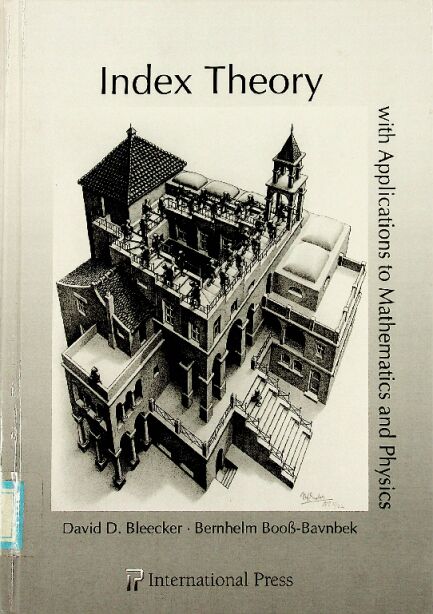
书名:Index theory with applications to mathematics and physics
责任者:David D. Bleecker | Bernhelm Boob-Bavnbek.
出版时间:2013
出版社:International Press of Boston,
前言
Target Audience and Prerequisites. The mathematical philosophy of index theory and all its basic concepts, technicalities and applications are explained in Parts Ⅰ-Ⅲ. Those are the easy parts. They are written for upper undergraduate students or graduate students to bridge the gap between rule-based learning and first steps towards independent research. They are also recommended as general orientation to mathematics teachers and other senior mathematicians with different background. All interested can pick up a single chapter as bedside reading.
In order to enjoy reading or even work through Parts I-III, we expect the reader to be familiar with the concept of a smooth function and a complex separable Hilbert space. Nothing more — but a will to acquire specialized topics in functional analysis, algebraic topology, elliptic operator theory, global analysis, Riemannian geometry, complex variables, and some other subjects. Catching so many different concepts and fields can make the first three Parts a bit sophisticated for a busy reader. Instead of ascending systematically from simple concepts to complex ones in the classical Bourbaki style, we present a patch-work of definitions and results when needed. In each chapter we present a couple of fully comprehensible, important, deep mathematical stories. That, we hope, is sufficient to catch our four messages:
(1) Index theory is about regularization, more precisely, the index quantifies the defect of an equation, an operator, or a geometric configuration from being regular.
(2) Index theory is also about perturbation invariance, i.e., the index is a meaningful quantity stable under certain deformations and apt to store certain topological or geometric information.
(3) Most important for many mathematicians, the index interlinks quite di�verse mathematical fields, each with its own very distinct research tradi�tion.
(4) Index theory trains the student to recognize all the elementary topics of linear algebra in finite dimensions in the sophisticated topics of infinite�dimensional and nonlinear analysis and geometry.
查看更多
目录
Synopsis xi
Preface xvi
Part I. Operators with Index and Homotopy Theory 1
Chapter 1. Fredholm Operators 2
1. Hierarchy of Mathematical Objects 2
2. The Concept of Fredholm Operator 3
3. Algebraic Properties. Operators of Finite Rank. The Snake Lemma 5
4. Operators of Finite Rank and the Fredholm Integral Equation 9
5. The Spectra of Bounded Linear Operators: Basic Concepts 10
Chapter 2. Analytic Methods. Compact Operators 12
1. Analytic Methods. The Adjoint Operator 12
2. Compact Operators18
3. The Classical Integral Operators 25
4. The Fredholm Alternative and the Riesz Lemma 26
5. Sturm-Liouville Boundary Value Problems 28
6. Unbounded Operators 34
7. Trace Class and Hilbert-Schmidt Operators 53
Chapter 3. Fredholm Operator Topology 63
1. The Calkin Algebra 63
2. Perturbation Theory 65
3. Homotopy Invariance of the Index 68
4. Homotopies of Operator-Valued Functions 72
5. The Theorem of KUIPER 77
6.The Topology of F 81
7. The Construction of Index Bundles 82
8. The Theorem of Atiyah-Janich 88
9. Determinant Line Bundles 91
10. Essential Unitary Equivalence and Spectral Invariants 108
Chapter 4. Wiener-Hopf Operators 120
1. The Reservoir of Examples of Fredholm Operators 120
2. Origin and Fundamental Significance of Wiener-Hopf Operators 121
3. The Characteristic Curve of a Wiener-Hopf Operator 122
4. Wiener-Hopf Operators and Harmonic Analysis 123
5. The Discrete Index Formula. The Case of Systems 125
6. The Continuous Analogue 129
Part II. Analysis on Manifolds 133
Chapter 5. Partial Differential Equations in Euclidean Space 134
1. Linear Partial Diflferential Equations 134
2. Elliptic Differential Equations 137
3. Where Do Elliptic Differential Operators Arise? 139
4. Boundary-Value Conditions 141
5. Main Problems of Analysis and the Index Problem 143
6. Numerical Aspects 143
7. Elementary Examples 144
Chapter 6. Differential Operators over Manifolds 156
1. Differentiable Manifolds — Foundations 157
2. Geometry of C~(∞) Mappings 160
3. Integration on Manifolds 166
4. Exterior Differential Forms and Exterior Differentiation 171
5. Covariant Diflferentiation, Connections and Parallelity 176
6. Differential Operators on Manifolds and Symbols 181
7. Manifolds with Boundary 190
Chapter 7. Sobolev Spaces (Crash Course) 193
1. Motivation 193
2. Definition 194
3. The Main Theorems on Sobolev Spaces 200
4. Case Studies 203
Chapter 8. Pseudo-Differential Operators 206
1. Motivation 206
2. Canonical Pseudo-DifFerential Operators 210
3. Principally Classical Pseudo-Differential Operators 214
4. Algebraic Properties and Symbolic Calculus 228
5. Normal (Global) Amplitudes 231
Chapter 9. Elliptic Operators over Closed Manifolds 237
1. Mapping Properties of Pseudo-Differential Operators 237
2. Elliptic Operators — Regularity and Fredholm Property 239
3. Topological Closure and Product Manifolds 242
4. The Topological Meaning of the Principal Symbol — A Simple Case Involving Local Boundary Conditions 244
Part III. The Atiyah-Singer Index Formula 251
Chapter 10. Introduction to Topological K-Theory 252
1. Winding Numbers 252
2. The Topology of the General Linear Group 257
3. Elementary /f-Theory 262
4. K-Theory with Compact Support 266
5. Proof of the Periodicity Theorem of R. Bott 269
Chapter 11. The Index Formula in the Euclidean Case 275
1. Index Formula and Bott Periodicity 275
2. The Difference Bundle of an Elliptic Operator 276
3. The Index Theorem for Ell_(c)(R~(n))281
Chapter 12. The Index Theorem for Closed Manifolds 284
1. Pilot Study: The Index Formula for Trivial Embeddings 285
2. Proof of the Index Theorem for Nontrivial Normal Bundle 287
3. Comparison of the Proofs 301
Chapter 13. Classical Applications (Survey) 310
1. Cohomological Formulation of the Index Formula 311
2. The Case of Systems (Trivial Bundles) 316
3. Examples of Vanishing Index 317
4. Euler Characteristic and Signature 319
5.Vector Fields on Manifolds 325
6. Abelian Integrals and Riemann Surfaces 329
7. The Theorem of Hirzebruch-Riemann-Roch 333
8. The Index of Elliptic Boundary-Value Problems 337
9. Real Operators 356
10. The Lefschetz Fixed-Point Formula 357
11. Analysis on Symmetric Spaces: The G-equivariant Index Theorem 360
12. Further Applications 362
Part IV. Index Theory in Physics and the Local Index Theorem 363
Chapter 14. Physical Motivation and Overview 364
1. Classical Field Theory 365
2. Quantum Theory 373
Chapter 15. Geometric Preliminaries 394
1.Principal G-Bundles 394
2. Connections and Curvature 396
3. Equivariant Forms and Associated Bundles 400
4. Gauge Transformations 409
5. Curvature in Riemannian Geometry 414
6. Bochner-Weitzenbock Formulas 434
7. Characteristic Classes and Curvature Forms 443
8. Holonomy 455
Chapter 16. Gauge Theoretic Instantons 460
1. The Yang-Mills Functional 460
2. Instantons on Euclidean 4-Space 466
3. Linearization of the Moduli Space of Self-dual Connections 489
4. Manifold Structure for Moduli of Self-dual Connections 496
Chapter 17. The Local Index Theorem for Twisted Dirac Operators 513
1. Clifford Algebras and Spinors 513
2. Spin Structures and Twisted Dirac Operators 525
3. The Spinorial Heat Kernel 538
4. The Asymptotic Formula for the Heat Kernel 549
5. The Local Index Formula 576
6. The Index Theorem for Standard Geometric Operators 594
Chapter 18. Seiberg-Witten Theory 643
1.Background and Survey 643
2. Spinc Structures and the Seiberg-Witten Equations 655
3. Generic Regularity of the Moduli Spaces 663
4. Compactness of Moduli Spaces and the Definition of S-W Invariants 685
Appendix A. Fourier Series and Integrals - Fundamental Principles 705
1.Fourier Series 705
2. The Fourier Integral 707
Appendix B. Vector Bundles 712
1.Basic Definitions and First Examples 712
2. Homotopy Equivalence and Isomorphy 716
3. Clutching Construction and Suspension 718
Bibliography 723
Index of Notation 741
Index of Names/Authors 749
Subject Index 757
查看更多
馆藏单位
中科院文献情报中心