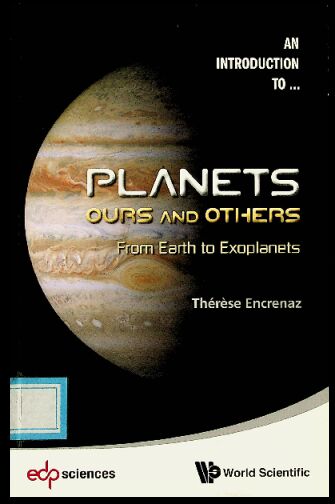
书名:Planets
责任者:Therese Encrenaz | Paris Observatory | France.
出版时间:2014
出版社:World Scientific,
前言
What is a planet? The answer may seem obvious; still, the definition of a planet has continuously evolved over the centuries, and their number has changed following successive discoveries. In 2006, the decision endorsed by the International Astronomical Union to remove Pluto from the list of planets has well illustrated the difficulty associated with their definition. The recent discovery of hundreds of exoplanets around nearby stars of our Galaxy opens a new and spectacular dimension to astrophysics. We presently know very little about the physical nature of exoplanets. In contrast, our knowledge on solar system planets has made huge progress over the past decades, thanks, especially, to space planetary exploration. The purpose of this book is first to characterize what planets are, in their global properties and in their diversity. Then, this knowledge is used to try to imagine the physical nature of exoplanets, starting from the few parameters we know about them. Throughout, we keep in mind the ultimate question of the search for possible extraterrestrial life: Could life exist or have existed in the solar system and beyond?
查看更多
目录
Acknowledgements vii
Foreword xi
Introduction xiii
1. How to Explore Planets? 1
1.1 The Earth in space 1
1.2 Telescopic observations 3
1.3 Observations from space 7
1.4 Searching for exoplanets 15
2. The Birth of Planets 21
2.1 A formation within a disk 21
2.2 A common scenario in the Universe 22
2.3 What is the age of the solar system? 26
2.4 The main steps of planetary formation 29
2.5 Telluric planets and giant planets 31
2.6 Between the two families of planets: asteroids 33
2.7 Pluto and the transneptunian objects 35
3. Exploring Planet Earth 37
3.1 Rocks and metals: a differentiated internal structure 39
3.2 A terrestrial singularity: plate tectonics 43
3.3 Formation of terrestrial relief: the isostasy principle 45
3.4 Our natural environment: the terrestrial atmosphere 46
3.5 The water cycle: another specificity of Earth 52
3.6 Between the Earth and space, the magnetosphere 54
3.7 A brief history of the Earth’s climate 56
3.8 The Earth–Moon couple: a double system 60
3.9 The Earth, a unique planet... 62
4. The Neighbors of the Earth 65
4.1 Closest to the Sun, Mercury 66
4.2 A Moon that looks like Mercury 69
4.3 Venus, the furnace 72
4.4 Mars, a desert word 79
4.5 Comparative evolution of terrestrial planets: the role of water 89
5. A Little Further, the Giant Planets 93
5.1 Two classes of giant planets 95
5.2 From Jupiter to Neptune: four decades of exploration 112
5.3 The outer satellites 118
6. Exoplanets, the New Worlds 129
6.1 A long quest marked with failures 130
6.2 Fifteen years later, the situation 144
6.3 The formation of planetary systems 157
6.4 How to classify exoplanets? 161
6.5 From detection to characterization 164
7. Searching for Habitable Worlds 171
7.1 A new discipline, astrobiology 171
7.2 Life elsewhere in the solar system? 176
7.3 Life on exoplanets? 182
7.4 Searching for inhabited worlds 186
查看更多
作者简介
Thérèse Encrenaz, born in 1946, is a Senior Scientist at the Centre National de la Recherche Scientifique. She works at LESIA (Laboratory of Space and Instrumental Studies for Astrophysics) at Paris Observatory. Her expertise is the study of planetary atmospheres, in particular by remote sensing analyses, using space and ground-based data. She has been involved in many space missions (Vega, Phobos, Galileo, ISO, Mars Express, Venus Express, Rosetta). She is the author of over 250 articles in refereed journals and a dozen popular books. She received the silver medal of CNRS in 1998, the Janssen medal of the Astronomical French Society in 2007, and the David Bates medal of the European Geophysical Union in 2010.
查看更多
馆藏单位
中科院文献情报中心