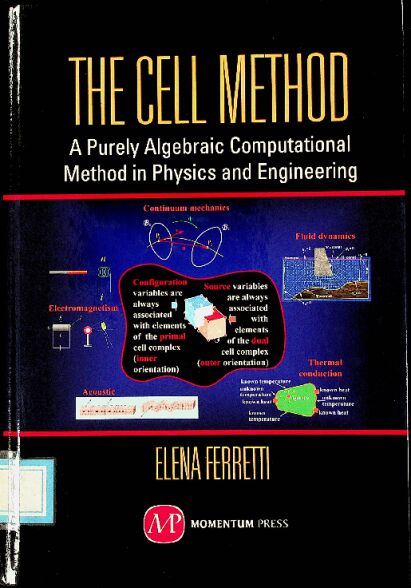
书名:The cell method
出版时间:2014
出版社:Momentum Press,
前言
The computational methods currently used in physics are based on the discretization of the dif* ferential formulation, by using one of the many methods of discretization, such as the finite ele�ment method (FEM), the boundary element method (BEM), the finite volume method (FVM), the finite difference method (FDM), and so forth. Infinitesimal analysis has without doubt played a major role in the mathematical treatment of physics in the past, and will continue to do so in the future, but, as discussed in Chapter 1, we must also be aware that several important aspects of the phenomenon being described, such as its geometrical and topological features, remain hidden, in using the differential formulation. This is a consequence not of performing the limit, in itself but rather of the numerical technique used fbr finding the limit. In Chapter 1, we analyze and compare the two most known techniques, the iterative technique and the application of the Cancelation Rule fbr limits. It is shown how the first technique, leading to the approximate solution of the algebraic formulation, preserves information on the trend of the function in the neighborhood of the estimation point, while the second technique, leading to the exact solution of the differential formulation, does not. Under the topological point of view, this means that the algebraic formulation preserves information on the length scales associated with the solution, while the differential formulation does not. On the basis of this observation, it is also proposed to consider that the limit provided by the Cancelation Rule for limits is exact only in the broad sense (i.e., the numerical sense), and not in the narrow sense (involving also topological information). Moreover, applying the limit process introduces some limitations as regularity conditions must be imposed on the field variables. These regularity conditions, in particular those concerning differentiability, are the price we pay fbr using a formalism that is both very advanced and easy to manipulate.
The Cancelation Rule fbr limits leads to point-wise field variables, while the iterative pro�cedure leads to global variables (Section 1.2), which, being associated with elements provided with an extent, are set functions (Section 1.3). The use of global variables instead of field vari�ables allows us to obtain a purely algebraic approach to physical laws (Chapter 4, Chapter 5), called the direct algebraic formulation. The term "direct" emphasizes that this formulation is not induced by the differential formulation, as is the case for the so-called discrete formulations that are often compared to it (Section 1.4). By performing densities and rates of the global vari�ables, it is then always possible to obtain the differential formulation from the direct algebraic formulation.
查看更多
目录
Acknowledgments vii
Preface ix
1 A Comparison Between Algebraic and Differential Formulations Under the Geometrical and Topological Viewpoints 1
1.1 Relationship Between How to Compute Limits and Numerical Formulations in Computational Physics 2
1.1.1 Some Basics of Calculus 2
1.1.2 The c-6 Definition of a Limit 4
1.1.3 A Discussion on the Cancelation Rule fbr Limits 8
1.2 Field and Global Variables 15
1.3 Set Functions in Physics 20
1.4 A Comparison Between the Cell Method and the Discrete Methods 21
2 Algebra and the Geometric Interpretation of Vector Spaces 23
2.1 The Exterior Algebra 23
2.1.1 The Exterior Product in Vector Spaces 24
2.1.2 The Exterior Product in Dual Vector Spaces 25
2.1.3 Covariant and Contravariant Components 35
2.2 The Geometric Algebra 40
2.2.1 Inner and Outer Products Originated by the Geometric Product 43
2.2.2 The Features of p-vectors and the Orientations of Space Elements 52
2.2.2.1 Inner Orientation of Space Elements 52
2.2.2.2 Outer Orientation of Space Elements 58
3 Algebraic Topology as a Tool for Treating Global Variables with the CM 73
3.1Some Notions of Algebraic Topology 74
3.2 Simplices and Simplicial Complexes 77
3.3 Faces and Cofaces 80
3.4 Some Notions of the Graph Theory 88
3.5 Boundaries, Coboundaries, and the Incidence Matrices 93
3.6 Chains and Cochains Complexes, Boundary and Coboundary Processes 97
3.7 Discrete p-forms 103
3.8 Inner and Outer Orientations of Time Elements 105
4 Classification of the Global Variables and Their Relationships 113
4.1 Configuration, Source, and Energetic Variables 114
4.2 The Mathematical Structure of the Classification Diagram 127
4.3 The Incidence Matrices of the Two Cell Complexes in Space Domain 135
4.4 Primal and Dual Cell Complexes in Space/Time Domain and Their Incidence Matrices 137
5 The Structure of the Governing Equations in the Cell Method 145
5.1The Role of the Coboundary Process in the Algebraic Formulation 146
5.1.1 Performing the Coboundary Process on Discrete 0-fbrms in Space Domain: Analogies Between Algebraic and Differential Operators 151
5.1.2 Performing the Coboundaiy Process on Discrete 0-fbrms in Time Domain: Analogies Between Algebraic and Differential Operators 155
5.1.3 Performing the Coboundary Process on Discrete 1-forms in Space/Time Domain: Analogies Between Algebraic and Differential Operators 158
5.1.4 Performing the Coboundary Process on Discrete 2-fbrms in Space/Time Domain: Analogies Between Algebraic and Differential Operators 164
5.2 How to Compose the Fundamental Equation of a Physical Theory 167
5.3 Analogies in Physics 168
5.4 Physical Theories with Reversible Constitutive Laws 177
5.5 The Choice of Primal and Dual Cell Complexes in Computation 178
6 The Problem of the Spurious Solutions in Computational Physics 183
6.1Stability and Instability of the Numerical Solution 184
6.2The Need fbr Non-Local Models in Quantum Physics 198
6.3Non-Local Computational Models in Differential Formulation 203
6.3.1 Continuum Mechanics 204
6.4 Algebraic Non-Locality of the CM 208
References 215
Index 227
查看更多
馆藏单位
中科院文献情报中心