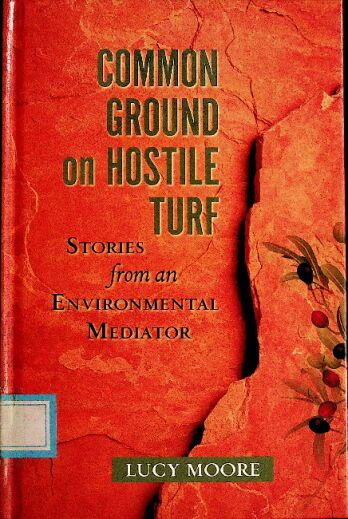
书名:Common ground on hostile turf
ISBN\ISSN:9781610914109,9781610914116
出版时间:2013
出版社:Island Press,
前言
After painting avery grim picture of a future world impacted by climate change, author and environmentalist Bill McKibben was asked where he would move in order to have the best chance of surviving.Where on the planet, asked the questioner, would one's chances be the best?He smiled. Although people who ask that question are usually thinking in terms of geography—where can I goto escape the rising oceans, the killer drought, the devastating floods?—he said that the answer, in his opinion, was not a geographic one."T would look for a place to go, " he said, "where there is a community that can make decisions together.That is the kind of place where survival is possible."
His remarks at the Quivira Coalition's 2011 conference in Albu quer-que were exciting for me because I have tried for decades to create those "communities" where decisions are made collectively, where decisions include and respect the full diversity of interests.My communities are not usually "communities of place" but rather "communities of interest, " where those who have come together share a common problem, strive for a common goal, or seek to resolve a conflict.
As an environmental and public policy mediator for the past twenty-five years, I have been in the middle of dozens of highly controversial re-gional and national conflicts.Each, of course, is different.There are those that make the drive or the flight home a joyful time for happy reflection. There are those that wake me up at night, and in that distorted time when all things frightening rush in, I despair over my community, my country, the world.
Both the human and the natural worlds are under enormous stress. My cases are illustrations of our need to make critical choices as conflict-ing demands from a growing and mobile population increase.We need to extract natural resources to have the quality of life we want.We want to live with open space and recreational opportunities in our backyards.We need ranchers and farmers to feed us.We want to preserve species whie we are making their survival unlikely We want our children educated, yet other priorities seem to come first.We want to be respected, but we have a hard time respecting others.Without away to resolve these conf icts in an equitable and sustainable way, the battles wll continue and the hostility among interests will escalate.
The circuitous path to a collective answer is def ned by personalities, culture, power, and how we feel about one another.One of the media-tors most important contributions toward resolving any dispute is pro-viding the space—physical and emotional—where those in conflict can tell their stories to eachother.In that spirit, I am offering my stories from the trenches of conflict resolution, in hopes that they will further Mc Kib-ben's conversation about how we can grow and support those communi-ties that make decisions together.
I wll start by suggesting that the first step is basic human interaction in which everyone, mediator included, is able to be honest, vulnerable, open, and respectful.Once this happens, the logjam of warring studies and legal threats may break loose.The result can be a resolution that not only is equitable and sustainable but also shows that trust and respect among adversaries are possible.This is a vision that I hold dear, a sabal-ance to the deep and real fears for the future.
查看更多
目录
Preface xi
Acknowledgments xiii
Chapter 1.Introduction 1
Chapter 2.Encountering Hostile Turf 9
Chapter 3.The Power of Story 23
Chapter 4.Sheep in the Wilderness 33
Chapter 5.Finding Common Ground 69
Chapter 6.The Army Corps Takes Orders 87
Chapter 7.A Rugged Road 103
Chapter 8.So Close to Consensus 117
Chapter 9.When the Past Won't Go Away 131
Chapter 10.When Cookies Are n't Enough 147
Chapter 11.Tribes Take the Lead 161
Chapter 12.Conclusion 179
About the Author 193
Index 195
查看更多
馆藏单位
中科院文献情报中心