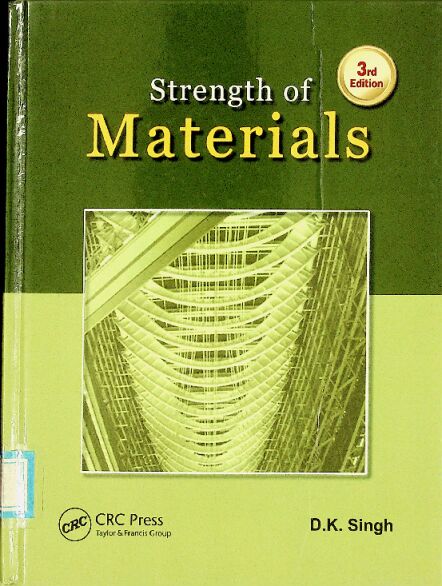
书名:Strength of Materials
责任者:D.K. Singh. | Singh, D. K.
ISBN\ISSN:9781482245714,148224571X
出版时间:2014
出版社:Ane Books ;,CRC Press,
前言
In this revised and augmented third edition, many new solved problems have been added especially in the chapters l, 2, 5, 6, 7, 10 and 13. Simultaneously, a large number of model objective questions have also been added to test the understanding of the students from the viewpoints of competitive examinations. The biggest advantage of this book is its simplicity in expressing the subject matter in the most simplified manner. The material covered is so designed that any beginner can follow it easily, and get a complete picture of the subject after having gone through the material covered in the text.
I deeply appreciate the many comments and suggestions that I received from the users of the previous editions of this book. I may be contacted on my email for any further suggestion, comment.
查看更多
目录
1. Simple Stresses and Strains 1-44
1.1 Introduction 1
1.2 Stress-Strain Curves in Tension 1
1.3 True Stress-Strain Curve 3
1.4 Poisson's Ratio 5
1.5 Ductility 5
1.6 Elongation produced in a Test Specimen 6
1.7 Shear Stress and Strain 6
1.8 Volumetric Strain 7
1.9 Bulk Modulus of Elasticity 8
1.10 Elastic Constants Relationship 8
1.10 Thermal Stress and Strain
1.11 Thermal Stress and Strain in a Simple Bar 27
1.12 Thermal Stress and Strain in a Compound Bar 28
Multiple Choice Questions 39
Exercises 41
2. Principal Stresses 45-78
2.1 Introduction 45
2.2 Stresses on an Inclined Plane (Principal Planes and Principal Stresses) 45
2.3 Mohr's Circle of Plane Stress 64
Multiple Choice Questions 74
Exercises 76
3. Centroid and Moment of Inertia 79-116
3.1 Centre of Gravity 79
3.2 Centroid 79
3.3 Moment of Inertia 92
3.3.1 Moment of Inertia of Mass 92
3.3.2 Radius of Gyration w.r.t. Mass Moment of Inertia 93
3.3.3 Moment of Inertia of Area 93
3.3.4 Radius of Gyration w.r.t. Second Moment of Area 94
3.4 Parallel-Axes Theorem 94
3.5 Moment of Inertia of a Rectangular Section 95
3.6 Moment of Inertia of a Solid Circular Section 97
3.7 Moment of Inertia of a Hollow Circular Section 99
3.8 Moment of Inertia of a Semi-Circle 99
3.9 Moment of Inertia of a Quarter-Circle 100
Multiple Choice Questions 112
Exercises 113
Shear Forces and Bending Moments in Beams 117-178
4.1 What is a Beam ? 117
4.2 Classification of Beams 117
4.3 Types of Loadings 118
4.4 Calculation of Beam Reactions 119
4.5 Shear Forces in a Beam 119
4.6 Bending Moments in a Beam 120
4.7 Sign Conventions for Shear Force and Bending Moment 120
4.8 Shear Force and Bending Moment Diagrams (SFD and BMD) 121
4.9 SFD and BMD for Cantilever Beams 121
4.9.1 Cantilever Beam carrying a Point Load at its Free End 121
4.9.2 Cantilever Beam carrying Uniformly Distributed Load (udl) throughout the Span 122
4.9.3 Cantilever Beam carrying Uniformly Distributed Load Over a Certain Length from Free End 124
4.9.4 Cantilever Beam carrying Uniformly Distributed Load Over a Certain Length from Fixed End 125
4.9.5 Cantilever Beam carrying Uniformly Distributed Load Over its Entire Span and a Point Load at its Free End 126
4.9.6 Cantilever Beam carrying several Point Loads 127
4.9.7 Cantilever Beam carrying Uniformly Varying Load 129
4.10 SFD and BMD for Simply Supported Beams 134
4.10.1 Simply Supported Beam carrying a Central Point Load 134
4.10.2 Simply Supported Beam carrying an Eccentric Point Load 136
4.10.3 Simply Supported Beam carrying Uniformly Distributed Load (udl) Over its Entire Span 138
4.10.4 Simply Supported Beam carrying Uniformly Varying Load which varies from Zero at Each End to w per unit Length at the Mid-Point 139
4.10.5 Simply Supported Beam carrying Uniformly Varying Load which varies from Zero at One End to w per unit Length at Other End 142
4.10.6 Simply Supported Beam Subjected to a Couple 144
4.11 Relations among Load, Shear Force and Bending Moment 159
4.12 SFD and BMD for Overhanging Beams 160
4.12.1 Overhanging Beam with Equal Overhangs on Each Side and Loaded with Point Loads at the Ends 160
4.12.2 Overhanging Beam with Equal Overhangs on Each Side and Loaded with a Uniformly Distributed Load Over its Entire Span 162
Multiple Choice Questions 171
Exercises 174
5. Stresses in Beams 179-220
5.1 Pure Bending in Beams 179
5.2 Simple Bending Theory 179
5.3 Position of Neutral Axis 181
5.4 Section Modulus 182
5.5 Composite Beam 182
5.6 Beams of Uniform Strength 184
5.7 Shear Stresses in Beams 198
5.8 Shear Stress Distribution (General Case) 198
5.9 Shear Stress Distribution in a Rectangular Cross-Section 200
5.10 Shear Stress Distribution in a Circular Cross-Section 202
5.11 Shear Stress Distribution in an I-Section 204
Multiple Choice Questions 215
Exercises 218
6. Deflection of Beams 221-286
6.1 Introduction 221
6.2 Differential Equation of Flexure 221
6.3 Sign Convention 2Z3
6.4 Double Integration Method 223
6.4.1 Cantilever Beam carrying a Point Load at its Free End 223
6.4.2 Cantilever Beam carrying zidl over its Entire Span 225
6.4.3 Cantilever Beam subjected to a Pure Couple at its Free End 226
6.4.4 Cantilever Beam carrying a Point Load anywhere on its Span 227
6.4.5 Cantilever Beam carrying Gradually Varying Load 229
6.4.6 Simple Beam carrying a Central Point Load 231
6.4.7 Simple Beam carrying udl over its Entire Span 232
6.5 Macaulay's Method 241
6.6 Moment Area Method 250
6.6.1 Cantilever Beam carrying a Point Load at its Free End 752
6.6.2 Cantilever Beam carrying a udl over its Entire Span 254
6.6.3 Simple Beam carrying a Central Point Load 255
6.6.4 Simple Beam carrying a udl over its Entire Span 256
6.7 Conjugate Beam Method 263
6.7.1 Simple Beam carrying a Point Load at its Centre 263
6.7.2 Simple Beam carrying a Point Load not at the Centre 265
6.8 Method of Superposition 279
Multiple Choice Questions 281
Exercises 283
7.Torsion of Circular Members 287-334
7.1 Introduction 287
7.2 Torsion Equation 287
7.3 Torsional Rigidity 290
7.4 Polar Modulus 290
7.5 Power Transmitted by a Shaft 291
7.6 Effect of Stress Concentration 318
7.7 Torsion of a Tapered Shaft 321
7.8 Torsion of a Thin Circular Tube 322
7.9 Effect of End Thrust 323
7.10 Strain energy Due to Torsion 327
Multiple Choice Questions 329
Exercises 332
8.Springs 335-376
8.1 Introduction 335
8.2 Spring Terminology 335
8.3 Classification of Springs 335
8.4 Load-deflection Curve 337
8.5 Leaf Spring 337
8.6 Quarter-elliptic Leaf Spring 343
8.7 Spiral Spring 346
8.8 Helical Spring 349
8.8.1 Close Coiled Helical Spring Subjected to an Axial Load 349
8.8.2 Close Coiled Helical Spring Subjected to an Axial Twist 351
8.8.3 Open Coiled Helical Spring Subjected to an Axial Load 353
8.8.4 Open Coiled Helical Spring Subjected to an Axial Twist 355
8.9. Combination of Springs 366
8.9.1 Series Combination 366
8.9.2 Parallel Combination 367
Multiple Choice Questions 372
Exercises 375
9. Strain Energy 377-400
9.1 Introduction 377
9.2 Strain Energy due to Direct Loads 377
9.2.1 Strain Energy due to Gradually Applied Load 377
9.2.2 Strain Energy due to Suddenly Applied Load 379
9.2.3 Strain Energy due to Impact or Shock Load 380
9.3 Strain Energy due to Shear 382
9.4 Strain Energy due to Pure Bending 383
9.5 Strain Energy due to Principal Stresses 385
9.6 Strain Energy due to Volumetric Strain 386
9.7 Shear Strain Energy due to Principal Stresses 388
9.8 Castigliano's Theorem 389
Multiple Choice Questions 396
Exercises 398
10. Theory of Elastic Failure401-424
10.1 Introduction 401
10.2 Maximum Normal Stress Theory 401
10.3 Maximum Normal Strain Theory 402
10.4 Maximum Total Strain Energy Theory 403
10.5 Maximum Shear Stress Theory 403
10.6 Maximum Distortion Energy Theory 404
Multiple Choice Questions 421
Exercises 424
11. Buckling of Columns 425-460
11.1 Introduction 425
11.2 Important Terminology 425
11.3 Classification of Columns 425
11.4 Euler's Theory 426
11.4.1 Euler's Formula (When Both Ends of the Column are Hinged or Pinned) 426
11.4.2 Euler's Formula (When Both Ends of the Column are Fixed) 428
11.4.3 Euler's Formula (When One End of the Column is Fixed and Other End Hinged) 430
11.4.4 Euler's Formula (When One End of the Column is Fixed and Other End Free) 432
11.4.5 Crippling Stress 434
11.4.6 Limitations of Euler's Formula 435
11.5 Empirical Formulae 440
11.5.1 Rankine-Gordon Formula 441
11.5.2 Johnson's Parabolic Formula 442
11.5.3 Straight-Line Formula 443
11.6 IS Code Formula (IS: 800-1962) 444
11.7 Secant Formula (for Eccentric Loading) 444
Multiple Choice Questions 455
Exercises 457
12. Pressure Vessels 461-530
12.1 Introduction 461
12.2 Stresses in a Thin Cylindrical Shell 46I
12.3 Volumetric Strain for a Thin Cylindrical Shell 463
12.4 Wire Wound Thin Cylinders 465
12.5 Stresses in a Thin Spherical Shell 475
12.6 Volumetric Strain for a thin Spherical Shell 477
12.7 Cylindrical Shell with Hemispherical Ends 480
12.8 Stresses in Thick Cylinders (Lame's Theory) 482
12.8.1 General Case (When Internal and External Pressures both are acting) 485
12.8.2 When only Internal Pressure is acting 485
12.8.3 When only External Pressure is acting 487
12.8.4 When a Solid Circular Shaft is Subjected to External Pressure 488
12.9 Longitudinal Stress 488
12.10 Strains in Thick Cylinders 495
12.11 Compound Cylinders 499
12.11.1 Stress due to Shrinkage 500
12.11.2 Stresses due to Fluid Pressure 502
12.11.3 Resultant Stresses 504
12.11.4 Shrinkage Allowance 505
12.12 Stresses in a Thick Spherical Shell 518
Multiple Choice Questions 523
Exercises 527
13. Plane Trusses 531-578
13.1 Introduction 531
13.2 Types of Trusses 531
13.3 Forces in the Truss 533
13.4 Analysis of Trusses 533
13.4.1 Analysis of Trusses by Method of Joints 533
13.4.2 Analysis of Trusses by Method of Sections 559
13.5 Zero-Force Members 571
Multiple Choice Questions 572
Exercises 573
14. Mechanical Testing of Materials 579-588
14.1 Introduction 579
14.2 Hardness Test 579
14.2.1 Brinell Test 579
14.2.2 Rockwell Test 580
14.2.3 Vickers Test 580
14.3 Fatigue 580
14.4 Creep 581
14.5 Tension Test 582
14.6 Compression Test 582
14.7 Stiffness Test 583
14.8 Torsion Test 583
14.9 Bend Test 584
14.10 Impact Test 584
Multiple Choice Questions 586
Model Multiple Choice Questions for Competitive Examinations 589-612
Appendix A 613-620
Appendix B 621-622
Subject Index 623-624
查看更多
作者简介
D. K. Singh is associate professor in the Division of Manufacturing Processes and Automation Engineering at Netaji Subhas Institute of Technology, University of Delhi, New Delhi. He has contributed over 35 papers to various national and international journals, and conferences. He has also authored 11 books. His books are published by Ane Books Pvt. Ltd. (co-published with CRC Press /Taylor & Francis Group, USA) and Pearson Education, Singapore.
查看更多
馆藏单位
中科院文献情报中心