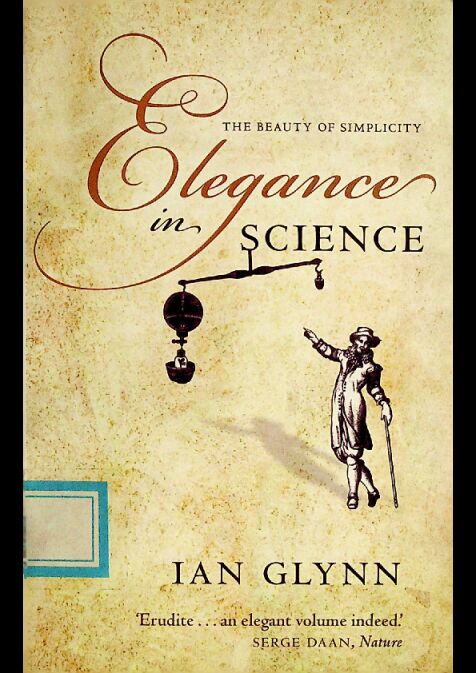
书名:Elegance in science
责任者:Ian Glynn. | Glynn, Ian.
ISBN\ISSN:9780199668816,0199668817,9780199578627
出版时间:2010
出版社:Oxford University Press,
前言
Many years ago I was asked by an undergraduate science society in Cambridge to give a talk about my own research. My colleagues and I had, as it happens, just got some very interesting experimental results, but we were not yet sure that those results, and our interpretation of them, were valid. To talk about work that might later prove to be wrong would be rash. On the other hand, to talk about our older experiments while we were preoccupied with thinking about our more recent ones did not seem very inviting. In this situation, I suggested that I talk about a subject that had fascinated me since my schooldays: the nature and attractiveness of elegance in science. Mathematicians, especially pure mathematicians, are, of course, well known to get excited about elegance. But though scientists talk less about it, elegant theories and elegant experiments do give great pleasure in a wide variety of scientific fields - and not only to the originators. Anyway, my suggestion was accepted, the talk was given, and I wondered at that time whether it could usefully give birth to a book.
Although more than twenty years have passed since then, it is only in the last few years that I have had time to think seriously about the book. There are two obvious difficulties. Firstly, to appreciate the elegance of a theory or an experiment, the reader needs to be aware of the state of play in the relevant field at the time that that theory or experiment was created; and elegant theories and experiments have been around for a very long time. Inevitably, then, each topic has to be seen against its historical background. Fortunately, the fascinating character of so many of the scientists involved will, I hope, make the necessary historical digressions something of a bonus.
Secondly, because elegance is found in all branches of science, from the most mathematical to clinical neurology, the state of play needs to be presented in a way that is intelligible to readers unfamiliar with the particular field. In most of the book I have, therefore, excluded topics that are too sophisticated or too mathematical; and where they are not excluded I have either made their character clear in the text or relegated discussion to an appendix. Many elegant theories and experiments are, of course, famous, but in choosing topics I have tried to show that such theories and experiments can also be found in areas where the adjective elegant is not often used. And because the book is not a catalogue, and I want it to be fairly short, it is likely that many readers will find favourite examples not mentioned.
I have been greatly helped in writing the book by my colleagues, my friends, and my family. Graeme Mitchison, mathematician, neuroscientist, molecular biologist, and physicist, gave helpful advice and criticism, whatever the topic. For advice on mathematics and the physical sciences, I am grateful to Béla Bollobas, Anson Cheung, Martin Cowley, John Davidson, Marie Farge, Tim Gowers, Hugh Hunt, David Khmelnitskii, Peter Littlewood, Piero Migliorato, Chris Morley, Hugh Osborn, Malcolm Perry, Martin Rees, Gordon Squires, and Peter Swinnerton-Dyer. For advice on the biological sciences and medicine, I am grateful to Horace Barlow, Michael Berridge, Andrew Crawford, Doug Fearon, Andrew Huxley, Aaron Klug, Sachiko Kusukawa, John Mollon, Michael Neuberger, and Nigel Unwin. Different members of my family, spread over three generations, have been able to provide expert criticism of my treatment of some topics, and have helped me to assess the response of 'the intelligent layman' to my treatment of others. In particular I am grateful to my wife for her endless patience and skill in suggesting, or commenting on, possible improvements of the text. Finally I must thank my agent, Felicity Bryan, and my editor, Latha Menon together with her colleagues at the Oxford University Press, for their encouragement, advice, and understanding during the successive stages of the book's production.
查看更多
目录
Illustrations vii
Preface xv
1. The meaning of elegance 1
2. Celestial mechanics: the route to Newton 18
3. Bringing the heavens down to earth 37
4. So what is heat? 61
5. Elegance and electricity 87
6. Throwing light on light: with the story of Thomas Young 106
7. How do nerves work? 140
8. Information handling in the brain 170
9. The genetic code 196
10. Epilogue: a cautionary tale 232
Appendix to Chapter4 235
Notes 245
Index 263
查看更多
馆藏单位
中科院文献情报中心