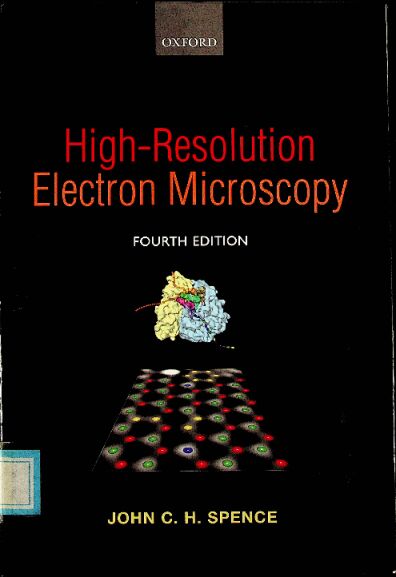
书名:High-resolution electron microscopy
ISBN\ISSN:9780199668632,0199668639
出版时间:2013
出版社:Oxford University Press,
分类号:无线电电子学、电信技术
版次:4th ed.
摘要
This new fourth edition of the standard text on atomic-resolution transmission electron microscopy (TEM) retains previous material on the fundamentals of electron optics and aberration correction, linear imaging theory (including wave aberrations to fifth order) with partial coherence, and multiple-scattering theory. Also preserved are updated earlier sections on practical methods, with detailed step-by-step accounts of the procedures needed to obtain the highest quality images of atoms and molecules using a modern TEM or STEM electron microscope. Applications sections have been updated - these include the semiconductor industry, superconductor research, solid state chemistry and nanoscience, and metallurgy, mineralogy, condensed matter physics, materials science and material on cryo-electron microscopy for structural biology. New or expanded sections have been added on electron holography, aberration correction, field-emission guns, imaging filters, super-resolution methods, Ptychography, Ronchigrams, tomography, image quantification and simulation, radiation damage, the measurement of electron-optical parameters, and detectors (CCD cameras, Image plates and direct-injection solid state detectors). The theory of Scanning transmission electron microscopy (STEM) and Z-contrast are treated comprehensively. Chapters are devoted to associated techniques, such as energy-loss spectroscopy, Alchemi, nanodiffraction, environmental TEM, twisty beams for magnetic imaging, and cathodoluminescence. Sources of software for image interpretation and electron-optical design are given.
查看更多
目录
Symbols and abbreviations xvii
1 Preliminaries 1
1.1 Elementary principles of phase-contrast TEM imaging 2
1.2 Instrumental requirements for high resolution 8
1.3 First experiments 10
References 11
2 Electron optics 13
2.1 The electron wavelength and relativity 13
2.2 Simple lens properties 16
2.3 The parax.ial ray equation 22
2.4 The constant- field approximation 24
2.5 Projector lenses 26
2.6 The objective lens 28
2.7 Practical lens design 29
2.8 Aberrations 31
2.9 The pre-field 37
2.10 Aberration correction 38
References 43
Bibliography 45
3 Wave optics 46
3.1 Propagation and Fresnel diffraction 47
3.2 Lens action and the diffraction limit 50
3.3 Wave and ray aberrations (to fifth order) 55
3.4 Strong-phase and weak-phase objects 61
3.5 Diffractograms for aberration analysis 63
References 65
Bibliography 66
4 Coherence and Fourier optics 67
4.1 Independent electrons and computed images 69
4.2 Coherent and incoherent images and the damping envelopes 70
4.3 The characterization of coherence 76
4.4 Spatial coherence using hollow-cone illumination 79
4.5 The effect of source size on coherence 81
4.6 Coherence requirements in practice 83
References 86
Bibliography 87
5 TEM imaging of thin crystals and their defects 88
5.1 The effect of lens aberrations on simple lattice fringes 89
5.2 The effect of beam divergence on depth of field 93
5.3 Approximations for the diffracted amplitudes 96
5.4 Images of crystals with variable spacing-spinodal decomposition and modulated structures 102
5.5 Are the atom images black or white? A simple symmetry argument 104
5.6 The multislice method and the polynomi al solution 106
5.7 Bloch wave methods, bound states, and 'symmetry reduction of the dispersion matrix 107
5.8 Partial coherence effects in dynamical computations-beyond the product representation Fourier images 113
5.9 Absorption effects 115
5.10 Dynamical forbidden reflections 117
5.11 Relationship between algorithms. Supercells, patching 122
5.12 Sign conventions 125
5.13 Image simulation , quantification, and the Stobbs factor 126
5.14 Image interpretation in germanium一 a case study 129
5.15 Images of defects and nanostructures 134
5.16 Tomography at atomic resolution一 imaging in three dimensions 143
5.17 Imaging bonds between atoms 145
References 146
6 Imaging molecules: radiation damage 154
6.1 Phase and amplitude contrast 154
6.2 Single atoms in bright field 157
6.3 The use of a higher accelerating voltage 165
6.4 Contrast and atomic number 169
6.5 Dark-field methods 171
6.6 Inelastic scattering 174
6.7 Noise, information , and the Rose equation 177
6.8 Single-particle cryo-electron microscopy: tomography 180
6.9 Electron crystallography of two-dimensional crystals 188
6.10 Organic crystals 190
6.11 Radiation damage: organics and low-voltage EM 192
6.12 Radiation damage: inorganics 195
References 197
7 Image processing, super-resolution, and di岛active imaging 204
7.1 Through-focus series, coherent detection, optimization, and error metrics 204
7.2 Tilt series, aperture synthesis 210
7.3 Off-axis electron holography 211
7.4 Imaging with aberration correction: STEM and TEM 212
7.5 Combining diffraction and image data for crystals 215
7.6 Ptychography, Rρnchigrams , shadow images, in-line holography, and diffractive imaging 219
7.7 Direct inversion from dynamical di仔raction patterns 226
References 226
8 Scanning transmission electron microscopy and Z-contrast Contents 233
8.1 Imaging modes, reciprocity, and Bragg scattering 233
8.2 Coherence functions in STEM 240
8.3 Dark-field STEM: incoherent imaging, and resolution limits 243
8.4 Multiple elastic scattering in STEM: channelling 249
8.5 Z-contrast in STEM: thermal diffuse scattering 251
8.6 Tlu-ee-dimensional STEM tomography 257
References 260
9 Electron sources and detectors 264
9.1 The illumination system 265
9.2 Brightness measurement 268
9.3 Biasing and high-voltage stability for thermal sources 270
9.4 Hafr-pin tungsten filaments 274
9.5 Lanthanum hexaboride sources 274
9.6 Field-emission sources 275
9.7 The charged-coupled device detector 276
9.8 Image plates 281
9.9 Film 282
9.10 Direct detection cameras 283
References 286
10 Measurement of electron-optical parameters 289
10.1 Objective-lens focus increments 289
10.2 Spherical aberration constant 291
10.3 Magnification calibration 293
10.4 Chromatic aberration constant 295
10.5 Astigmatic difference: three-fold astigmatism 295
10.6 Diffractogram measurements 296
10.7 Lateral coherence width 299
10.8 Electron wavelength and camera length 302
10.9 Resolution 303
10.10Ronchigram analysis for aberration correction 306
References 312
11 Instabilities and the microscope environment 315
11.1 Magnetic fields 315
11.2 High-voltage instability 31
11.3 Vibration 319
11.4 Specimen movement 319
11.5 Contamination and the vacuum system 321
11.6 Pressure, temperature, and draughts 323
References 323
12 Experimental methods 324
12.1 Astigmatism correction 325
12.2 τaking the picture 326
12.3 Recording atomic-resolution images-an example 328
12.4 Adjusting the crystal orientation using non-eucentric Specimen holders 335
12.5 Focusing techniques and autφtuning 337
12.6 Substrates, sample supports, and graphene 340
12.7 Film analysis and handling for cryo-EM 343
12.8 Ancillary instrumentation for HREM 344
12.9 A checklist for high-resolution work 345
References 346
13 Associated techniques 34
13.1 X-ray microanalysis and ALCHEMI 348
13.2 Electron energy loss spectroscopy in STEM 357
13.3 Microdiffraction, CBED, and precession methods 363
13.4 Cathodoluminescence in STEM 372
13.5 Environmental HREM, imaging surfaces, holography of fields, and magnetic imaging with twisty beams 376
Reference 380
Appendices 3
Index 403
查看更多
作者简介
John C. H. Spence is Regents' Professor of Physics at Arizona State University with a joint appointment at Lawrence Berkeley Laboratory. He completed a PhD in Physics at Melbourne University in Australia, followed by postdoctoral work in Materials Science at Oxford University, UK. He is a Fellow of the American Physical Society, of the Institute of Physics, of the American Association for the Advancement of Science, and of Churchill College Cambridge, UK. He is a recent co-editor of Acta Crystallographica and served on the editorial board of Reports on Progress in Physics. He has served on the Scientific Advisory Committee of the Molecular Foundry and the Advanced Light Source at the Lawrence Berkeley Laboratory and the DOE's BESAC committee. He has been awarded the Burton Medal and the Distinguished Scientist Award of the Microscopy Society of America, and the Buerger Medal of the American Crystallographic Association.
查看更多
馆藏单位
中科院文献情报中心