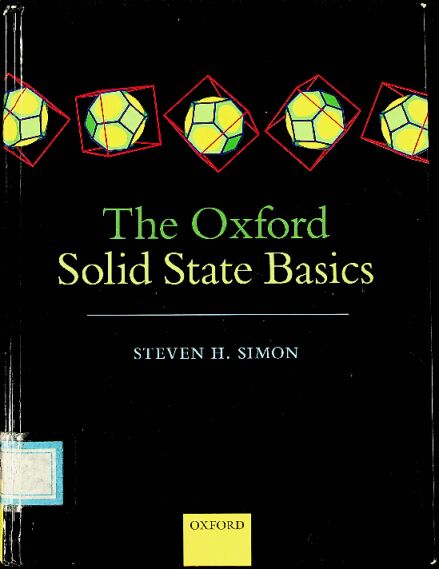
书名:The Oxford solid state basics
ISBN\ISSN:9780199680764,9780199680771
出版时间:2013
出版社:Oxford University Press,
摘要
The study of solids is one of the richest, most exciting, and most successful branches of physics. While the subject of solid state physics is often viewed as dry and tedious this new book presents the topic instead as an exciting exposition of fundamental principles and great intellectual breakthroughs. Beginning with a discussion of how the study of heat capacity of solids ushered in the quantum revolution, the author presents the key ideas of the field while emphasizing the deep underlying concepts.
查看更多
目录
1 About Condensed Mattei·Physics 1
1.1 What Is Condensed Matter Physics 1
1.2 Why Do We Study Condensed Matter Physics? 1
1.3 Why Solid State Physics? 3
I Physics of Solids wi thou t Considering Micro- scopic Structure: The Early Days of Solid State 5
2 Specific Heat of Solids: Boltzmann, Einstein, and Debye 7
2.1 Einstein's Calculation
2.2 Debye's Calculation 9
2.2.1 Periodic (Born-vo n Karman) Bow1dary Conditions 10
2.2.2 Debye's Calculation Followi ng Planck 11
2.2.3 Debye's “Interpolation” 13
2.2.4 Some Shortcom ings of the Debye Theory 14
2.3 Appendix to th.is Chapter: ((4) 16
Exercises 17
3 Electrons in Metals: Drude Theory 19
3.1 Electrons in Fields 20
3.1.1 Electrons in an Electric Field 20
3.1.2 Electrons in Electric and Magnetic Fields 21
3.2 Thermal 'I'ransport 22
Exercises 25
4 More Electrons in Metals: Sommerfeld (Free Electron) Theory 27
4.1 Basic Fermi- Dirac Statistics 27
4.2 Electronic Heat Capacity 29
4.3 Magnetic Spin Susceptibility (Pauli Paramagnetism) 32
4.4 Why Drude Theory Works So Well 34
4.5 Shortcomi ngs of the Free Electron Model 35
Exercises 37
II Structure of Materials 39
5 The Periodic Table 41
5.1 Chcmist,ry, Atoms, and the Schroed i nger Equation 41
5.2 Structure of the Periodic Table 42
5.3 Periodic Tend 43
5.3.1 Effective Nuclear Charge 45
Exercises 46
6 What Holds Solids Together: Chemical Bonding 49
6.1 Ionic Bonds 49
6.2 Covalent Bond 52
6.2.1 Particle i n a Box Pictu re 52
6.2.2 Molecu lar Orbital or Tight Binding Theory 53
6.3 Van der \Naals, Fluctuating Dipole Forces, or Molecular Bonding 57
6.4 Metallic Bond i ng 59
6.5 Hydrogen Bonds 59
Exercises 61
7 Types of Matter 65
III Toy Models of Solids in One Dimension 69
8 One-Dimensional Model of Compressibility, Sound, and Thermal Expansion 71
Exercises 74
9 Vibrations of a One-Dimensional Monatomic Chain 77
9.1 First Exposure to the Reciprocal Lattice 79
9.2 Properties of the Dispersion of the One-Dimensional Chain 80
9.3 Quantum Jvlodes: Phonons 82
9.4 Crystal Momentum 84
Exercises 86
10 Vibrations of a One-Dimensional Diatomic Chain 89
10.1 Diatomic Crystal Structure: Some Useful Definitions 89
10.2 Norm al Nifodes of the Diatomic Solid 90
Exercises 96
11 Tight Binding Chain (Interlude and Preview) 99
11.1 Tight Binding Model in One Dimension 99
11.2 Solution of the Tight Binding Chain 101
11.3 Introduction to Electrons Filling Bands 104
11.4 Multiple Bands 105
Exercises 107
IV Geometry of Solids 111
12 Crystal Structure 113
12.1 Lattices and Unit Cells 113
12.2 Lattices in Th ree Dimensions 117
12.2.1 The Body-Centered Cubic (bee) Lattice 118
12.2.2 The Face-Centered Cubic (fee) Lattice 120
12.2.3 Sphere Packi ng 121
12.2.4 OLher Lattices in Three Dimensions 122
12.2.5 Some Real Crystals 123
Exercises 125
13 Reciprocal Lattice, Brilloui n Zone, Waves in Crystals 127
13.1 The Reciprocal Lattice in Three Dimensions 127
13.1.1 Review of One Dimension 127
13.1.2 R eci procal LaUice Definition 128
13.1.3 The Reci procal LaUice as a Fou rier Transform 129
13.1.4 n eci procal Lattice Points as Families of Lattice Planes 130
13.1.5 LaUice Planes and Mi ller Indices 132
13.2 Bri llouin Zones 134
13.2.1 R eview of One-Di mensional Dispersions and Bril louin Zones 134
13.2.2 General Bri llouin Zone Construction 134
13.3 Electron ic and Vi brational Waves in Crystals in Three Dimensions 136
Exercises 137
V Neutron and X-Ray Diffraction 139
14 Wave Scattering by Crystals 141
14.1 The Laue and Bragg Cond i tions 141
14.1.1 Fermi 's Golden Rule Approach 141
14.1.2 Diffraction Approach 142
14.1.3 Equivalence of Laue and Bragg conditions 143
14.2 Scattering Amplitudes 144
14.2.1 Simple Exam ple 146
14.2.2 Systematic Absences and Ntlore Example 147
14.2.3 Geometric Interpretation of Selection Rules 149
14.3 Methods of Scattering Experi ments 150
14.3.1 Advanced Methods 150
14.3.2 Powd er Diffraction 151
14.4 Still More Abou t Scatteri ng 156
14.4.1 Scattering in Liquids and Amorph ous Solids 156
14.4.2 Variant: Inelastic Scattering 156
14.4.3 Exper imental Apparatus 157
Exercise 159
VI Electrons in Solids 161
15 Electrons in a Period ic Potential 163
15.1 Nearly Free Electron Model 163
15.1.1 Degenerate Pertu rbation Theory 165
15.2 Bloch's Theorem 169
Exercises 171
16 Insulator, Semiconductor, or Metal 173
16.1 Energy Bands i n One Dimension 173
16.2 Energy Ba11ds in Two and Three Dimensions 175
16.3 Tight Binding 177
16.4 Failu res of the Band-Structure Picture of Metals and Insulators 177
16.5 Band Structure and Optical Properties 179
16.5.1 Optical Properties of Insulators and Semicond uctors 179
16.5.2 Direct and Indirect Transitions 179
16.5.3 Optical Properties of Nietals 180
16.5.4 Optical Effects of Impurities 181
Exercises 182
17 Semiconductor Physics 183
17.1 Electrons and Hole: 183
17.1.1 Drude Transport: Redux 186
17.2 Addi ng Electrons or Holes with Impurities: Doping 187
17.2.1 Lnpw-ity States 188
17.3 Statistical Mechanics of Semicond uctors 191
Exercises 195
18 Semiconductor Devices 197
18.1 Band Structure Engineering 197
18.1.1 Designing Band Gaps 197
18.1.2 Non-Homogeneous Band Gaps 198
18.2 p-π Junction 199
18.3 The Transistor 203
Exercises 205
VII Magnet ism and Mean Field Theories 207
19 Magnetic Properties of Atoms: Para- and Dia-Magnetism 209
19.1 Basic Definitions of Types of 1/fagnetisrn 209
19.2 Atomic Physics: Hund 's Rules 211
19.2.1 Why Moments Align 212
19.3 Coupling of Electrons i n Atoms to an External Field 214
19.4 Free Spin (Curie or Langevin) Paramagnetism 215
19.5 Larrnor Diamagnetism 217
19.6 Atoms in Solids 218
19.6.1 Pauli Paramagnetism in Mctals219
19.6.2 Diamagnetismin Solid 219
19.6.3 Curie Paramagnetism in Solids 220
Exercises 222
20 Spontaneous Magnetic Order: Ferro-, Antiferro- , and Ferri-Magnetism 225
20.1 (Spontaneous) Magnetic Order 226
20.1.1 Ferromagnets 226
20.1.2 Antifcrromagnets 226
20.1.3 Ferri magnets 227
20.2 Breaking Symmetry 228
20.2.1 Ising Model 228
Exercises 229
21 Domains and Hysteresis 233
21.1 Macroscopic Effects in Ferromagnets: Domains 233
21.1.1 Domain Wall Structu re and the Bloch/ Neel Wall 234
21.2 Hyst.eresis in Fcrromagn ets 236
21.2.1 Disorder Pinning 236
21.2.2 Single-Domain CrysLallites 236
21.2.3 Domai n Pin ning and Hyster℃sis 23
Exercises 240
22 Mean Field Theory 243
22.1 Mean Field Equations for the Ferrom agnetic Ising 243
22.2 Solu tion of Self-Consistency Equation 245
22.2.1 Paramagnetic Susceptibility 246
22.2.2 Further Thoughts 247
Exercises 248
23 Magnetism from Interactions: The Hubbard Model 251
23.1 Itinerant Ferrom agnetism 252
23.1.1 Hu bbard Ferromagnetism Mean Field Theory 252
23.1.2 Stoner Criterion 253
23.2 Mott Antiferrom agnetism 255
23.3 Appendix: Hu bbard Model for the Hydrogen Molecule 257
Exercises 259
A Sample Exam and Solutions 261
B List of Other Good Books 275
Indices 279
Index of People 280
Index of Topics 283
查看更多
作者简介
Steven H. Simon, Professor of Theoretical Condensed Matter Physics, Department of Physics, University of Oxford, and Fellow of Somerville College, Oxford.PA\Professor Steven Simon earned a BSc degree from Brown in Physics & Mathematics in 1989 and a PhD in Theoretical Physics from Harvard in 1995. Following a two-year post-doc at MIT, he joined Bell Labs, where he was a director of research for nine years. He is currently Professor of Theoretical Condensed Matter Physics in the Department of Physics at the University of Oxford, and a Fellow of Somerville College, Oxford. His research is in the area of condensed matter physics and communication, including subjects ranging from microwave propagation to high temperature superconductivity. He is interested in quantum effects and how they are manifested in phases of matter. He has recently been studying phases of matter known as "topological phases" that are invariant under smooth deformations of space-time. He is also interested in whether such phases of matter can be used for quantum information processing and quantum computation.
查看更多
馆藏单位
中科院文献情报中心