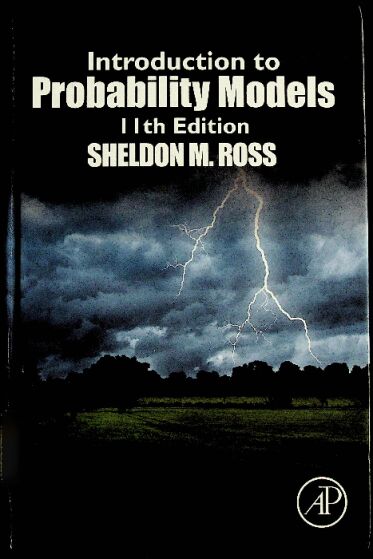
书名:Introduction to probability models
ISBN\ISSN:9780124079489,0124079482
出版时间:2014
出版社:Academic Press is an imprint of Elsevier,
摘要
Introduction to Probability Models, Eleventh Edition is the latest version of Sheldon Ross's classic bestseller, used extensively by professionals and as the primary text for a first undergraduate course in applied probability. The book introduces the reader to elementary probability theory and stochastic processes, and shows how probability theory can be applied fields such as engineering, computer science, management science, the physical and social sciences, and operations research.
The hallmark features of this text have been retained in this eleventh edition: superior writing style; excellent exercises and examples covering the wide breadth of coverage of probability topic; and real-world applications in engineering, science, business and economics. The 65% new chapter material includes coverage of finite capacity queues, insurance risk models, and Markov chains, as well as updated data. The book contains compulsory material for new Exam 3 of the Society of Actuaries including several sections in the new exams. It also presents new applications of probability models in biology and new material on Point Processes, including the Hawkes process. There is a list of commonly used notations and equations, along with an instructor's solutions manual.
This text will be a helpful resource for professionals and students in actuarial science, engineering, operations research, and other fields in applied probability.
查看更多
目录
Preface xi
Introduction to Probability Theory 1
1.1 Introduction 1
1.2 Sample Space and Events 1
1.3 Probabilities Defined on Events 4
1.4 Conditional Probabilities 6
1.5 Independent Events 9
1.6 Bayes'Formula 11
Exercises 14
References 19
2.Random Variables 21
2.1 Random Variables 21
2.2 Discrete Random Variables 25
2.3.1The Bernoulli Random Variable 26
2.3.2The Binomial Random Variable 26
2.3.3The Geometric Random Variable28
2.3.4The Poisson Random Variable 29
2.3 Continuous Random Variables30
2.3.1The Uniform Random Variable 31
2.3.2Expectation of a Random Variable 32
2.3.3Gamma Random Variables 33
2.3.4Normal Random Variables 33
2.4 Expectation of a Random Variable 34
2.4.1The Discrete Case 34
2.4.2The Continuous Case 37
2.4.3Expectation of a Function of a Random Variable 38
2.5 Jointly Distributed Random Variables 42
2.5.1Joint Distribution Functions 42
2.5.2Independent Random Variables 45
2.5.3Covariance and Variance of Sums of Random Variables 46
2.5.4Joint Probability Distribution of Functions of Random Variables 55
2.6 Moment Generating Functions 58
2.6.1The Joint Distribution of the Sample Mean and
Sample Variance from a Normal Population 66
2.7 The Distribution of the Number of Events that Occur 69
2.8 Limit Theorems 71
2.9 Stochastic Processes 77
Exercises79
References 91
3.Conditional Probability and Conditional Expectation 93
3.1 Introduction 93
3.2 The Discrete Case 93
3.3 The Continuous Case 97
3.4 Computing Expectations by Conditioning100
3.4.1Computing Variances by Conditioning 111
3.5 Computing Probabilities by Conditioning 115
3.6 Some Applications 133
3.6.1A List Model 133
3.6.2A Random Graph 135
3.6.3Uniform Priors,Polya'sUrn Model,and Bose Einstein Statistics 141
3.6.4MeanTime for Patterns 146
3.6.5The k-Record Values of Discrete Random Variables 149
3.6.6Left Skip Free RandomWalks 152
3.7 An Identity for Compound Random Variables 157
3.7.1Poisson Compounding Distribution 160
3.7.2Binomial Compounding Distribution 161
3.7.3A Compounding Distribution Related to the Negative Binomial 162
Exercises 163
4.Markov Chains 183
4.1 Introduction183
4.2 Chapman–Kolmogorov Equations 187
4.3 Classification of States 194
4.4 Long-Run Proportions and Limiting Probabilities 204
4.4.1Limiting Probabilities 219
4.5Some Applications 220
4.5.1The Gambler's Ruin Problem220
4.5.2A Model for Algorithmic Efficiency 223
4.5.3Using a Random Walk to Analyze a Probabilistic Algorithm for the Satisfiability Problem 226
4.6 Mean Time Spent in Transient States 231
4.7 Branching Processes 234
4.8 Time Reversible Markov Chains 237
4.9 Markov Chain Monte Carlo Methods 247
4.10 Markov Decision Processes 251
4.11 Hidden Markov Chains 254
4.11.1 Predicting the States 259
Exercises 261
References 275
5.The Exponential Distribution and the Poisson Process 277
5.1 Introduction 277
5.2 The Exponential Distribution 278
5.2.1Definition 278
5.2.2Properties of the Exponential Distribution 280
5.2.3Further Properties of the Exponential Distribution 287
5.2.4Convolutions of Exponential Random Variables 293
5.3 The Poisson Process 297
5.3.1Counting Processes297
5.3.2Definition of the Poisson Process 298
5.3.3Interarrival and Waiting Time Distributions 301
5.3.4Further Properties of Poisson Processes 303
5.3.5Conditional Distribution of the Arrival Times 309
5.3.6Estimating Software Reliability 320
5.4 Generalizations of the Poisson Process 322
5.4.1Nonhomogeneous Poisson Process 322
5.4.2Compound Poisson Process 327
5.4.3Conditional or Mixed Poisson Processes 332
5.5 Random Intensity Functions and Hawkes Processes 334
Exercises 338
References 356
6.Continuous-Time Markov Chains 357
6.1 Introduction 357
6.2 Continuous-Time Markov Chains 358
6.3 Birth and Death Processes 359
6.4 The Transition Probability Function Pij(t) 366
6.5 Limiting Probabilities 374
6.6 Time Reversibility 380
6.7 The Reversed Chain 387
6.8 Uniformization 393
6.9 Computing the Transition Probabilities 396
Exercises 398
References 407
7 Renewal Theory and Its Applications 409
7.1 Introduction 409
7.2 Distribution of N(t) 411
7.3 Limit Theorems and Their Applications 415
7.4 Renewal Reward Processes 427
7.5 Regenerative Processes 436
7.5.1Alternating Renewal Processes 439
7.6 Semi-Markov Processes 444
7.7 The Inspection Paradox 447
7.8 Computing the Renewal Function 449
7.9 Applications to Patterns 452
7.9.1Patterns of Discrete Random Variables 453
7.9.2The Expected Time to a Maximal Run of Distinct Values 459
7.9.3Increasing Runs of Continuous Random Variables 461
7.10 The Insurance Ruin Problem 462
Exercises 468
References 479
8 Queueing Theory 481
8.1 Introduction 481
8.2 Preliminaries 482
8.2.1Cost Equations 482
8.2.2Steady-State Probabilities 484
8.3 Exponential Models 486
8.3.1A Single-Server Exponential Queueing System 486
8.3.2A Single-Server Exponential Queueing System Having Finite Capacity 495
8.3.3Birth and Death Queueing Models 499
8.3.4A ShoeShine Shop 505
8.3.5A Queueing System with Bulk Service 507
8.4 Network of Queues 510
8.4.1Open Systems 510
8.4.2Closed Systems 514
8.5 The System M/G/1 520
8.5.1Preliminaries:Work and Another Cost Identity 520
8.5.2Application of Work to M/G/ 1 520
8.5.3Busy Periods 522
8.6 Variations on the M/G/1 523
8.6.1The M/G/ 1 with Random-Sized Batch Arrivals 523
8.6.2Priority Queues 524
8.6.3An M/G/ 1 Optimization Example 527
8.6.4TheM/G/1Queue with Server Breakdown 531
8.7 The Model G/M/1 534
9.2.1The G/M/1BusyandIdle Periods 538
8.8 A Finite Source Mode l538
8.9 Multiserver Queues 542
8.9.1Erlang'sLoss System 542
8.9.2The M/M/kQueue 544
8.9.3The G/M/kQueue 544
8.9.4The M/G/kQueue 546
Exercises 547
References 558
9 Reliability Theory 559
9.1 Introduction 559
9.2 Structure Functions 560
Minimal Path and Minimal Cut Sets 562
9.3 Reliability of Systems of Independent Components 565
9.4 Bounds on the Reliability Function 570
9.4.1Method of Inclusion and Exclusion 570
9.4.2Second Method for Obtaining Bounds on r(p) 578
9.5 System Life as a Function of Component Lives 580
9.6 Expected System Lifetime 587
An UpperBound on the Expected Life of a Parallel System 591
9.7 Systems with Repair 593
9.7.1A Series Model with Suspended Animation 597
Exercises 599
References 606
10 Brownian Motion and Stationary Processes 607
10.1 Brownian Motion 607
10.2 Hitting Times, Maximum Variable, and the Gambler’s Ruin Problem 611
10.3 Variations on Brownian Motion 612
10.3.1 Brownian Motion with Drift 612
10.3.2 Geometric Brownian Motion 612
10.4 Pricing Stock Options 614
10.4.1An Example in Options Pricing 614
10.4.2 The Arbitrage Theorem 616
10.4.3 The Black-Scholes Option Pricing Formula 619
10.5 The Maximum of Brownian Motion with Drift 624
10.6 White Noise 628
10.7 Gaussian Processes 630
10.8 Stationary and Weakly Stationary Processes 633
10.9 Harmonic Analysis of Weakly Stationary Processes 637
Exercises 639
References 644
11Simulation 645
11.1 Introduction 645
11.2 General Techniques for Simulating Continuous Random Variables 649
11.2.1 The Inverse Transformation Method 649
11.2.2 The Rejection Method 650
11.2.3 The Hazard Rate Method 654
11.3 Special Techniques for Simulating Continuous Random Variables 657
11.3.1 The Normal Distribution 657
11.3.2 The Gamma Distribution 660
11.3.3TheChi-Squared Distribution 660
11.3.4 The Beta(n,m) Distribution 661
11.3.5 The Exponential Distribution—The Von Neumann Algorithm 662
11.4 Simulating from Discrete Distributions 664
11.4.1 The Alias Method 667
11.5 Stochastic Processes 671
11.5.1 Simulating a Nonhomogeneous Poisson Process 672
11.5.2 Simulating a Two-Dimensional Poisson Process 677
11.6 Variance Reduction Techniques 680
11.6.1Use of Antithetic Variables 681
11.6.2 Variance Reduction by Conditioning 684
11.6.3 Control Variates 688
11.6.4 Importance Sampling 690
11.7 Determining the Number of Runs 694
11.8 Generating from the Stationary Distribution of a Markov Chain695
11.8.1Coupling from the Past 695
11.8.2 Another Approach 697
Exercises 698
References 705
Appendix:Solutions to Starred Exercises 707
Index 759
查看PDF
查看更多
馆藏单位
中科院文献情报中心