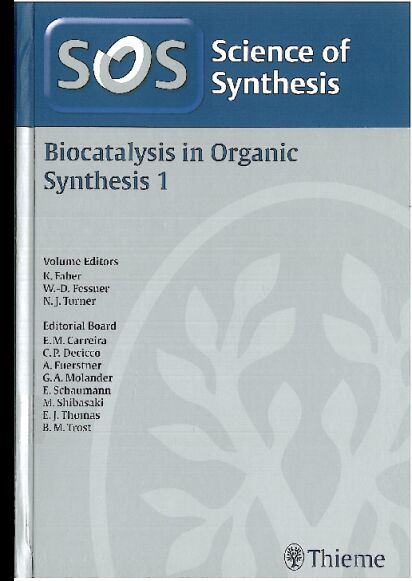
书名:Biocatalysis in organic synthesis 1
责任者:K. Faber, W.-D. Fessner, N.J. Turner | Fessner, W. D. | Faber, K. | Turner, N. J.
出版时间:2015
出版社:Thieme Chemistry
摘要
This chapter describes the evolution of modern biocatalysis, focusing on the application of both whole-cell biocatalysts and isolated enzymes in organic synthesis Milestones in this process are the application to β-lactam and amino acid chemistry, the preparation of chiral synthons as single enantiomers for the synthesis of pharmaceutical intermediates, the modification of carbohydrates and the synthesis of value-added products from lipids The application of hydrolytic enzymes (lipases, proteases, esterases, and nitrile hy-dratases) has evolved in time toward more complex enzymatic systems such as oxido-reductases involving cofactor recycling or aminotransferases (transaminases) leading to the formation of chiral amines The recently developed techniques of molecular biology and directed evolution toward the preparation of better enzymatic catalysts are dramatically improving the availability and efficiency of the enzymes and thus significantly increasing the role of biocatalysis in organic synthesis.
查看更多
前言
As the pace and breadth of research intensifies, organic synthesis is playing an increasingly central role in the discovery process within all imaginable areas of science: from pharmaceuticals, agrochemicals, and materials science to areas of biology and physics, the most impactful investigations are becoming more and more molecular As an enabling science, synthetic organic chemistry is uniquely poised to provide access to compounds with exciting and valuable new properties Organic molecules of extreme complexity can, given expert knowledge, be prepared with exquisite efficiency and selectivity, allowing virtually any phenomenon to be probed at levels never before imagined With ready access to materials of remarkable structural diversity, critical studies can be conducted that reveal the intimate workings of chemical, biological, or physical processes with stunning detail.
The sheer variety of chemical structural space required for these investigations and the design elements necessaiy to assemble molecular targets of increasing intricacy place extraordinary demands on the individual synthetic methods used They must be robust and provide reliably high yields on both small and large scales, have broad applicability, and exhibit high selectivity Increasingly, synthetic approaches to organic molecules must take into account environmental sustainability Thus, atom economy and the overall environmental impact of the transformations are taking on increased importance.
The need to provide a dependable source of information on evaluated synthetic methods in organic chemistry embracing these characteristics was first acknowledged over 100 years ago, when the highly regarded reference source Houben-Weyl Methoden der Organischen Chemie was first introduced Recognizing the necessity to provide a modernized, comprehensive, and critical assessment of synthetic organic chemistry, in 2000 Thieme launched Science of Synthesis, Houben-Weyl Methods of Molecular Transformations This effort, assembled by almost 1000 leading experts from both industry and academia, provides a balanced and critical analysis of the entire literature from the early 1800s until the year of publication The accompanying online version of Science of Synthesis provides text, structure, substructure, and reaction searching capabilities by a powerful, yet easy-to-use, intuitive interface.
From 2010 onward, Science of Synthesis is being updated quarterly with high-quality content via Science of Synthesis Knowledge Updates The goal of the Science of Synthesis Knowledge Updates is to provide a continuous review of the field of synthetic organic chemistry, with an eye toward evaluating and analyzing significant new developments in synthetic methods A list of stringent criteria for inclusion of each synthetic transformation ensures that only the best and most reliable synthetic methods are incorporated These efforts guarantee that Science of Synthesis will continue to be the most up-to-date electronic database available for the documentation of validated synthetic methods.
Also from 2010, Science of Synthesis includes the Science of Synthesis Reference Library, comprising volumes covering special topics of organic chemistry in a modular fashion, with six main classifications: (1) Classical, (2) Advances, (3) Transformations, (4) Applications, (5) Structures, and (6) Techniques Titles will include Stereoselective Synthesis, Water in Organic Synthesis, and Asymmetric Organocatalysis, among others With expert-evaluated content focusing on subjects of particular current interest, the Science of Synthesis Reference Library complements the Science of Synthesis Knowledge Updates, to make Science of Synthesis the complete information source for the modern synthetic chemist.
The overarching goal of the Science of Synthesis Editorial Board is to make the suite of Science of Synthesis resources the first and foremost focal point for critically evaluated information on chemical transformations for those individuals involved in the design and construction of organic molecules.
Throughout the years, the chemical community has benefited tremendously from the outstanding contribution of hundreds of highly dedicated expert authors who have devoted their energies and intellectual capital to these projects We thank all of these individuals for the heroic efforts they have made throughout the entire publication process to make Science of Synthesis a reference work of the highest integrity and quality.
查看更多
目录
Preface V
Volume Editors' Preface IX
Abstracts XIII
Table of Contents XXV
1.1 Introduction 1
1.1.1 Historical Perspectives: Paving the Way for the Future
S Servi, D Tessaro, and F Hollmann 1
1.1.2 Enzyme Classification and Nomenclature and Biocatalytic Retrosynthesis
A Liese and L Pesci 41
1.1.3 Enzyme Sources and Selection of Biocatalysts
R Lauchli and D Rozzell 75
1.2 Strategies and Methods in Biocatalysis
A Diaz-Rodriguez and I Lavandera 95
1.3 Hydrolysis and Transacylation: Esterases, Lipases, Phosphatases,
and Phosphoryl Transferases 129
1.3.1 Resolution of Alcohols, Acids, and Esters by Hydrolysis
M Bertau and C E Jeromin 129
1.3.2 Resolution of Alcohols, Amines, Acids, and Esters by Nonhydrolytic Processes
M Rodnguez-Mata and V Gotor-Fernandez 189
1.3.3 Transphosphorylation
R Wever, L Babich, and A F Hartog 223
1.4 Nitrile and Amide Hydrolysis and Enzymatic Synthesis of
Amides and Peptides 255
1.4.1 Hydrolysis of Nitriles to Amides
Y Asano 255
1.4.2 Hydrolysis of Nitriles to Carboxylic Acids
L Martinkova and A B Vesela 277
1.4.3 Hydrolysis of Amides
M Hall, K Faber, and G Tasnadi 303
1.4.4 Enzymatic Synthesis of Amides
J W Schmidberger, L J Hepworth, A P Green, and S L Flitsch 329
1.4.5 Hydrolysis of Hydantoins, Dihydropyrimidines, and Related Compounds
C Slomka, U Engel, C Syldatk, and J Rudat 373
1.5 Isomerizations: Racemization, Epimerization, and E/Z-lsomerization
K Faber and S M Glueck 415
1.6 Glycosides 483
1.6.1 Glycosidases and Glycosynthases
B Cobucci-Ponzano and M Moracci 483
1.6.2 Glycosyltransferases
J Voglmeir and S L Flitsch 507
Keyword Index 543
Author Index 575
Abbreviations 603
查看PDF
查看更多
馆藏单位
中国化工信息中心