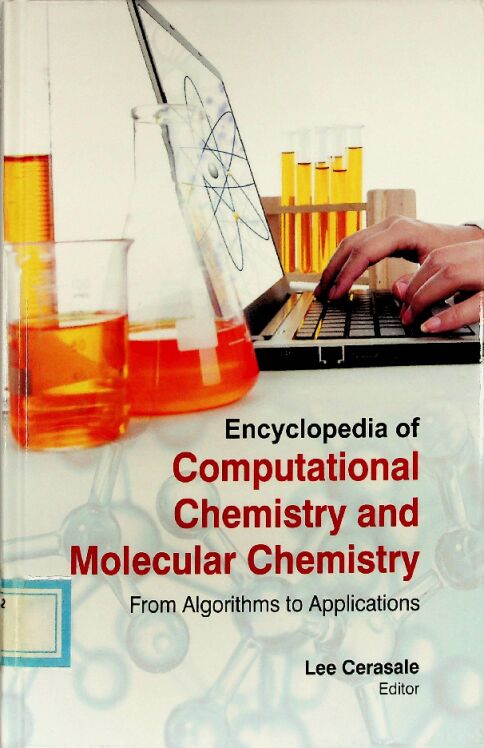
书名:Encyclopedia of computational chemistry and molecular chemistry
责任者:Lee Cerasale. | Cerasale, Lee.
ISBN\ISSN:9781781542712,1781542716
出版时间:2014
出版社:Auris Reference,
前言
Computational chemistry extends beyond the traditional boundaries separating chemistry from physics, biology, and computer science. It allows the exploration of molecules through the use of a computer in cases when an actual laboratory investigation may be inappropriate, impractical, or impossible. As an adjunct to experimental chemistry, its significance continues to be enhanced by explosive increases in computer speed and power. Computational chemistry met hods encompass a variety of mat hematical met hods which fall into two broad categories: molecular mechanics and quantum mechanics. Molecular mechanics applies the laws of classical physics to molecular nuclei without explicit consideration of electrons. Quantum mechanics relies on the Schrodinger equation to describe a molecule with explicit treatment of electronic structure. Generally, quantum mechanical methods can be subdivided into two classes: ab initio and semiempirical, making a total of three generally accepted method classes. An individual computational method may also be referred to as a “theoty”. Stable states of molecular systems correspond to global and local minima on their potential energy surface. Starting from a non-equilbrium molecular geometry, energy minimization employs the mathematical procedure of optimization to move atoms so as to reduce the net forces (the gradients of potential energy) on the atoms until they become negligible. Like molecular dynamics and Monte-Carlo approaches, periodic boundary conditions have been allowed in energy minimization met hods, to make small syst ems. A well est ablished algorithm of energy minimization can be an efficient tool for molecular structure optimization. Unlike molecular dynamics simulations, which are based on Newtonian dynamic laws and allow calculation of atomic trajectories with kinetic energy, molecular energy minimization does notinclude the effect of temperature, and hence the trajectories of atoms during the calculation do not really make any physical sense, i.e. we can only obtain a final st ate of system that corresponds to a local minimum of potential energy.
Geome try optimiza tion is a technique used for locating a st able conformation of a model. As a general rule, this should be performed before performing additional computations or analyses of a model. Locating global and local energy minima is often accomplished through energy minimization; locating a saddle point is referred to as optimizing to a transition state. The ability of a geometry optimization to converge to a minimum will depend on the starting geometry, the potential energy function used, and the settings for a minimum acceptable gradient between steps (convergence criteria). Geometry optimizations are iterative and begin at some starting geometry. First, the single point energy calculation is performed on the starting geometry. Then the coordinates for some subset of atoms are changed and another single point energy calculation is performed to determine the energy of that new conformation. The first or second derivative of the energy (depending on the method) with respect to the atomic coordinates then determines how large and in what direction the next increment of geometry change should be. Then the change is made.
This book offers a comprehensive description of the applications of various fields in this subject. The book will be appropriate as a guide for students.
查看更多
目录
Preface vii
1. Introduction Interpreting Molecular Wave Functions · Mathematical Preliminaries · Biomolecular Analysis · Vitamins · Protein Primary Structure · Ubiquitination and Sumoylation · Nucleic Acid Primary Structure · Secondary Structure · Protein Secondary Structure · Folding · Nucleic Acid Secondary Structure · Tertiary Structure · Protein Tertiary Structure · Nucleic Acid Tertiary Structure · Quaternary Structure 1
2. Molecular Dynamics/Brownian Dynamics Simulations Molecular Dynamics Algorithms · Beeman's Algorithm · Constraint Algorithms (for Constrained Systems) · Symplectic Integrator · Short-Range Interaction Algorithms · Molecular Modelling on GPU · Brownian Dynamics 70
3. Evaluating Experiment with Computation in Physical Chemistry Basics of Quantum Computation·Universal Quantum Computer · Density-Functional Theory · Molecular Dynamics of Protogated Schiff Base · Imine · Molecular Nanowires · Molecular Wire 109
4. Biomolecular Structure and Modelling Modern Analytical Ultracentrifugation in Protein Science · Ultracentrifuge · Buoyant Density Ultracentrifugation · Ab Initio Methods · Generalized Valence Bond (GVB) · Modern Valence Bond Theory (MVBT) 153
5. Cheminformatics Walsh Diagram · Tanabe-Sugano DiagramVOrgel Diagrams · Bonding in Hypervalent Molecules · Structure,Reactivity, and Kinetics · Molecular Orbital Theory · Three-Centre Four-Electron Bond 182
6. Bonding in Organic and Inorganic Systems Conjugated System·InorganicChemistry · Formulas of Inorganic and Organic Compounds · Intra-Molecular Bonding and Identification of Organicand Inorganic Macromolecules · Inorganic Macromolecules · Bonding in Electron Deficient Molecules·Isolobal Principle · The Concept of the Potential Energy Surface 219
7. Computational Strategies for Small Molecules Nanochemistry.Computational Strategies for Macromolecules · Macromolecular Docking · Molecular Geometry 268
Bibliography 285
Index 287
查看PDF
查看更多
馆藏单位
中科院文献情报中心