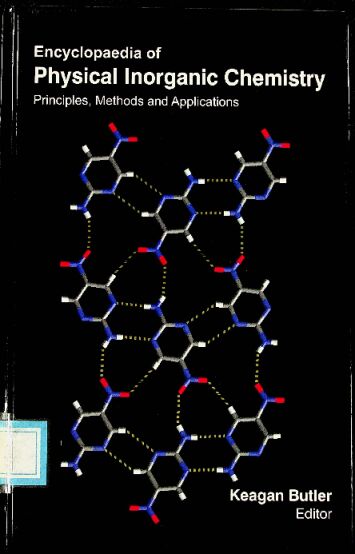
书名:Encyclopaedia of physical inorganic chemistry
出版时间:2012
出版社:Auris Reference,
前言
Many inorganic compounds are ionic compounds, consisting of cations and anions joined by ionic bonding. Examples of salts (which are ionic compounds) are magnesium chloride MgCl9 , which consists of magnesiumcations Mg2+ and chloride anions Cl-; -or sodium oxide Na20 , which consists of sodium cations Na+ and oxideanions 0 2-. In any salt, the proportions of the ions are such that the electric charges cancel out, so that the bulk compound is electrically neutral. The ions are described by their oxidation state and their ease of formation can be inferred from the ionization potential (for cations) or from the electron affinity (anions) of the parent elements. Important classes of inorganic salts are the oxides, the carbonates, the sulfates and the halides. Many inorganic compounds are characterized by high melting points. Inorganic salts typically are poor conductors in the solid state. Another important feature is their solubility in water e.g., and ease of crystallization. Where some salts (e.g. NaCl) are very soluble in water, others (e.g. Si09 ) are not. The simplest inorganic reaction is double displacement when in mixing of two salts the ions are swapped without a change in oxidation state. In redox reactions one reactant, the oxidant, lowers its oxidation state and another reactant, the reducta.nt, has its oxidation state increased.
The net result is an exchange of electrons. Electron exchange can occur indirectly as well, e .g. in batteries, a key concept in electrochemistry. When one reactant contains hydrogen atoms, a reaction can take place by exchanging protons in acid-base chemistry. In a more general definition, an acid can be any chemical species capable of binding to electron pairs is called a Lewis acid; conversely any molecule that tends to donate an electron pair is referred to as a Lewis base. As a refinement of acid-base interactions, the HSAB theory takes into account polarizability and size of ions. Inorganic compounds are found in nature as minerals. Soil may contain iron sulfide as pyrite or calcium sulfate as gypsum. Inorganic compounds are also found multitasking as biomolecules: as electrolytes (sodium chloride), in energy storage (ATP) or in construction. The first important man-made inorganic compound was ammonium nitrate for soil fertilization through the Haber process. Inorganic compounds are synthesized for use as catalysts such as vanadium 01) oxide and titanium (III) chloride, or as reagents in organic chemistry such as lithium aluminium hydride. Subdivisions of inorganic chemistry are organometallic chemistry, cluster chemistry and bioinorga nic chemistry. These fields are active areas of research in inorganic chemistry, aimed toward new catalysts, superconductors, and therapies. Inorganic chemistry is a highly practical area of science. Traditionally, the scale of a nation's economy could be evaluated by their productivity of sulfuric acid. The top 20 inorganic chemicals manufactured in Canada, China, Europe, India, Japan, and the US (2005 data): a luminium sulfate, ammonia, ammonium nitrate, ammonium sulfate, carbon black, chlorine, hydrochloric acid, hydrogen, hydrogen peroxide, nitric acid, nitrogen, oxygen, phosphoric acid, sodium carbonate, sodium chlorate, sodium hydroxide, sodium silicate, sodium sulfate, sulfuric acid, and titanium dioxide. The manufacturing of fertilizers is a nother practical application of industrial inorganic chemistry. Descriptive inorganic chemistry focuses on the classification of compounds based on their properties. Partly the classification focuses on the position in the periodic table of the heaviest element in the compound, partly by grouping compounds by their structural similarities. When studying inorganic compounds, one often encounters parts of the different classes of inorganic chemistry (an organometallic compound is characterized by its coordination chemistry, and may show interesting solid state properties). Classical coordination compounds feature metals bound to "lone pairs" of electrons residing on the main group atoms of ligands such as H20 , NH3 , Cl-, andCN-. In modern coordination compounds almost all orga nic and inorganic compounds can be used as ligands. The "metal" usually is a metal from the groups 3-13, as well as the trans-lanthanides and lrans-actinides, but from a certain perspective, all chemical compounds can be described as coordination complexes. The stereochemistry of coordination complexes can be quite rich, as hinted at by Werner 's separation of two enantiomers of [Co((OH)2Co(NH:),,\)6+, an early demonstration that chirality is not inherent to organic compounds. A topical theme within this specialization is supramolecular coordination chemistry.
This book offers only an elementary approach to certain theoretical concepts. The choice of materia ls has resulted from a process of elimination.
查看更多
目录
Preface vii
1. Introduction 1
Physical Chemistry • History of Chemistry • The Philosopher’S Stone and the Rise of Alchemy • The Vitalism Debate and Orga nic Chemistry • The Modern Definition of Chemistry • Branches of Description
2. Thermody namic Equilibrium 20
Laws of Thermodynamics • System Models • Thermodynamic State Variables • Axiomatics • Scope of Thermodynamics • First Law of Thermody namics • Evidence for the First Law of Thermodynamics • Spatially Inhomogeneous Systems
3. Equipartition Theorem 44
Rotational Energy and Molecular Tumbling in Solution•Specific Heat Capacity of Solids • Quadratic Energies and the Partition Function • The Microcanonical Ensemble •Van Der Waals Equation •Work (Thermodynamics) • Enthalpy • Difference Between Enthalpy and Internal Energy • Differential Scanning Calorimetry
4. Thermodynamic Equations 102
Introduction • Gibbs-Duhem Relationship •Joule-Thomson Effect •Proof that Enthalpy Remains Constant in a Joul Thomson Process • Joule-Thomson Expansion •Ideal Gas Law
·Equation•Deviations From Real Gases•Derivations• Curve Fitting • Different Types of Curve Fitting • Error Analysis • Carnot Heat Engine
5. Second Law of Thermodynamics 135
Corollaries • Derivation from Statistical Mechanics•Derivation for Systems Described by • the Canonical Ensemble • Consequences and Applications • Entropy Balance Equation for Open Systems•Approaches to Understanding Entropy • Entropy Changes in an Ideal Gas
6. Quantum Phase Transition 174
Arrhenius Equation • Spontaneous Process • Entropy of Mixing Solutions and Temperature Dependence of Miscibility • Other Types of Mixing
7. Thermodynamic Potential 192
The Equations of State • Equation of State • Classical Ideal Gas Law • Peng-Robinson-Stryjek-Vera Equations of State • Non-cubic Equations of State • Multiparameter Equations of State • Other Equations of State of Interest
8. Chemical Potential 214
Thermodynamic Chemical Potential • Fundamental Particle Chemical Potential • Thermodynamic 仕ee Energy • Gibbs’ Phase Rule • Consequences and Examples • Phase Equilibrium
9. Clausius-Clapeyron Relation 283
Derivation from State Postulate • Applica tions•Phase Tra nsition • Classifica tions • Characterist ic Properties • Symmetry • Critical Slowing Down and other Phenomena
• Ehrenfest Equations • Quantitative Consideration • Molar Concentration • Related Quantities • Properties • Mole Fraction • Boiling-point Eleva tion • The General Equation for Calculations at Dilute Concentration
Bibliography 307
Index 311
查看更多
馆藏单位
中科院文献情报中心