
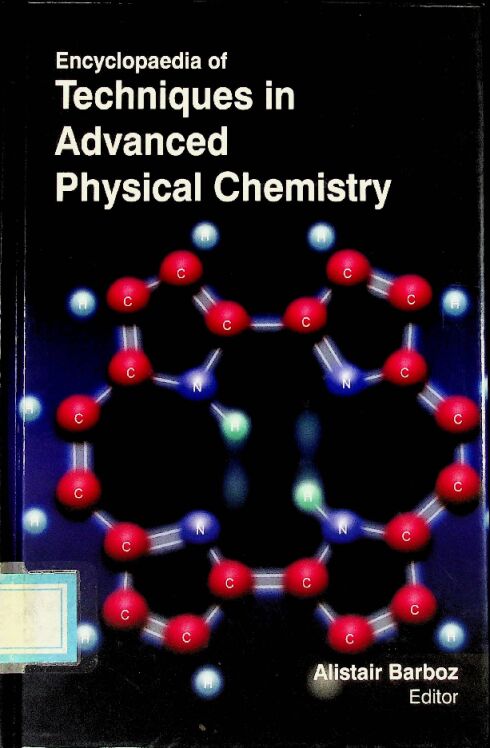
书名:Encyclopaedia of techniques in advanced physical chemistry. Volume 4, Analytical chemistry
责任者:Alistair Barboz
ISBN\ISSN:9781781540527,1781540527
出版时间:2012
出版社:Auris Reference,
分类号:化学
前言
Chemical bonds are what hold atoms together to form the more complicated aggregates that we know as molecules and extended solids. Chemists talk about bonds all the time, and draw pictures of them as lines joining atom symbols. Teachers often identify them as the little sticks that connect the spheres that represent atoms in a plastic molecular model. So ifs not surprising tha t we some times tend to think of chemical bonds as "things”. But no one has ever seen a chemical bond, and there is no reason to believe that they really even exist as physical objects. "Sometimes It Seems to me that a bond bet ween two atoms has become so real, so tangible, so friendly, that I can almost see it. Then I awake with a little shock, for a chemical bond is not a real thing. It does not exist. No one has ever seen one. No one ever can. It is a figment of our own imagination.” C.A. Coulson was an English theoretical chemist who played a central role in the development of quantum theories of chemical bonding. It is more useful to regard a chemical bond as an effect that causes certain atoms to join together to form enduring structures that have unique physical and chemical properties.
So although the “chemical bond” is no more than a convenient fiction, chemical bonding, which leads to the near-infinity of substances, lies at the very core of chemistry. The forces that hold bonded atoms together are basically just the same kinds of electrostatic attractions that bind the elections of an atom to its positively-charged nucleus. This is the most important fact about chemical bonding that you should know, but it is not of itself a workable theory of bonding because it does not describe the conditions under which bonding occurs, nor does it make useful predictions about the properties of the bonded atoms. Our views of what constitutes chemical bonding are still evolving, according to a 2007 article in Chemical and Engineering News (85 37-40). This < synthesized in 2007 by Andrzej Sygula is a case in point. The buckyball CG0 resides in the CG0H28 "buckybowr. There are no traditional “chemical bonds” here!
A more res trictive definition distinguishes bet ween a "tme” molecule that exists as an independent particle, and an extended solid that can only be represented by its simplest formula. Methane, CHt, is an example of the former, while sodium chloride, which does not contain any discrete NaCl units, is the most widely-known extended solid. Eut because we want to look at chemical bonding in the most general way, we will avoid making this distinction here except in a few special cases. In order to emphasize this ^aggregate of atoms definition, we will often use terms such as “chemical species” and “structures” in place of “molecules” in this lesson. The definition written above is an operational one; that is, it depends on our ability to observe and measure the molecule's proper ties. Clearly, this means that the molecule must retain its identity for a period of time long enough to carry out the measurements. For most of the molecules that chemistry deals with, this presents no difficulty. But it does happen that some structures that we can write formulas for, such as He2, have such brief lives that no significant properties have been observed. So to some extent, what we consider to be a molecule depends on the technology we use to observe them, and this will necessarily change with time.
The book integrates theoretical chemistry teachings with industrial and laboratory practice, providing a realistic grounding for future practising chemists and engineers.
A more res trictive definition distinguishes bet ween a "tme” molecule that exists as an independent particle, and an extended solid that can only be represented by its simplest formula. Methane, CHt, is an example of the former, while sodium chloride, which does not contain any discrete NaCl units, is the most widely-known extended solid. Eut because we want to look at chemical bonding in the most general way, we will avoid making this distinction here except in a few special cases. In order to emphasize this ^aggregate of atoms definition, we will often use terms such as “chemical species” and “structures” in place of “molecules” in this lesson. The definition written above is an operational one; that is, it depends on our ability to observe and measure the molecule's proper ties. Clearly, this means that the molecule must retain its identity for a period of time long enough to carry out the measurements. For most of the molecules that chemistry deals with, this presents no difficulty. But it does happen that some structures that we can write formulas for, such as He2, have such brief lives that no significant properties have been observed. So to some extent, what we consider to be a molecule depends on the technology we use to observe them, and this will necessarily change with time.
The book integrates theoretical chemistry teachings with industrial and laboratory practice, providing a realistic grounding for future practising chemists and engineers.