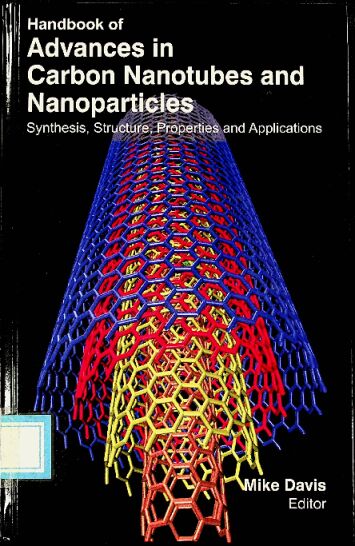
书名:Handbook of advances in carbon nanotubes and nanoparticles
出版时间:2012
出版社:Auris Reference,
前言
There are many fascinating examples of nanotechnology applications in new materials. For example, polymer coatings are notoriously easily damaged, and affected by heat. Adding only 2% of nanoparticulate clay minerals to a polymer coating makes a dramatic difference, resulting in coatings that are tough, durable and scratch resistant. This has implications for situations where a material fits a particular application in terms of its weight and strength, but needs protection from an external, potentially corrosive environment - which a reinforced polymer nanocoating can provide. Particles at the nanoscale are below the wavelength of visible light, and therefore cannot be seen. Consequently, they can impart new properties while being invisible themselves! Fluorescent nanoparticles, or quantum dots have a whole range of possible applications. They are invisible until 'lit up' by ultraviolet light, and can even be made to exhibit a range of colours, depending on their composition and size. Such nanoparticles are ideal for crime prevention, where goods can be invisibly 'tagged', preventing counterfeiting; stolen goods can be traced by their invisible 'bar code' and illicit drugs by the fact they have no legal identification. In some countries, cheap agricultural fuel is 'laced' with harmless nanoparticles, making it easy for police to identify a stolen consignment, merely by using ultraviolet light.
Nanoparticles can seem to be quite strange as they have new and unusual properties that are not obvious in the corresponding bulk material. This is because a nanoparticle has a large surface area in relation to its size, and is consequently highly reactive. This is exemplified by the fine grained materials that we use in our daily lives, such as flour, which can become explosive In some circumstances. Applications of nanoparticles include nanoparticulate titanium dioxide for sunscreens, and it also acts as a photocatalytic agent in coatings that can be applied to stay-clean windows, causing the dirt to be oxidized and easily washed away by rain. Carbon nanotubes are a recently discovered unique material possessing amazing electronic, thermal, and structural properties. They are highly conductive both to electricity and heat, with an electrical conductivity as high as copper, and a thermal conductivity as great as diamond. They offer amazmg possibilities for creating future nanoelectronic devices, circuits and computers. Carbon nanotubes also have extraordinary mechanical properties - they are 100 times stronger than steel, while only one sixth of the weight. These mechanical properties offer huge possibilities, for example, in the production of new stronger and lighter materials for military, aerospace and medical applications. Other applications include lubricants, coatings, catalysts and electro-optical devices. The cost, purification, separation of nanotube types, constraints in processing and scaling up and assembly methods are still hurdles for some applications. However, there are already products containing nanotubes on the market, for example, in some tennis racquets nanotubes are used to reinforce the frame and improve the racquet's ability to absorb shocks.
Carbon nanotubes can also be mixed with many different materials such as plastics and textiles, for example to produce lightweight bullet-proof vests. According to engineers at the Fraunhofer Technology Development Group in Stuttgart the greatest potential for creating new products lies in harnessing the electrical properties of lightweight and robust nanotubes to generate heat. Applications range from electric blankets to heatable aircraft wings that no longer ice up, to 'wallpaper' heating for cold walls.
This handbook introduces the reader to novel, superfunctional and composite materials, metamaterials, electronics, electrets, carbon nanotubes, nanowires, molecular transistors, and graphene currently attracting research focus.
查看更多
目录
Preface xi
VOLUME 1
1.Optical Properties of Carbon Nanotubes Electronic Structure of Carbon Nanotube • Van Hove Singularities • Kataura Plot • Optical Absorption •
Luminescence • Raman Scattering • Rayleigh Scattering 1
2.Nanoparticle Background • Uniformity • Properties • Synthesis • Sol-gel
•Colloids • Surface Coating for Biological Applications • Carbon
Nanotube and Related Structures • Cup Stacked Carbon Nanotubes • Potential Applications of Carbon Nanotubes 14
3. Magnetic Nanoparticles Properties • Types of Magnetic Nanoparticles • Synthesis •Applications • Nanoparticle Tracking Analysis • Carbon Nanotubes in Photovoltaics • Reduction of Energy Consumption •Nanotechnology and Constructions • Nanoparticles in Fire Protection and Detection • Carbon Nanotubes in Medicine • In Vitro Cytotoxicity • Cytotoxicity of SWNTs and MWNTs • Carbon Nanotube Springs 60
4. Silicon Nanotubes Synthesis • Applications • Selective Chemistry of Single-walled Nanotubes • Selective Reaction and Raman Features • Multi-
walled Carbon Nanotubes • Platinum Nanoparticles • Iron 101
Oxide Nanoparticles • Microemulsions • Solid lipid Nanoparticle • Nanometrology • Nanonetwork
5. Nanofluidics Nanofluidic Circuitry • Nanomechanics • Nanobiotechnology • Nanobiomechanics • Nanoengineering • Green Nanotechnology • Nanoelectronics 127
6. Nanophotonics Nanotechnology Education • Nanotechnology in Water Treatment • Nanofiltration • Electrospinning • Nano-thermite • NanoHUB • Energy Applications of Nanotechnology • Nanomaterial-based Catalyst • Colloidal Gold 157
7. Nanobacterium 1981-2000 • 2001—present • Nanotoxicology • Nanoflower • Boron Nitride • Cubic Boron Nitride • Boron Nitride Nanotubes • Colossal Carbon Tube 194
8. Carbon Nanofiber Synthesis • Carbon Black • Carbon-fiber-reinforced Polymer • Activated Carbon • Carbon Nanocone • Nanoarchaeum Equitans • Nanobe • Aggregated Diamond Nanorod • Nanotube Membrane 220
VOLUME 2
9. Graphene NanoribbonsTimeline of Carbon Nanotubes • Nanocomposite • Nanocrystal • Nanocrystal Solar Cell • Nanocrystalline Silicon • Nanocages • Nanomesh • Nanoshell • Nanoimprint Lithography • Nanolithography • Nanochannel Glass Materials • Nanocomputer 257
10. Nanocircuitry Production Methods • Potential Applications and Breakthroughs • History of Nanotechnology • Experimental Advances • Invention of Scanning Probe Microscopy • Advances in Interface and Colloid Science • National Nanotechnology Initiative • Growing Public Awareness and Controversy • Impact of Nanotechnology • Health and Safety Impact from Nanoparticles • Fail-safes in Nanotechnology • DNA Nanotechnology • Structural DNA Nanotechnology • Nanosensor • Dip-pen Nanolithography 286
11. Nanochondrion Nano-abacus • Nanopore • Nanopore Sequencing • Nanometre • Nanoscale Iron Particles • Magnetic Chemistry • Melting-point Depression • Hybrid Material • Nanoelectromechanical System • Sarfus 339
12. Nano Carbon Items Diamond • Graphite • Amorphous Carbon • Buckminsterfullerenes • Carbon Nanobuds • Glassy Carbon • Atomic and Diatomic Carbon • Linear Acetylenic Carbon (LAC) 372
13. Molecular Mechanics Functional Form • Areas of Application • Molecular Assembler • Molecular Machine • Nano Brain • Materiomics • Hydrogen Storage • Capacitor • Software for Nanostructures Modelling • Microfluidics 382
14. Nanowire Synthesis of Nanowires • Physics of Nanowires • Welding Nanowires • Uses of Nanowires • Inorganic Nanotube • Molecular Wire • Nantenna • Nanoscopic Scale • Centre for Probing the Nanoscale • Centre for Nanoscale Materials • X-ray Nanoprobe • Nanowire Battery 443
15. Silver Nano Environmental Concerns • Silver Nanoparticles • Nanomanufacturing • Quantum Dot • Quantum Dot Display • Pros and Cons • Quantum Wire • Nanorod • Nanoprobe 468
16. Nanosolar Financial Backers and Manufacturing • Cluster • Transition Metal Carbonyl Clusters • Superlens • Conventional Lens • Subwavelength Imaging • Early Subwavelength Imaging • Near-field Imaging with Magnetic Wires • Negative Index GRIN Lenses • Plasmon-assisted Microscopy • Cylindrical Superlens via Coordinate Transformation 495
VOLUME 3
17. Nano-optics with Metamaterials Nanohole Array Subwavelength Imaging • Negative Index of Refraction and Pendry's Perfect Len • Photonic Metamaterial • Optical Frequency Metamaterials • Extraordinary Optical Transmission • Buckypaper • Frit Compression • Lithium—sulphur Battery • Lithium—air Battery • Technological Applications of Superconductivity 521
18. Polymer Nanocomposite Bio-hybrid Polymer Nanofibres • Delivery from Compartmented Nanotubes • Size and Pressure Effects on Nanopolymers • Nanogeoscience • Waterloo Institute for Nanotechnology • Environmental Applications of Nanotechnology • In Situ Chemical Reduction • Societal Impact of Nanotechnology 557
19. Nanorobotics Nanorobotics Theory • California NanoSystems Institute • Quantum Computer • Nanorobot • Nanotechnology 586
20. Nanoproducts Implications • Health and Environmental Concerns • Carbon Nanotubes • Nanocarbon Output Values Surging, Production Catching Up • Procedure • Peering Inside Nanowires • Four-Point Bending Method • Nanowire Electronics • Nanowire Applications 626
21. Nano Chemical Particles Liquid Chromatography • Ion Exchange Chromatography • Anion Exchange Chromatography (AEC) • Partitioning Chromatography • Supercritical Chromatography • Capillary Electrophoresis • Nano Process • Nano Chemical Reactivity • Electrochemical Cells • Thermodynamics Equilibrium • Cell EMF Measurements • Acid-Base Titrations • Solids in Liquids • Gases in Liquids • Liquids in Liquids • Solubility • Acid-Base Titrations • Redox titrations • Titration of Hydrogen Peroxide • Nanofabrication • Crude Technology 694
Bibliography 769
Index 771
查看更多
馆藏单位
中科院文献情报中心