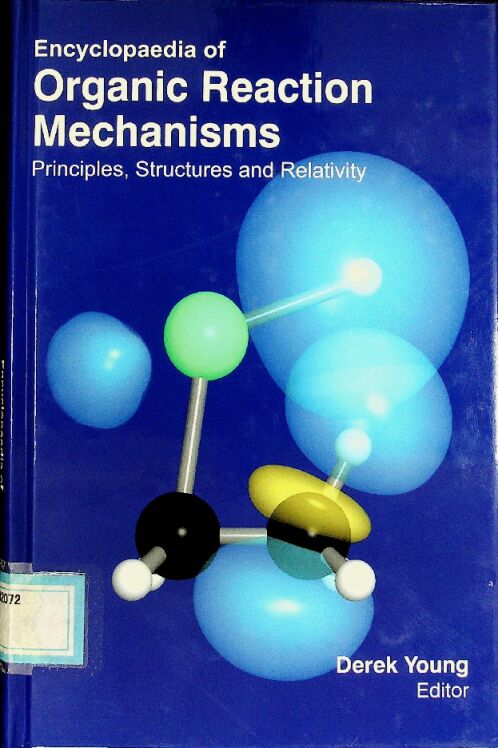
书名:Encyclopaedia of organic reaction mechanisms
ISBN\ISSN:9781781540138,1781540136
出版时间:2012
出版社:Auris Reference,
前言
Chemical kinetics, also known as reaction kinetics, is the study of rates of chemical processes. Chemical kinetics includes investigations of how different experimentai conditions can influence the speed of a chemical reaction and yield information about the reactions mechanism and transition states, as well as the construction of mathematical models that can describe the characteristics of a chemical reaction. In 1864, Peter Waage and Cato Guldberg pioneered the development of chemical kinetics by formulating the law of mass action, which states that the speed of a chemical reaction is proportional to the quantity of the reacting substances. Chemical kinetics deals with the experimentai determination of reaction rates from which rate laws and rate constants are derived. Relatively simple rate laws exist for zero-order reactions (for which reaction rates are independent of concentration), first-order reactions, and second-order reactions, and can be derived for others. In consecutive reactions, the rate�determining step often determines the kinetics. In consecutive first- order reactions, a steady state approximation can simplify the rate law. The activation energy for a reaction is experimentally determined through the Arrhenius equation and the Eyring equation. The main factors that influence the reaction rate include: the physical state of the reactants, the concentrations of the reactants, the temperature at which the reaction occurs, and whet her or not any catalysts are present in the reaction.
Depending upon what substances are reacting, the reaction rate varies. Acid/base reactions, the formation of salts, and ion exchange are fast reactions. When covalen t bond formation t akes place bet ween the molecules and when large molecules are formed, the reactions tend to be very slow. Nature and strength of bonds in reactant molecules greatly influence the rate of its transformation into products. The physical state of a reactant is also an important factor of the rate of change. When reactants are in the same phase, as in aqueous solution, thermal motion brings them into contact. However, when they are in different phases, the reaction is limited to the interface between the reactants. Reaction can occur only at their area of contact; in the case of a liquid and a gas, at the surface of the liquid. Vigorous shaking and stii'ring may be needed to bring the reaction to completion. This means that the more finely divided a solid or liquid reactant the greater its surface area per unit volume and the more contact it makes with the other reactant, thus the faster the reaction. To make an analogy, for example, when one starts a fire, one uses wood chips and small branches 一 one does not start with large logs right away. In organic chemistry, on water reactions are the exception to the rule that homogeneous reactions take place faster than heterogeneous reactions.
This book is not a physical organic chemistry text. The sole purpose of this book is to teach students how to come up with reasonable mechanisms for reactions that they have never seen before. As most chemists know, it is usually possible to draw more than one reasonable mechanism for any given reaction.
查看更多
目录
Preface vii
1. Chemical Kinetics Factors Affecting Reaction Rate • Reaction Progress Kinetic Analysis • Determining Reaction Stoichiometry • The Half-Life • Enzyme Kinetics • Irreversible Inhibitors • Mechanisms of Catalysis 1
2. The Collision Theory Rate Constant • Quantitative Insights • Classical Mechanics • Electron Gas • The Collision Theory of Reaction Rates • The Energy of the Collision • Collisions • Rates of Reactions 55
3. Mechanisms of Chemical Reactions Properties of Mechanisms • Reaction Coordinate Diagrams • Activation Energy and the Arrhenius Equation • The Relationship bet ween the Rate Constants and the Equilibrium Constant for a Reaction • The Integrated Form of First-Order and Second-Order Rate Laws • Determining the Order of a Reaction with the Integrated Form of Rate Laws • Reactions That are First-Order in Two Reactants 75
4. Temperature, Catalysis, Orders of Reaction, Rate Expressions More Advanced Particle Theory to Help Explain the Kinetic Effects of Temperature Change and Catalysis • The ESect of Increasing Temperature and Activation Energy • Catalytic Mechanisms • Heterogeneous Cat alysts and Theory • Heterogeneous Catalyst Theoiy • Homogeneous Catalysis and Theory • A Brief Review of Methods of Collecting Rate Data • Rate Expressions and Orders of Reaction • Deducing Orders of Reaction • Simple Exemplar Rates Questions 93
5. Activation Energy Potential Energy Diagrams Revisited • Negative Activation Energy • Catalysis • Autocatalysis • Abiogenesis Hypothesis • Involvement in Life Processes • Creation of Order • One- Component Reaction-Diffusion Equations 120
6. Reaction-Diffusion Systems Abiogenesis • Complex Biological Molecules and Proto cells • Ultraviolet and Temperature-Assisted Replication Model • Molecular Biologisfs Dream • Pumice Rafts • Other Models • Extra terrestrial Organic Molecules • Morphogenesis • Photocatalysis 141
7. Arrhenius Equation Quantum Tunnelling • The Tunnelling Problem • Chain-Decay Processes • Conductivity • Theory of Ballistic Conduction • Mean Kinetic Tempera ture • Diode • Transistor • Semiconductor Device Mat erials • Semiconduc tor Device Applications • Histoiy of Semiconductor Device Development 191
Bibliography 251
Index 255
查看PDF
查看更多
作者简介
Derek Young is Professor of Pharmacology and Toxicology.He completed his B.S.in 1989 and Ph.D.in 1992.His research interests are:Organic Chemistry,Chemical Biology and Synthesis/Synthetic Methods Development. Dr. Young has over 100 publications, including twenty book chapters, one book and eight patents.
查看更多
馆藏单位
中科院文献情报中心