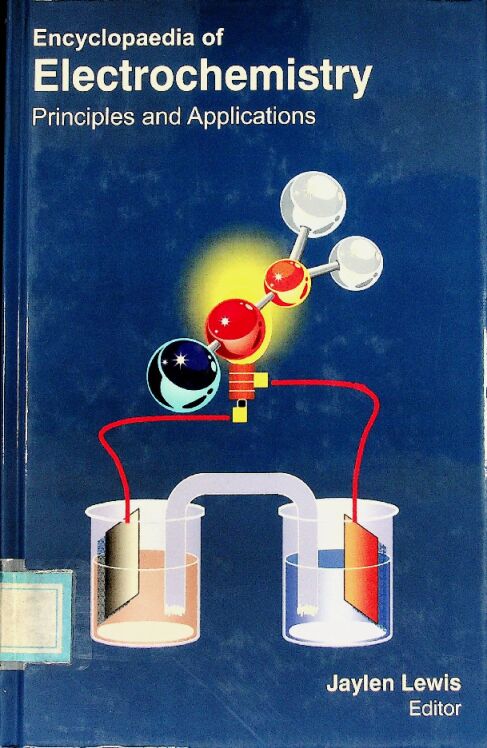
书名:Encyclopaedia of electrochemistry
ISBN\ISSN:9781781540121,1781540128
出版时间:2012
出版社:Auris Reference,
前言
Electrochemical met hods can be used to investigate specific properties of materials, such as their corrosion behaviour, their electrocatalytic properties or the energy states in molecular systems. By having access to all common electrochemical methods, we can offer you our services for the investigation of a wide variety of sample systems. High- performance potentiostats at our disposal cover a wide range of currents and thus can be applied for a broad spectrum of met hods. Our expertise in the field of electrochemical analysis enables us to provide you with a capable support in finding answers to the specific questions you have about your material. Our spectrum of electrochemical methods ranges from cyclic voltammetry through pulsed methods such as differential pulse voltammetry to electrochemical impedance spectroscopy. With these methods at hand, we can provide services ranging from the electrochemical characterization of colorants, polymers, and catalysts, to the answering of complex questions involving industrial electrolysis and electrocatalytic processes. A major strength of our tearn stems from the combination of our scientific expertise in the area of electrochemical investigations and the long-term experience that we have gleaned in the fields of materials, corrosion, and catalysis. Already in the performance and interpretation of independent electrochemical measurements, the practical knowledge of our experts can represent a significant added value for you.
Knowing the energy states of molecules, metal complexes, and conductive polymers is a key prerequisite for working with functional molecular systems such as polymer-based solar cells, organic lightemitting diodes, photoinitiatots, or even catalytic systems. Voltammetry is a powerful and easy-t o・use met hod for obtaining information about the energy states of molecular systems. We offer both cyclic and pulsed voltammetry — methods with which our team has many years of user experience, enabling them to interpret data in a way that is directly relevant to yout functional system. The development of new catalysts for electrolytic processes is a time consuming process in which the greatest challenge is the scale-up of the intentionally simple electrochemical lab experiment to production scale. With our expertise, we can help you to identify suitable new materials still in early stages of development, thus avoiding time-consuming and expensive experiments in model or pilot plants. In combination with compact electrolysis cells, voltammetty with rotating disk electrodes enables us to investigate your catalytic materials for promising candidates in a cost-efficient manner. We can provide you with new perspectives in the development of catalytic materials through a combination of electrochemical investigations and a broad spectrum of mat erial charactetization methods, such as porosimetry, thermogravimetry, and microscopy. As a result, you gain comprehensive insights into the physical and structural properties of your material.
Because of their sensitivity, electrochemical measurements are ideally suited to the qualitative and quantitative characterization of corrosion. Relevant parameters for a corrosion monitoring of chemical production plants are the corrosive surface attack, which is used to estimate service life and define inspection cycles, as well as the occurrence of localized corrosion, which can lead to significant damage on short time scales. The electrochemical techniques available to us for these applications are linear polarization resistance (LPR) monitoring, electrochemical noise (EN), and non-linear analytical techniques (HAD, EFM). Non-metallic anti-corrosion coatings are used in shipbuilding and piping engineering to protect met allic materials. Some times damage to these protective coatings cannot be avoided, however. Corrosion at these damaged locations results in the production of hydrogen, which causes the coating in the immediate area to debond. This allows a corrosive medium in the environment to get between the protective coating and the metal substrate, which neutralizes the protective effect and allows the extent of the damage to grow. The electrochemical cathodic debonding test can be used to simulate this behaviour exhibited by organic anti-corrosion coatings so that the quality of the coatings can be assessed.
This book will be found useful by those who wish to make a more detailed study of the topics discussed.
查看更多
目录
Preface vii
1. Periodic Current Reversal pH Metre • Storage Conditions of the Glass Probes • Photocathode • Platinum Black • Polarisa tion (Electrochemistry) • Potentiometric Sensor • Pourbaix Diagram 1
2. Process Analytical Chemistry Proton Conductor • Proton-Coupled Electron Transfer • Quantum Electrochemistry • Reduction Potential • Standard Hydrogen Electrode • Reversible Charge Injection Limit • Sacrificial Metal • Salt Bridge • Liquid Rheostat • Solid-state Ionics • Underpotential Deposition • Unimolecular Rectifier • Volta Potential • Warburg Coefficient • Warburg Element • Weak Salt • Wien Effect • Yttria-Stabilised Zirconia • Amperostat 12
3. Capacitive Deionization Cell Notation • Charge Transfer Coefficient • Chemical Field- effec t Transistor • Counterion • Debye Leng th • Debye- Falkenhagen Effect • Debye-Huckel Theory • Depolariser • Differential Capacitance • Double Layer (Interfacial) • Titration • Titration Curve • Types of Titrations • Acid-base Titration • Alkalime try and Acidimetry • Redox Titration • Complexometric Titration • Zeta Potential Titration • Assay • Equivalence Point • Voltammetry • Types of Voltammetry • Linear Sweep Voltammetry • Staircase Voltammetry • Squarewave Voltammetry • Cyclic Voltammetry • Cathodic St ripping Voltammetry • Adsorptive St ripping Voltammetiy 34
4. Polarography Theory of Operation • Rotated Electrode Voltammetry • Differential Pulse Voltammetry • Chronoamperometry • Electrolytic Process • Regenerative Fuel Cell • Solid Oxide Electrolyser Cell • Unitized Regenerative Fuel Cell • Castner— Kellner Process • Chloralkali Process • Hall-Heroult Process • Kolbe Electrolysis • Activating Function 88
5. Enzymatic Biofuel CellMicrobial Fuel Cell • GHK Flux Equation • Copper Coulometre • Galvanostat • Quinhydrone Electrode • Potentiostat • Mercury Coulometre • Voltametre • Types of Voltametre • Amperometric Titration • Bulk Electrolysis 110
6. ElectrogravimetryCoulometry • Karl Fischer Titration • Hydrodynamic Technique• Electrophoresis • Affin辻y Electrophoresis • Capillary Electrophoresis • Electrochromatography • Electric Current• Conductivity (Electrolytic) 140
7. SuperconductivityMeissner Effect • History of Superconductivity • High- Tempera ture Superconductivity • Technological Applications of Superconductivity • Current Density 167
8. Electrical PhenomenaBiefeld-Brown Effect • Direct Current • Electroluminescence• Elec trie Shock • Ferroelectrici ty • Indue tance• Photoconductivity 207
9. Photoelectric EffectPiezoelectricity • Pyroelectricity • Static Electricity • Electric Spark • Telluric Current • Thermoelec trie Effect 240
Bibliography 291
Index 295
查看PDF
查看更多
作者简介
Jaylen Lewis is a principal investigator at the Department of Ceramics and Glass Engineering,University of Melbourne.Having received his doctoral degree in physical chemistry from the Belarus State University in 1993,Dr. Lewis has published over 280 scientific papers in internationalSCI journals, including 10 reviews,and coauthored over 40 papers in other refereed journals and volumes, 3 books and 2 patents.
查看更多
馆藏单位
中科院文献情报中心