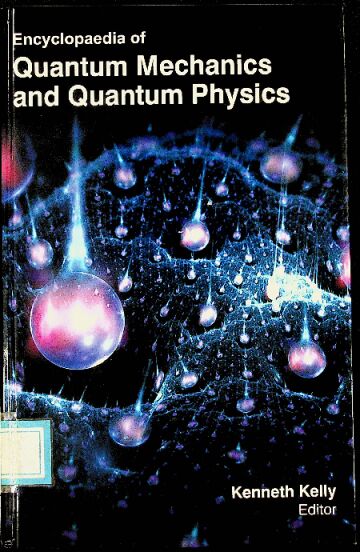
书名:Encyclopaedia of quantum mechanics and quantum physics. Volume 1, Foundations of quantum mechanics
出版时间:2012
出版社:Auris Reference,
前言
Quantum mechanics is a mathematical theory that can describe the behaviour of objects that are roughly 10, 000, 000, 000 times smaller than atypical human being.Quantum particles move from one point to another as if they are waves.However, at a detector they always appear as discrete lumps of matter.There is no counterpart to this behaviour in the world that we perceive with our own senses.One can not relyon everyday experience to form some kind of "intuition" of how these objects move.The intuition or "understanding" formed by the study of basic elements of quantum mechanics is essential to grasp the behaviour of more complicated quantum systems.
The approach adopted in all textbooks on quantum mechanics is that the mathematical solution of model problems brings insight in the physics of quantum phenomena.The mathematical prerequisites to work through these model problems are considerable. Moreover, only a few of them can actually be solved analytically.Furthermore, the mathematical structure of the solution is often complicated and presents an additional obstacle for building intuition.This presentation introduces the basic concepts and fundamental phenomena of quantum physics through a combination of computer simulation and animation.The primary tool for presenting the simulation results is computer animation. Watching a quantum system evolve in time is avery effective method to get acquainted with the basic features and peculiarities of quantum mechanics.The images used to produce the computer animated movies shown in this presentation are not created by hand but are obtained by visualization of the simulation data.The process of generating the simulation data for the movies requires the use of computers that are far more powerful than Pentium III based PC's.At the tine that these simulations were carried out(1994) , most of them required the use of a supercomputer.Consequently, within this presentation, it is not possible to change the model parameters and repeat a simulation in real time.
This presentation is intended for all those who are interested to learn about the fundamentals of quantum mechanics.Some knowledge of mathematics will help but is not required to understand the basics. This presentation is not a substitute for a textbook.The presentation begins by showing the simplest examples, such as the motion of a free particle, a particle in an electric field, etc..Then, the examples become more sophisticated in the sense that one can no longer relyon one's familiarity with classical physics to describe some of the qualitative features seen in the animations.Classical notions are of no use at all for the last set of examples.
In the mathematically rigorous formulation of quantum mechanics developed by Paul Dirac and John von Neumann, the possible states of a quantum mechanical system are represented by unit vectors(called "state vectors") .Formally, these reside in a complex separable Hilbert space well defined up to a complex number of norm 1.In other words, the possible states are points in the projective space of a Hilbert space, usually called the complex projective space.The exact nature of this Hilbert space is dependent on the system; for example, the state space for position and momentum states is the space of square-integrable functions, while the state space for the spin of a single proton is just the product of two complex planes.Each observable is represented by a maximally Hermitian linear operator acting on the state space.Each eigenstate of an observable corresponds to an eigenvector of the operator, and the associated eigenvalue corresponds to the value of the observable in that eigenstate.If the operator's spectrum is discrete, the observable can only attain those discrete eigenvalues.
In the formalism of quantum mechanics, the state of a system at a given time is described by a complex wavefunction, also referred to as state vector in a complex vector space.This abstract mathematical object allows for the calculation of probabilities of outcomes of concrete experiments.For instance, electrons maybe considered to be located somewhere within a region of space, but with their exact positions being unknown.Contours of constant probability, often referred to as "clouds", maybe drawn around the nucleus of an atom to conceptualize where the electron might be located with the most probability.Heisenberg s uncertainty principle quantifies the inability to precisely locate the particle given its conjugate momentum.
The book presents a comprehensive introductory treatment, ideally suited students of physics and engineering courses.The book covers basic principles and applications of quantum mechanics.
查看更多
目录
Preface vii
1. Introduction 1
Quantum Mechanics·History of Quantum Mechanics·Mathematical Formulations·Interactions with Other Scientific Theories·Unsolved Problems in Physics·Quantum Mechanics and Classical Physics·Relativity and Quantum Mechanics ·Attempts at a Unified Field Theory·Philosophical Implications·Applications
2. Some Fundamental Terms and Concepts 25
Matter·Energy·Conservation of Energy·Energy Transfer ·Energy and the Laws of Motion·Noether's Theorem 54
3. Energy and Thermodynamics 54
Internal Energy·The Laws of Thermodynamics·Equipartition of Energy·Oscillators, Phonons, and Photons·Energy and Life ·Energy Density·Transformations of Energy·WaveFunction .Vector Formalism·One Spin-0P article in Three Spatial Dimensions·WaveFunctions in Vector Form·Operators and Uncertainty Principle
·Matter Wave Wave functions·Interpretation·Energy-Time Uncertainty Principle·Entropic Uncertainty Principle·Origins and Use of the Literal Term ·Famous Thought Experiments·Schrodinger's Cat
4. Quantum Realm 118
Quantum Tunnelling·Scanning Tunnelling Microscope·Molecular Electronics·Molecular Scale Electronics·Organic Electronics·Organic Electronic Devices·Organic Semiconductor·Quantum Entanglement·EPR Paradox ·Locality in the EPR Experiment·Einstein's Hope for a Purely Algebraic Theory·Implications for Quantum Mechanics·Macroscopic Scale
5. Superconductivity 164
Elementary Properties of Superconductors·Zero Electrical DC Resistance·Theories of Superconductivity·Nobel Prize for Superconductivity·Semiconductor·Nuclear Physics·Modern Nuclear Physics·Nuclear Decay·Nuclear Fusion·Quantum·Planck Constant·Josephson Constant
6. Angular Momentum 218
Angular Momentum in Classical Mechanics·Fixed Axis of Rotation·Angular Momentum in Relativistic Mechanics·Angular Momentum in Quantum Mechanics·Angular Momentum in Quantum Mechanics·Angular Momentum in Electrodynamics·Atomic Orbital·Orbital Energy ·Electron Placement and the Periodic Table·Wave-Particle Duality·The Photoelectric Effect Illuminated·Treatment in Modern Quantum Mechanics·Quantum Harmonic Oscillator·Ladder Operator Method·Acoustic Resonance
Bibliography 281
Index 285
查看更多
作者简介
Kenneth Kelly is professor of Quantum Physics.His research interests lie mainly within the fields of theoretical condensed matter physics and the foundations of quantum mechanics.He has been particularly interested in the possibility of using special condensed-matter systems, such as Josephson devices, to test the validity of the extrapolation of the quantum formalism to the macroscopic level; this interest has led to a considerable amount of technical work on the application of quantum mechanics to collective variables and in particular on ways of incorporating dissipation into the calculations.
查看更多
馆藏单位
中科院文献情报中心