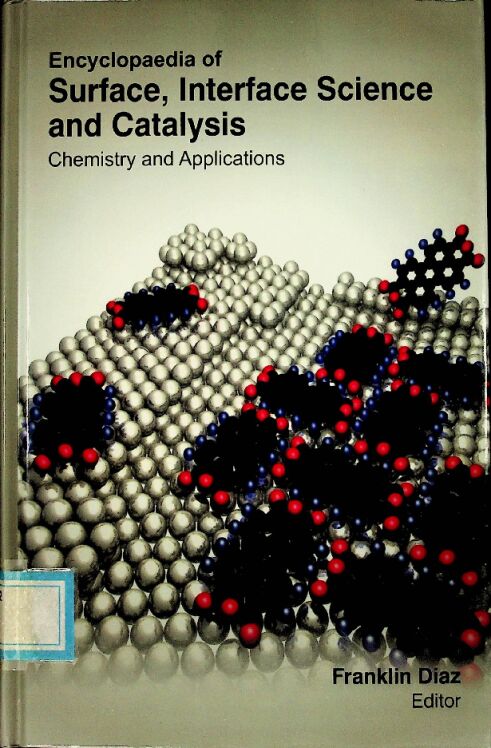
书名:Encyclopaedia of surface, interface science and catalysis
ISBN\ISSN:9781781540169,1781540160
出版时间:2012
出版社:Auris Reference,
前言
The goal of the Surface Chemical Dynamics Program is to elucidate the underlying physical processes that determine the products (selectivity) and yield (efficiency) of chemical transformations relevant to energy-related chemistry on cat a lytic and nanostructured surfaces. Achieving this end requires understanding the evolution of the reactant- molecule/surface complex as molecules adsorb, bonds dissociate, surface species diffuse, new bonds form and products desorb. The pathways and time scales of these processes are ultimately determined by a multidimensional potential energy surface that is a function of the geometric and electronic structures of the surface and the reactant, product, intermediate and transition・state molecular and atomic species.
To understand these processes, our group employs a battery of methods to measure the energetics and timescales of energy and charge transfer in the molecule/surface complex. Excitation of the complex is brought about either by preparing the reactants in a molecular beam or exciting adsorbates with photons. The response of the system is probed by measuring sticking coefficients, rovibrational- state-, angle-, and time-resolved molecular desorption distributions, electronic energy distribution dynamics, photoinduced desorption dynamics and adsorbate vibrational energy relaxation dynamics. In addition we are developing surface nanostructuring methods, including physical vapour and size-selected cluster deposition that can be coupled to these powerful surface chemical dynamics probes. By exercising temporal control over the excitation and spatial control over the surface we aim to gain det ailed insight into the dynamical links bet ween the st ructure and function of reactive surfaces.
A molecule may seattei off the surface, experiencing no or some finite degree of energy exchange with the surface. Alternatively, molecule-surface energy transfer can lead to accommodation and physical adsorption or chemical adsorption. In some cases, physisorption is a precursor to chemisorption, and in some cases, bond dissociation is required for chemisorption. Charge transfer plays a critical role in some adsorption processes. Once on the surface, the adsorbed intermediate may diffuse laterally with a temperature dependent rate, sampling surface features including adatoms, vacancies and steps. They may become tightly bound to a defect site. Various adsorbed intermediates may meet, either at defect sites or at regular lattice sites, and form short-lived transition state structures and ultimately product molecules. Finally, products desorb from the surface with a temperature dependent rate, imparting some fraction of the energy of the association reaction to the surface. The goal of surface chemical dynamics is to identify the roles, quantify the rates and understand the physics of these various mechanistic steps that comprise the surface chemical transformation.
This book contains a brief review of absorption and catalysis, for practical purposes. This also presents some important information on adsorbents and catalysts.
查看更多
目录
Preface vii
1. Geochemistry of Sedimentary Tectonic Setting of the Iberian Pyrite Belt • Reference Measured Section • Sedimentary Geochemistry • Contrasts between Igneous and Overlying Sedimentary Rocks • Geochemistry of Coeval Mesozoic Plutonic • Geochemistry of Pelagic and Hemipelagic Carbonates • Manganese Chemostratigraphy • Carbon Stable-isotope Stratigraphy • IoA • Marine Geochemistry of Mn • Isotopic Constraints on Subduction Polarity • Polarity of the Intra-oceanic Kohistan Arc 1
2. Toxicological Testing and Environmental Chemicals Dilution Not the Solution • False Assumptions • No Safe Dose • The Numbers Game • Circular Reasoning • The Biological and Chemical Reactivity of Zeolite-based Aluminosilicate Fibres • Zeolite Characterisation • Hydroxyl Radical Measurements • Measurement of the Oxidative Burst • Correlation of Biological and Chemical Reactivities 48
3. Cross Cellular Membranes by Nonphagocytic Mechanisms Implications in Epidemiologic Research • Characteristics and Potential Importance of UFPs • Nanoparticles • Cons: Translocation and Toxicity to Other Organs • Surfactaut on the Retention of Man-made Vitreous Fibres (MMVF 10a) • Tissue Processing for Microscopic Analysis 81
4. Carbon Nanotubes Exposure to Carbon Nan ot ube Mat erial • Pulmonary Cytotoxicity • Health Effects of Combustion By-products • Mechanisms of Chromate Mutagenesis • Ethical Issues Related to Combustion By-Products 134
5. Development for Genome Sequencing Understanding a New Ingredient • Products Under Scrutiny 170
6. Analysis of Bronchoalveolar Lavage FluidSpecies Composition and Structure of Vascular Plants and Bryophytes • Ordination of Vege tation Analyses • Environmental Efifect on the Distribution of Plant Groups 190
7. The Molecular BasisMolecular Basis of Tolerance • Effects on the Activity of Proteins • Effects on Protein Dynamics • Genetics of Tolerance 215
8. Carbon Dioxide Concentrations Amplify Alternaria Alternata SporulationInoculum Preparation, Leaf Inoculation, and Fungal Growth • Suppiemen tai Experiment with Field-collected Plant Material • Ultrafine Manganese Oxide Particles • Analyses of Metal Content in Tissue Samples • Toxicogenomics • Environmental Geochemistry • Essential and Potentially Harmful Chemical Elements • Some Applications of Modern Digital Geochemical Databases 229
Bibliography 275
Index 279
查看PDF
查看更多
作者简介
Franklin Diaz is BE in Chemical Engineering and PhD in Physical Chemistry.At present he is associate professor of Chemical Engineering. His main study focus on Methodical focus on model predictive control,robust control and nonlinear control; control engineering applications in the field of automotive engineering,railway engineering, medical engineering and industry automation.
查看更多
馆藏单位
中科院文献情报中心