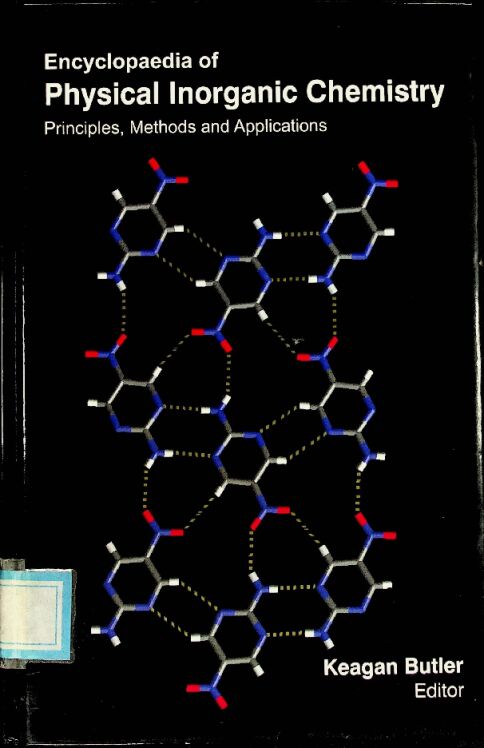
书名:Encyclopaedia of physical inorganic chemistry
出版时间:2012
出版社:Auris Reference,
前言
An alternative perspective on the area of inorganic chemistry begins with the Bohr model of the atom and, using the tools and models of theoretical chemistry and computational chemistry, expands into bonding in simple and then more complex molecules. Precise quantum mechanical descriptions for multielectron species, the province of inorganic chemistry, is difficult. This challenge has spawned many semi-quantitative or semi-empirical approaches including molecular orbital theory and ligand field theory, In parallel with these theoretical descriptions, approximate methodologies are employed, including density functional theory. Exceptions to theories, qualitative and quantitative, are extremely important in the development of the field. For example, Cun2(OAc)4(H.,O)2 is almost diamagnetic below room temperatuie whereas Crystal Field Theory predicts that the molecule would have two unpaired electrons. The disagreement between qualitative theory (paramagnetic) and observation (diamagnetic) led to the development of models for ^magnetic coupling.” These improved models led to the development of new magnetic materials and new technologies. A central construet in inorganic chemistry is the theory of molecular symmetry. Mathematical group theory provides the language to describe the shapes of molecules according to their point group symmetry. Group theory also enables factoring and simplification of theoretical calculations.
Spectroscopic features are analyzed and described with respect to the symmetry properties of the, inter alia, vibrational or electronic st ates. Knowledge of the symmetry proper ties of the ground and exci ted sta tes allows one to predict the numbers and intensities of absorptions in vibrational and electronic spectia. A classic application of group theory is the prediction of the number of C-0 vibrations in substituted metal carbonyl complexes. The most common applications of symmetry to spectroscopy involve vibrational and electronic spectra. As an ins true tio nal tool, group theory highlights commonalities and differences in the bonding of otherwise disparate species, such as WF(. and Mo(CO)6 or CO2and NO2.An alternative quantitative approach to inorganic chemistry focuses on energies of reactions. This approach is highly traditional and empirical, but it is also useful. Broad concepts that are couched in thermodynamic terms include redox potential, acidity, phase changes. A classic concept in inorganic thermodynamics is the Born-Haber cycle, which is used for assessing the energies of elementary processes such as electron affinity, some of which cannot be observed directly.
An important and increasingly popular aspect of inorganic chemistry focuses on reaction pathways. The mechanisms of reactions are discussed differently for different classes of compounds. The mechanisms of main group compounds of groups 13-18 are usually discussed in the context of organic chemistry. Elements heavier than C, N, O, and F often form compounds with more electrons than predicted by the octet rule, as explained in the article on hypervalent molecules. The mechanisms of their reactions differ from organic compounds for this reason. Elements lighter than carbon (B, Be, Li) as well as Al and Mg often form electron-deficient structures that are electronically akin to carbocations. Such electron-deficient species tend to react via associative pathways. The chemistry of the lanthanides mirrors many aspects of chemistry seen for aluminium. Because of the diverse range of elements and the correspondingly diverse properties of the resulting derivatives, inorganic chemistry is closely associated with many methods of analysis. Older methods tended to examine bulk properties such as the electrical conductivity of solutions, melting points, solubility, and acidity. With the advent of quantum theory and the corresponding expansion of electronic apparatus, new tools have been introduced to probe the electronic properties of inorganic molecules and solids. Often these measurements provide insights relevant to theoretical models. For example, measurements on the photoelectron spectrum of methane demonstrated that describing the bonding by the two-centre, two-electron bonds predicted between the carbon and hydrogen using Valence Bond Theory is not appropriate for describing ionisation processes in a simple way. Such insights led to the popularization of molecular orbital theory as fully delocalised orbitals are a more appropriate simple description of electron removal and electron excitation.
This book offers only an elementary approach to certain theoretical concepts. The choice of materials has resulted from a process of elimina tion.
查看更多
目录
Preface vii
1. Electronegativity Pauling Electronegativity • Sanderson Electronegativity Equalisation • Trends in Electronegativity • Variation of Electronegativity with Oxidation Number • Group (Periodic Table) • Period (Periodic Table) • Chemical Elements in the First Period • Period 2 Element • Period 3 Element • Period 4 Element • s-Block Elements • Period 5 Element • Period 6 Element • d-Block Elements p-Block Elements • Period 7 Element • Period 8 Element 1
2. Extended Periodic Table Extended Periodic Table, Including the g-Block • Block (Periodic Table) • s-Block • p-Block • d-Block • f-Block • Variations 80
3. Alternative Periodic Tables Bohr Model Breakdown • Periodic Table (Metals and nonmetals) • Periodic Table (Electron Configurations) • Extended Periodic Table (Large Version) 89
4. The Carbon Family Introduction • Carbon • Silicate • Sodium Silicate • Silicates with Non-Tetrahedral Silicon • Carbonate • Bicarbonate • Bicarbonate Compounds • Potassium Bicarbonate • Calcium Bicarbonate • Ammonium Bicarbonate • Carbonic Acid • Coordination Complex • Structural Isomerism 96
5. Magne to chemistry Magnetic Susceptibility • Magnetism • Diamagnetism • Material Property of Diamagnetism • Paramagnetism • Inorganic Chemistry • Organometallic Chemistry 148
6. Cluster Chemistry Stereodynamics of Clusters • Bioinorganic Chemistry • Types of Inorganic Elements in Biology • Bioorganometallic Chemistry • Solid-state Chemistry • Jahn—Teller Effect • Allotropy • Isolobal Principle • Spinel - HSAB Theory • Trans Effect • Structural Trans Effect • Cisplatin • Molar Mass • Atomic Weight 203
7. Molecular Mass DNA Synthesis Usage • Vapour Density • Freezing-point Depression of a Solvent and a Solute • Molecular Symmetry • Chemical Bond - DNA Replication - DNA Polymerase • DNA Replication within the Cell • DNA-modifying Enzymes • Oligosaccharide Synthesis • Glycosidic Bond Formation • Current Methods in Glycoside Synthesis • Fischer Glycosidation • Carbohydrate-mediated Cell Adhesion 253
Bibliography 299
Index 303
查看PDF
查看更多
馆藏单位
中科院文献情报中心