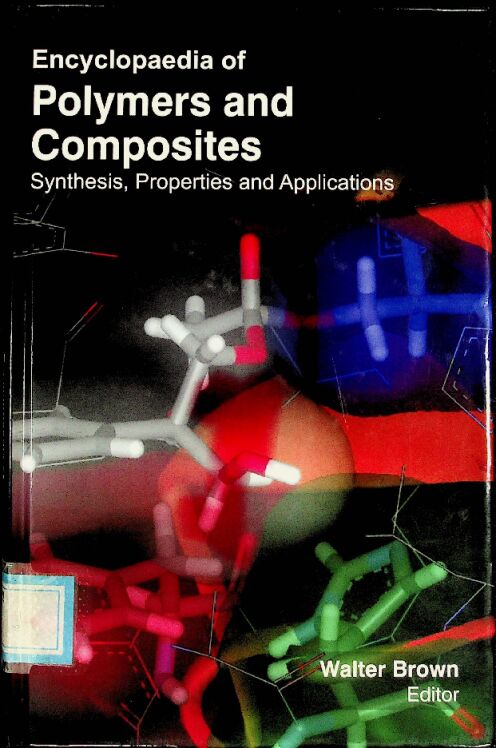
书名:Encyclopaedia of polymers and composites
出版时间:2012
出版社:Auris Reference,
前言
Henri Braconnofs work in the 1830s is perhaps the first modern example of polymer science. Braconnot, along with Christian Schonbein and others, developed derivatives of the natural polymer cellulose, producing new, semi-synthetic materials, such as celluloid and cellulose acetate. The term “polymer•” was coined in 1833 by Jons Jakob Berzelius, though Berzelius did little that would be considered polymer science in the modern sense. In the 1840s, Friedrich Ludersdorf and Nathaniel Hayward independently discovered that adding sulfur to raw natural rubber helped prevent the material from becoming sticky. In 1844 Charles Goodyear received a U.S. patent for vulcanizing natural rubber with sulfur and heat. Thomas Hancock had received a pat ent for the same process in the UK the year before. This process strengthened natural rubber and prevented it from melting with heat without losing flexibility. This made practical products such as water-proofed articles possible. It also facilitated practical manufacture of such rubberized materials. Vulcanized rubber represents the first commercially successful product of polymer research. In 1884 Hilaire de Chardonnet started the first artificial fiber plant based on regenerated cellulose, or viscose rayon, as a substitute for silk, but it was very flammable. In 1907 Leo Baekeland invented the first synthetic polymer, a thermosetting phenol�formaldehyde resin called Bakelite.
Despite significant advances in polymer synthesis, the molecular nature of polymers was not undetstood until the work of Hermann Staudinger in 1922. Prior to Staudingers work, polymers were understood in terms of the association theory or aggregate theory, which originated with Thomas Graham in 1861. Graham proposed that cellulose and other polymers were "colloids”一 that is, aggregates of molecules small molecular mass connected by an unknown intermolecLilar force. Hermann Staudinger was the first to propose that polymers consisted of long chains of atoms held together by covalent bonds. It took over a decade for Staudingers work to gain wide acceptance in the scientific community, work for which he was awarded the Nobel Prize in 1953.
The World War II era marked the emergence of a strong commercial polymer industry. The limited or restricted supply of natural materials such as silk and latex necessitated the increased production of synthetic substitutes, such as rayon and neoprene. In the intervening years, the development of advanced polymers such as Kevlar and Teflon have continued to fuel a strong and growing polymer industry. The growth in industrial applications was mirrored by the establishment of strong academic programmes and research institute. In 1946, Herman Mark established the Polymer Research Institute at Brooklyn Polytechnic, the first research facility in the United States dedicated to polymer research. Mark is also recognized as a pioneer in establishing curriculum and pedagogy for the field of polymer science. In 1950, the POLY division of the American Chemical Society was formed, and has since grown to the second-largest division in this association with nearly 8,000 members. Fred W.Billmeyer, JR, a Professor of Analytical Chemistry had once said that "although the scarcity of education in polymer science is slowly diminishing but it is still evident in many areas. What is mo就 unfortunate is that it appears to exist, not because of a lack of awareness but, rather, a lack of interest.” in his textbook of polymer science.
The book is intended for use in graduate and undergraduate courses, but practicing engineers and researchers in industry and academe will also find it a useful reference.
查看更多
目录
Preface vii
1. Introduction Polymer • Polymerisation • Step-growth Polymerisation • Polyester • Polyurethane • Polyurea • Silicone 1
2. Polycarbonate Structure • Production • Polysulfide • Ether 45
3. Chain Growth Polymerisation Radical Polymerisation • Cationic Polymerisation • Anionic Addition Polymerisation • Coordination Polymerisation • Vinyl Polymer • Ring-opening Polymerisation • Ring Opening Metathesis Polymerisation 57
4. Living Polymerisation Living Anionic Polymerisation • Living Cationic Polymerisation • Living Free Radical Polymerisation • Biopolymer • Polyelectrolyte 98
5. Polymer Chemistry Polymer Brush • Dendronised Polymer • High-density Polyethylene • Low-density Polyethylene • Cross-linked Polyethylene • Linear Low-density Polyethylene • Medium-density Polyethylene • Resin Identification Code • Ultra-high-molecular- weigh t Polye thylene • Cross-link • Vulcanisation • Copolymer • Nucleotide • Ionomer 125
6. Degree of Polymerisation Molar Mass Distribution • Polydispersity Index • Persistence Length • Tacticity • Polymer Morphology • Polymer Characterisation 185
7. Polymer Degradation Commodity Polymers •Thermal Degradation of Polymers • Thermal Depolymerisation • Chemically Assisted Degradation of Polymers • Synthetic Biodegradable Polymer • Stabilisers for Polymers • UV Stabilisers in Plastics • Antiozonant • Photo�oxidation of Polymers 203
8. Conjugated Microporous Polymer Emulsion Dispersion • Electroactive Polymers • Ionic Polymer- metal Composite • Ferroelectric Polymers • Forensic Polymer Engineering • Polyanhydrides • Polymer Adsorption • Polytetrafluoroethylene • Polymer Engineering • Polymer Separators • Polymersome • Shape-memory Polymer • Inorganic Polymer • Fluoropolymer 226
9. Thermal Properties of Polymers Polymer Glass Transition • Polymer Morphology • Polymer Structure • Polymer Growth Lattice • Polymer Synthesis • Statistical Polymer Growth • Viscosity Measurements 288
10. Applications of Polymers Elastomers • Plastics • Fibres • Processing Polymers • Injection Molding • Condensation Polymer • Functional Polymers • Liquid Crystal Polymer • Conductive Polymer • Fire-safe Polymers • Thermosetting Polymer • Polystyrene • Composite Material • Dendrimer • Solution Polymerisation 307
Bibliography 361
Index 365
查看PDF
查看更多
作者简介
Walter Brown is Professor of Material Science & Engineering.His Primary interests include developing new conductive polymer compositions and developing quantitative a relationships for constructing conjugating conductive polymers with predictable optical,electrical, and electrochemicalproperties.His Studies focus on the preparation and reactivity of various quinodimethane intermediates and polymerization to high molecular weight polymers. Further, he is investigating novel, non-redox methods for doping conjugated polymers to highly conductive compositions.
查看更多
馆藏单位
中科院文献情报中心