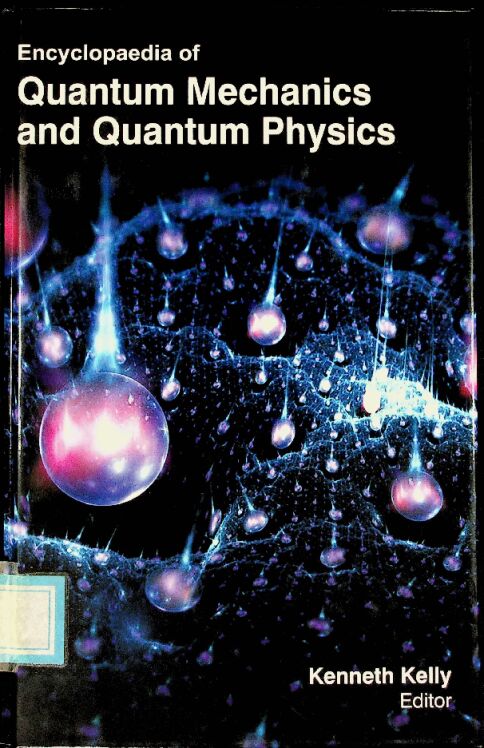
书名:Encyclopaedia of quantum mechanics and quantum physics. Volume 2, Philosophy of quantum mechanics
出版时间:2012
出版社:Auris Reference,
前言
Quantum mechanics is the body of scientific principles that explains the behaviour of matter and its interactions with energy on the scale of atoms and atomic particles. Classical physics explains matter and energy at the macroscopic level of the scale familiar to human experience, including the behaviour of astronomical bodies. It remains the key to measurement for much of modern science and technology; but at the end of the 19th Century observers discovered phenomena in both the large (macro) and the small (micro) worlds that classical physics could not explain. Coming to terms with these limitations led to the development of quantum mechanics, a major revolution in physics.
Many types of energy, such as photons (discrete units of light), behave in some respects like particles and in other respects like waves. Radiators of photons (such as neon lights) have emission spectra that are discontinuous, in that only certain frequencies of light are present. Quantum mechanics predicts the energies, the colours, and the spectral intensities of all forms of electromagnetic radiation. But quantum mechanics theory ordains that the more closely one pins down one measure (such as the position of a particle), the less precise another measurement pertainin呂 to the same particle (such as its momentum) must become. Put another way, measuring position first and then measuring momentum does not have the same outcome as measuring momentum first and then measuring position; the act of measuring the first property necessarily introduces additional energy into the micro�system being studied, thereby perturbing that system. Even more disconcerting, pairs of particles can be created as entangled twins — which means that a measurement which pins down one property of one of the particles will instantaneously pin down the same or another property of its ent angled t win, regardless of the distance separating them — though this may be regarded as merely a mathematical anomaly, rather than a real one.
查看更多
目录
Preface vii
1. Classical Mechanics Description of the Theory • Position and its Derivatives • Velocity and Speed • Forces; Newton's Second Law • Beyond Newton*s Laws • Ground State • Atomic Theoiy • Quantum Physical Models of the Atom • Corpuscular Theory of Light 1
2. Old Quantum Theory History • Some Eminent Scientists • Max Born • Wolfgang Pauli • Niels Bohr • Quantum Theory: Max Planck and Black Body Radiation • Quantisation of Matter: the Bohr Model of the Atom 25
3. Bohr's Model Wave-Paiticle Duality • Application to the Bohr Model • Development of Modern Quantum Mechanics • Copenhagen Interpretation • Wave Function Collapse • Dirac Wave Equation • Quantum Ent anglemen t • Quantum Chemistry • Quantum Optics • Quantum Information Science • Quantum Computer • Quantum Decoherence • Quantum Complexity Theory 65
4. Quantum Cryptography Quantum Key Distribution • Quantum Commitment • Bounded and Noisy-Quantum・Storage Model • Position-based Quantum Cryptography • Post-Quantum Cryptography • Quantum Error Correction • Communication Complexity • Superdense Coding • Quantum Teleportation • Entanglement Swapping • No- communication Theorem • Decision Tree Model • Classification by Query Computational Model 96
5. Quantum Field Theory History • Principles of Quantum Field Theory • Implications of Quantum Field Theory • Physical Meaning of Particle Indistinguishability • Phenomena Associated with Quantum Field Theoiy • Multivalued Gauge Transformations • Abraham- Lorentz Force • Paradoxes • Some Quantum Field Theories • Chiral Model • Gross-Neveu Model • Kondo Model • Nambu- Jona-Lasinio Model • Nonconimutative Quantum Field Theory 129
6. Quantum ChromodynamicsQCD Enjoys Two Peculiar Properties • Terminology • Theory• Additional Remarks: Duality • Symmetiy Groups • Area Law and Confinement • Quantum Electrodynamics • Feynman's View of Quantum Electrodynamics • Quantum Flavourdynamics• Quantum Gauge Theory • The Standard Model • Wess- Zumino Model • Yang-Mills Theory • Yukawa Interaction• Majorana Form 169
7. Constructive Quantum Field TheoryEinstein-Maxwell-Dirac Equations • Path Integral Formulation• Feynmans Interpretation • Free Pai-ticle • The Schrodinger Equation • Path Integral and the Partition Function• Localisation • The Need for Regulators and Renormalisation• Form Factor (Quantum Field Theory) • Green-Kubo Relations• Derivation from the Fluctuation Theorem and the Central Lindt Theorem • Green's Function (Many-Body Theory)• Invariance Mechanics • Photon Polarization • Polarization of Classical Electromagnetic Waves • Geometrodynamics 211
8. Quantum HydrodynamicsQuantum Triviality • Relationship bet ween String Theory and Quantum Field Theory • Static Forces and Virtual-Particle Exchange • Electrosta tics • Coulomb Potential bet ween Two Current Loops Embedded in a Magnetic Field • Gravitation• Classical Electromagnetic Waves • Plane Sinusoidal Waves• Spin Operator • Frame of the Observer 253
Bibliography 289
Index 293
查看PDF
查看更多
馆藏单位
中科院文献情报中心