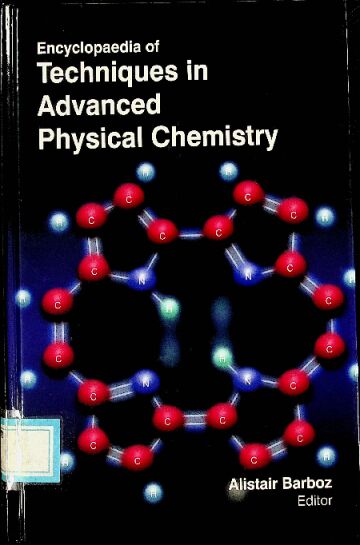
书名:Encyclopaedia of techniques in advanced physical chemistry. Volume 1, Basics of physical chemistry
ISBN\ISSN:9781781540527,1781540527
出版时间:2012
出版社:Auris Reference,
前言
The word chemistry comes from the earlier study of alchemy, which is a set of practices that encompasses elements of chemistry, metallurgy, philosophy, astrology, astronomy, mysticism and medicine. Alchemy in turn is derived from the Arabic word "value"; it is commonly thought of as the quest to turn lead or another common starting material into gold. This linguistic relation between the pursuit of value and alchemy is thought to have Egyptian origins. Many believe that the Arabic word "alchemy" is derived from the word Chemi or Kimi, which is the ancient name of Egypt in Egyptian. The word was subsequently borrowed by the Greeks, and from the Greeks by the Arabs when they occupied Alexandria (Egypt) in the 7th century. Thus, an alchemist was called a 'chemist' in popular speech, and later the suffix "-ry" was added to this to describe the art of the chemist as "chemistry''.
The concept of chemical element is related to that of chemical substance. A chemical element is specifically a substance which is composed of a single type of atom. A chemical element is characterized by a particular number of protons in the nuclei of its atoms. This number is known as the atomic number of the element. For example, all atoms with 6 protons in their nuclei are atoms of the chemical element carbon, and all atoms with 92 protons in their nuclei are atoms of the element uranium. Ninety-four different chemical elements or types of atoms based on the number of protons exist naturally. A further 18 have been recognised by IUP AC as existing artificially only. Although all the nuclei of all atoms belonging to one element will have the same number of protons, they may not necessarily have the same number of neutrons; such atoms are termed isotopes. In fact several isotopes of an element may exist. The most convenient presentation of the chemical elements is in the periodic table of the chemical elements, which groups elements by atomic number. Due to its ingenious arrangement, groups, or columns, and periods, or rows, of elements in the table either share several chemical properties, or follow a certain trend in characteristics such as atomic radius, electronegativity, etc. Lists of the elements by name, by symbol, and by atomic number are also available.
A compound is a substance with a particitlar ratio of atoms of particular chemical elements which determines its composition, and a particular organization which determines chemical properties. For example, water is a compound containing hydrogen and oxygen in the ratio of two to one, with the oxygen atom between the two hydrogen atoms, and an angle of 104.5° between them. Compounds are formed and interconverted by chemical reactions. A chemical substance is a kind of matter with a definite composition and set of properties. Strictly speaking, a mixture of compounds, elements or compounds and elements is not a chemical substance, but it may be called a chemical. Most of the substances we encounter in our daily life are some kind of mixture; for example: air, alloys, biomass, etc. Nomenclature of substances is a critical part of the language of chemistry. Generally it refers to a system for naming chemical compounds. Earlier in the history of chemistry substances were given name by their discoverer, which often led to some confusion and difficulty. However, today the IUP AC system of chemical nomenclature allows chemists to specify by name specific compounds amongst the vast variety of possible chemicals. The standard nomenclature of chemical substances is set by the International Union of Pure and Applied Chemistry (IUPAC). There are well-defined systems in place for naming chemical species. Organic compounds are named according to the organic nomenclature system. Inorganic compounds aTe named according to the inorganic nomenclature system. In addition the Chemical Abstracts Service has devised a method to index chemical substance. In this scheme each chemical substance is identifiable by a number known as CAS registry number.
The book integrates theoretical chemistry teachings with industrial and laboratory practice, providing a realistic grounding for future practising chemists and engineers.
查看更多
目录
Preface vii
1. Chemistry: An Introduction 1
History • Etymology • Basic Concepts • Chemical Laws • Chemical Industrγ ·Organic Chemistry • Analytical Chemistry • Green Chemistrγ ·Supramolecular Chemistry
2. Material Processes in Chemistry 51
Corrosion • Methods of hection from Corrosion • Water • Energy • Hydrogenation
3. Chemical Chemistry and Material Science 113
Chemical Indust • Technology • Gibbs’ Phase Rule • Metal: A Chemical Element • Nanomaterials • Acid-Base Reaction
4. Materials Reaction in Chemistry 155
Metallw·gy • Polymer • Alloy ·Fuel • Materials Science
5. Chemical Reactions in Chemistry 189
Thermodynamics • Factors Affecting Reaction Rate; the Rate Law • Experimental Determination of the Rate Law the Initial Rate Method • Elementary Processes and Reaction Mechanism • Temperature Dependence of Rate-Kinetic Molecular Theory • Kinetics and Equilibrium • Catalysis • Complex Reactions: Parallel Processes, Consecutive Processes, and Reversible Processes • Enzymes as Catalysts • Mechanisms of Substitution Reactions
6. Chemical Equilibrium 241
Quotient, Q • Le Chatelier and Chemical Equmibrium Chemical Equilibrium-A General Concept • The Reaction Principle • A Molecular View of Chemical Equilibrium ·Flee Energy and Equmibrium • An Everyday Example of Dynamic Equilibrium
Bibliography 267
Index 271
查看更多
馆藏单位
中科院文献情报中心