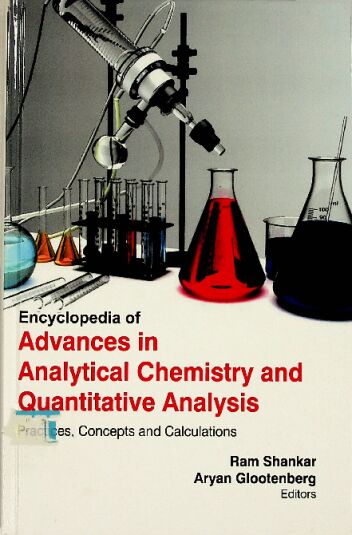
书名:Encyclopedia of advances in analytical chemistry and quantitative analysis
责任者:Ram Shankar | Aryan Glootenberg.
出版时间:2014
出版社:Auris Reference,
前言
Analytical chemistry is the science of obtaining, processing,and communicating information about the composition and structure of matter.In other words, it is the art and science of determining what matter is and how much of it exists.Any chemist has to understand how to analyse samples-whether they are water samples,blood samples or bits of a painting. Most often chemists do this using instruments of some sort. Machines like mass spectrometers or gas chromatographs can indicate both what's in a sample(qualitative)as well as how much of something there is(quantitative).Analytical chemists perform qualitative and quantitative analysis; use the science of sampling, defining,isolating,concentrating,and preservingsamples; set error limits; validate and verify results through calibration and standardization; perform separations based on differential chemical properties; create new ways to make measurements; interpret data in proper context; and communicate results.They use theirknowledge of chemistry,instrumentation,computers, and statistics to solve problems in almost all areas of chemistry. For example, their measurements are used to assure compliance with environmentaland other regulations; to assure the safety and quality of food, pharmaceuticals, and water; to support the legal process; to help physicians diagnose disease; and to provide chemical measurements essential to trade and commerce.Analytical chemists are employed in all aspects of chemical research in industry,academia,and government.They do basiclaboratory research, develop processes and products, design instruments used in analytical analysis, teach, and work in marketing and law. Analytical chemistry is a challenging profession that makes significant contributions to many fields of science.
Analytical methods using robots and instrumentation specifically designed to prepare and analyse samples have been automated. In addition,increasingly powerful personal computers and workstations are enabling the development and use of increasingly sophisticated techniques and methods of interpreting instrumental data. So,in some cases, because the instrumentation does more, fewer chemists
查看更多
目录
Preface (uii)
1. Introduction 1· Spectroscopy· AutoAnalyser· Weighing Scale
2. Applications of Analytical Chemistry 21. Laser-induced Breakdown Spectroscopy ·Laser Ablation· Genomics·Proteomics· Metabolomics· Transcriptome· Lipidomics · Microscale Chemistry·Macrocycle
3. Instrumental Methods 55·Spectroscopy· Astronomical Spectroscopy· Spectroscopic Methods·Mass Spectrometry· Creating Ions·Mass Selection·Ion Traps·Common Mass Spectrometre Configurations and Techniques·Chromatographic Techniques Combined with Mass Spectrometry
4.Analytical Methods 86· Classical Methods· Instrumental Methods · Standards·Signals and Noise·Flicker Noise·Noise Reduction
5. Crystallography and Electrochemical Analysis 109· Theory · Thermal Analysis·Relations Between Classical Calorimetric Quantities·Thermal Analysis of Printed Circuit Boards (PCB)· Chromatography · Techniques by Chromatographic Bed Shape
6. Gravimetric Analysis 188·Advantages·Disadvantages·Gravimetry·Microgravimetry· Physical Geodesy· Titration· Types of Titrations· Acid Dissociation Constant
7.Chemical Equilibrium 225·Thermodynamics·Metastable Mixtures·Multiple Equilibria·Acid-base Reaction·Common Acid-base Theories·Other Acid-base Theories·Redox Titration·Gas Phase Titration·Zeta Potential Titration
Bibliography 277
Index 279
查看PDF
查看更多
馆藏单位
中科院文献情报中心