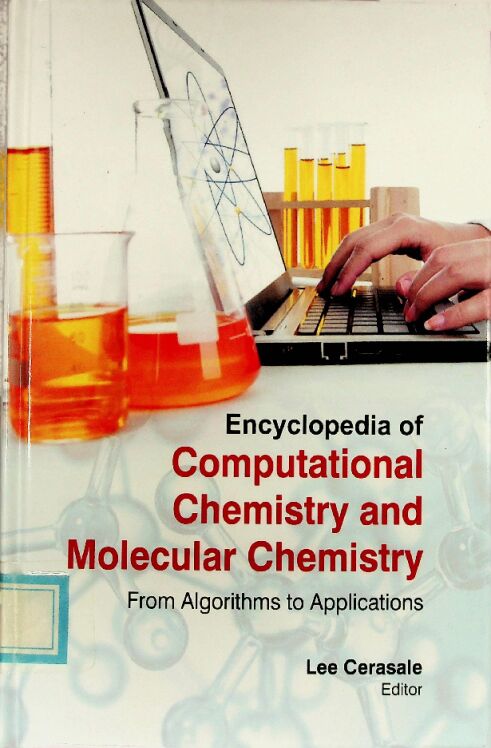
书名:Encyclopedia of computational chemistry and molecular chemistry
责任者:Lee Cerasale. | Cerasale, Lee.
ISBN\ISSN:9781781542712,1781542716
出版时间:2014
出版社:Auris Reference,
前言
Recent years have seen an increase in the number of people doing theoretical chemistry. Many of these newcomers are part time theoreticians, who work on other aspects of chemistry as well. This increase has been facilitated by the development of computer software which is increasingly easy to use. It is now easy enough to do computational chemistry that you do not have to know what you are doing to do a computation. As a result, many people don't understand even the most basic description of how the calculation is done and are t he re fore sucessufully doing a lot of work which is, frankly, garbage. Many universities are now offering classes, which are an overview of various aspects of computational chemistty. Since we have had many people wanting to start doing computations before they have had even an introductory course, this document has been written as step one in understanding what computational chemistry is about. Note that this is not intended to teach the fundamentals of chemistry, quantum mechanics or mathematics, only most basic description of how chemical computations are done. The term theoretical chemistry may be defined as the mathematical description of chemistry. The term computational chemistry is usually used when a mathematical method is sufficiently well developed that it can be automated for implementation on a computer. Note that the words exact and perfect do not appear in these definitions. Very few aspects of chemistry can be computed exactly, but almost every aspect of chemistry has been described in a qualitative or approximate quantitative computational scheme.
The biggest mistake that a comput^tional chemists can make is to assume that any computed number is exact. However, just as not all spectra are perfectly resolved, often a qualitative or approximate computation can give useful insight into chemistry if you understand what it tells you and what it doesn't.
Computational techniques are being used increasingly as an alternative to experiment in chemistry. In what is called ab initio quantum chemistty , computer programs are used to compute fundamentai properties of atoms and molecules, such as bond strengths and reaction energies, from first principles, by solving various approximations to the Schrodinger equation that describes their basic structures. This approach allows the chemist to explore reaction pathways that would be hazardous or expensive to explore experimentally. One application for these techniques is in the investigation of biological processes. Significantly growing demand for higher quality computational results for large molecular systems can be recently observed. This trend is accompanied by advances in theoretical chemistry resulting in proliferation of quantum-chemical models. As a result, the needs of computational chemistry community are constantly rising. Efficient algorithms and domain-specific tools facilitating software development are necessary to fulfil them. If a molecule is too big to effectively use a semiempirical treatment, it is still possible to model it's behaviour by avoiding quantum mechanics totally. The methods referred to as Molecular Mechanics set up a simple algebraic expression for the total energy of a compound, with no necessity to compute a wave function or total elec iron density. The energy expression consists of simple classical equations, such as the harmonic oscillator equation in order to describe the energy associated with bond stretching, bending, totation and intermolecular forces, such as van der waals interactions and hydrogen bonding. All of the constants in these equations must be obtained from experimentai data or an ab initio calculation. In a molecular mechanics method, the data base of compounds used to parame tetize the met hod (a set of parameters and functions is called a force field) is crucial to 卍s success. Where as a semiempirical met hod may be parameterized against a set of organic molecules, a molecular mechanics method may be parame tetized a gains t a specific class of molecules, such as proteins. Such a force field would only be expected to have any relevance to describing other proteins.
In this book the challenges specific to the development of computational chemistry software are discussed. Selected solutions are presented, including examples of algorithmic optimisations and improved load-balancing for parallel calculations. Optimization techniques are briefly described. Important implementation aspects, like automatic code generation, are highlighted.
查看更多
目录
Preface vii
1. Computational Chemistry Ab Initio Quantum Chemistry MethodsVHartree-Fock Method · Fock Matrix · Basis Set (Chemistry) · Restricted Open-Shell Hartree-Fock .Unrestricted Hartree-Fock · Møller-Plesset Perturbation Theory 1
2. Configuration Interaction Quadratic Configuration Interaction · Multi-Configurational Self-Consistent Field·Multireference Configuration Interaction · n-Electron Valence State Perturbation Theory · Density Functional Theory · Semi-Empirical Quantum Chemistry Method 29
3. Molecular Mechanics Computational Chemical Methods in Solid-State Physics · Chebyshev Polynomials·Multi-Configuration Time-Dependent Hartree · Force Field (Chemistry)·Water Model · Force Field Implementation 66
4. Molecular Dynamics Algorithms Beeman's Algorithm.Constraint Algorithm · Symplectic Integrator · Verlet Integration·Short-Range Interaction Algorithms · Verlet List · Long-Range Interaction Algorithms · Parallelization Strategies · Genetic Algorithm · Selection (Genetic Algorithm) · Crossover (Genetic Algorithm) · Methods of Selection of Chromosomes for Crossover · Tournament Selection · Mutation(Genetic Algorithm) 117
5. Molecular Modelling Cheminformatics · Walsh Diagram · Hypervalent Molecule · Structure,Reactivity,and Kinetics · Molecular Orbital · Linear Combination of Atomic Orbitals · Molecular Orbital Diagram · Degenerate Energy Levels · LonicBond.Bond Order · Homo/Lumo.Embedded Atom Model · Molecular Descriptor · Molecular Graphics · Space-Filling Model 181
6. Combinatorial Chemistry Bond Order Potential · Davidson Correction · Distributed Multipole Analysis · Docking (Molecular) · Searching the Conformational Space for Docking .Scoring Functions for Docking · Katchalski-Katzir Algorithm · Gaussian Network Model · Fractional Coordinates.Protein-ligand docking · Reaction Field Method·Macromolecular Docking · Accessible Surface Area · Implicit Salvation · Poisson-Boltzmann Equation · Anisotropic Network Model · Drude Particle · Ball-and-Stick Model · Fenske-Hall Method 249
7. Full Configuration Interaction Gillespie Algorithm · Koopmans' Theorem · Matthews Correlation Coefficient · Modern Valence Bond Theory · Metadynamics·Partial Charge · Polarizable Continuum Model·Slater-Condon Rules · Spin Contamination · Time-Dependent Density Functional Theory 310
Bibliography 341
Index 343
查看PDF
查看更多
馆藏单位
中科院文献情报中心