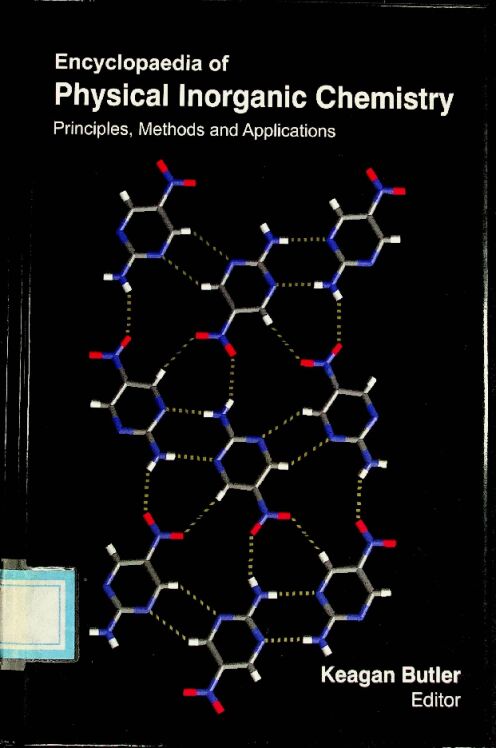
书名:Encyclopaedia of physical inorganic chemistry
出版时间:2012
出版社:Auris Reference,
前言
About 99% of mammals, mass are the elements carbon, nitrogen, calcium, sodium, chlorine, potassium, hydrogen, phosphorus, oxygen and sulfur. The organic compounds (proteins, lipids and carbohydrates) contain the majority of the carbon and nitrogen and most of the oxygen and hydrogen is present as water. The entire collection of metal-containing biomolecules in a cell is called the metallome. The abundant inorganic elements act as ionic electrolytes. The most important ions are sodium, potassium, calcium, magnesium, chloride, phosphate, and the organic ion bicarbonate. The maintenance of precise gradients across cell membranes maintains osmotic pressure and pH. Ions are also critical for nerves and muscles, as action potentials in these tissues are produced by the exchange of electrolytes between the extracellular fluid and the cytosol. Electrolytes enter and leave cells through proteins in the cell membrane called ion channels. For example, muscle contraction depends upon the movement of calcium, sodium and potassium through ion channels in the cell membrane and T-tubules. The transition metals are usually present as trace elements in organisms, with zinc and iron being most abundant. These metals are used in some proteins as cofactots and are essential for the activity of enzymes such as catalase and oxy gen-carrier proteins such as hemoglobin. These cofactors are bound tightly to a specific protein; although enzyme cofactors can be modified during catalysis, cofactors always ret urn to their original state after cat alysis has taken place. The metal micro nut rien ts are taken up into organisms by specific transporters and bound to storage proteins such as ferritin or met allothionein when not being used.
As a mix of biochemistty and inorganic chemistry, bioinorganic chemistry is important in elucidating the implications of electron- transfer proteins, substrate bindings and activation, atom and group transfer chemistry as well as metal properties in biological chemistry. Paul Ehrlich used organoarsenic (“arsenicals”)for the treatment of syphilis, demonstratin呂 the relevance of metals, or at least metalloids, to medicine, that blossomed with Rosenbergs discovery of the anti�cancer activity of cisplatin (cis-PtCl.,(NH3).,). The first protein ever crys tallized was urease, la ter shown to cont ain nickel at its active site. Vitamin B12, the cure for pernicious anemia was shown crystallographically by Dorothy Crowfoot Hodgkin to consist of a cobalt in a corrin macrocycle. The Watson-Crick structure for DNA demonstrated the key structural role played by phosphate-containing polymers. Many reactions in life sciences involve water and metal ions are often at the catalytic cent res (active sites) for these enzymes, i.e. these are met alloproteins. Often the reacting water is a ligand. Examples of hydrolase enzymes are carbonic anhydrase, metallophosphatases, and metalloproteinases. Bioinorganic chemist seek to understand and replicate the function of these metalloproteins. Metal-containing electron transfer ptoteins are also common. They can be organized into three major classes: iron-sulfur proteins (such as rubredoxins, ferredoxins, and Rieske proteins), blue copper proteins, and cytochromes. These electron transport proteins are complementary to the non・metal electton transportets nicotinamide adenine dinucleotide (NAD) and flavin adenine dinucleotide (FAD).
This book offers only an elementary approach to certain theoretical concep ts. The choice of mat erials has resul ted from a process of elimination.
查看更多
目录
Preface vii
1. Cryp toregiochemistry Curtin—Ham me tt Principle • Synthetic Applications • Elementary Reaction • Entropy of Activation • Enzymatic Strategies • Eurokin • Gillespie Algorithm • Half-life • Hammond's Postulate • Harpoon Reaction • Induction Period • Iodine Clock Reaction • Khimera 1
2. Kinetic Capillary Electrophoresis Kinetic Iso tope Effect • Inverse KIE's • Kinetic PreProcessor • Kintech Lab • Mass Averaged Velocity • Molecularity • More OTerrall-Jencks Plot 33
3. Multi-component Reaction Neighbouring Group Participation • Non-thermal Microwave Effect • Order of Reaction • Second Order • Phase・boundary Catalysis • Photoelectron Photoion Coincidence Spectroscopy • Pre-exponential Factor • Pressure Jump • Q10 (Temperature Coefficient) • Radical clocC • Rate-determining Step • Reaction Half Life • Reaction Intermediate 52
4. Reaction Mechanism Reaction Rate Constant • Reaction Step • Ribozyme • RRKM Theory • Stabiliser (Chemistry) • Stepwise Reaction • Steric Factor • Stern-Volmer Relationship • Stopped Flow • Transition State • The Structure-correlation Principle • Microcanonical Variational TST • Canonical Variational TST • Improved Canonical Variational TST • Purine Nucleoside Phosphorylase • Turnover Number • Acid-base Homeostasis • Acid-base Imbalance • Acid-base Reaction • Historic Acid-base Theories • Common Acid—base Theories • Activity Coefficient • Application to Chemical Equilibrium 74
5. Autoprotolysis Binding Constant • Binding Selectivity • Bronsted—Lowry Acid�base Theory • Buffer Solution • Chelation • Common-ion Effect • Dissociation (Chemistry) • Distribution Law • Haber Process • Hemoglobin • Research History • Analogues in Non-vertebrate Organisms • Homoconjugation 122
6. HydrolysisHydrolysis Constant • ICE Table • Ion-association • Irving- Williams Series • Mineraliser • Cation Effects • Applications • Multimedia Fugacity Model 174
7. OxyanionPartial Pressure • Partition Coefficient • Partition Equilibrium• pH Indicator • Phase Diagram • Types of Phase Diagrams• Solubility Equilibrium • Specific Ion Interaction Theory 190
8. Thermal HydrolysisVan 't Hoff Equation • Vapour—liquid Equilibrium• Thermodynamic Description of Vapour-Liquid Equilibrium• Predominance Diagram • Polyamino Carboxylic Acid • Protein pKa Calculations • Reaction Quotient • Sulphuric Acid• Physical Properties • Extraterrestrial Sulphuric Acid • Safety• Self-Ionisation of Water 233
9. Periodic TableHistory of the Periodic Table • Dm辻ri Mendeleev • Refinements to the Periodic Table • Organisation • Periodic Trends • Atomic Radius • Ionisation Energy • Electrostatic Explanation* Electron Affinity • Electron Affinities of the Elements* Electronic Properties of Metal Complexes 268
Bibliography 299
Index 303
查看PDF
查看更多
馆藏单位
中科院文献情报中心