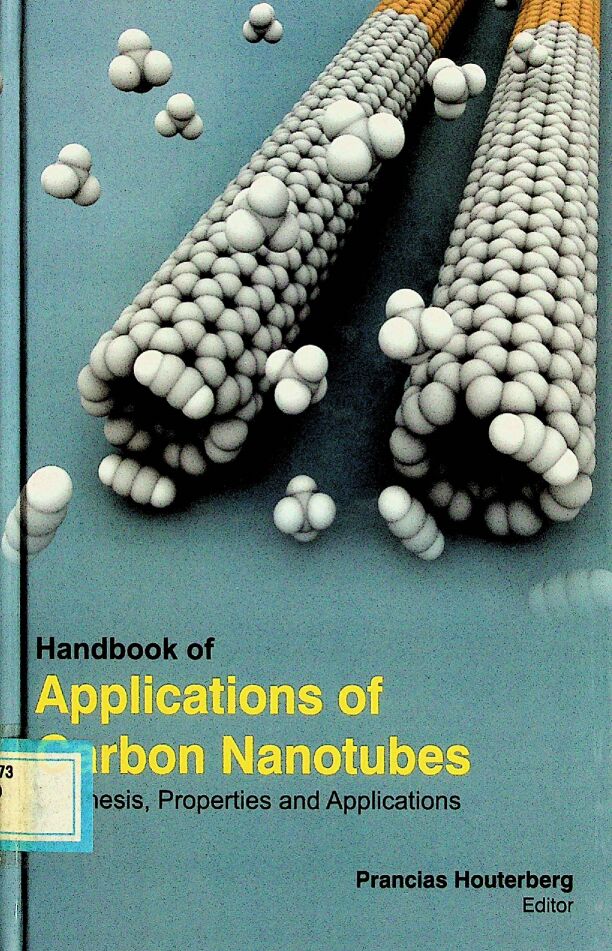
书名:Handbook of applications of carbon nanotubes
ISBN\ISSN:9781781543016,1781542996
出版时间:2014
出版社:Auris Reference,
前言
A Carbon Nanotube is a tube-shaped material, made of carbon, having a diameter measuring on the nanometer scale. A nanometer is one-billionth of a meter, or about one ten-thousandth of the thickness of a human hair. The graphite layer appears somewhat like a rolled-up chicken wire with a continuous unbroken hexagonal mesh and carbon molecules at the apexes of the hexagons. Carbon Nanotubes have many structures, differing in length, thickness, and in the type of helicity and number of layers. Although they are formed from essentially the same graphite sheet, their electrical characteristics differ depending on these variations, acting either as metals or as semiconductors. As a group, Carbon Nanotubes typically have diameters ranging from<1 nm up to 50 nm. Their lengths are typically several microns, but recent advancements have made the nanotubes much longer, and measured in centimetres. Carbon nanotubes are the strongest and stiffest materials yet discovered in terms of tensile strength and elastic modulus respectively. This strength results from the covalent sp² bonds formed between the individual carbon atoms. In 2000, a multi-walled carbon nanotube was tested to have a tensile strength of 63 gigapascals (GPa). (For illustration, this translates into the ability to endure tension of a weight equivalent to 6422 kg (14, 158lbs) on a cable with cross-section of 1mm².) Further studies, such as one conducted in 2008, revealed that individual CNT shells have strengths of up to~100GPa, which is in agreement with quantum/atomistic models. Since carbon nanotubes have a low density for a solid of 1.3 to 1.4g/cm³, its specific strength of up to 48, 000kN·m·kg-1 is the best of known materials, compared to high-carbon steel’s 154kN·m·kg-1. Under excessive tensile strain, the tubes will undergo plastic deformation, which means the deformation is permanent. This deformation begins at strains of approximately 5% and can increase the maximum strain the tubes undergo before fracture by releasing strain energy.
Although the strength of individual CNT shells is extremely high, weak shear interactions between adjacent shells and tubes leads to significant reductions in the effective strength of multi-walled carbon nanotubes and carbon nanotube bundles down to only a few GPa's. This limitation has been recently addressed by applying high-energy electron irradiation, which crosslinks inner shells and tubes, and effectively increases the strength of these materials to~60GPa for multi-walled carbon nanotubes and~17GPa for double-walled carbon nanotubes bundles.Multi-walled nanotubes are multiple concentric nanotubes precisely nested within one another. These exhibit a striking telescoping property whereby an inner nanotube core may slide, almost without friction, within its outer nanotubes hell, thus creating anatomically perfect linear or rotational bearing. This is one of the first true examples of molecular nanotechnology, the precise positioning of atoms to create useful machines. Already, this property has been utilized to create the world's smallest rotational motor. Future applications such as a gigahertz mechanical oscillator are also envisioned. Techniques have been developed to produce nanotubes in sizeable quantities, including arc discharge, laser ablation, high-pressure carbon monoxide disproportionation(HiPco), and chemical vapour deposition(CVD). Most of these processes take place in vacuum or with process gases. CVD growth of CNTs can occur in vacuum or at atmospheric pressure. Large quantities of nanotubes can be synthesized by these method; advances in catalysis and continuous growth processes are making CNTs more commercially viable. The present book has been designed to outline the basic and fundamental aspects of this subject to be understood in its right perspective. The book uses straightforward, less-technical jargon and manages to introduce each chapter with a basic concept, which ultimately evolves into a more specific detailed principle.
-Editor
查看更多
目录
Preface vii
1.Carbon Nanofiber 1
·Synthesis·Carbon Black·Carbon-fiber-reinforced Polymer·Activated Carbon·Classification· Carbon Nanocone ·Nanoarchaeum Equitans ·Nanobe·Aggregated Diamond Nanorod·Nanotube Membrane
2.Nanochondrion 37
·Nano-abacus·Nanopore·Nanopore Sequencing·Nanometre·Nanoscale Iron Particles·Magnetic Chemistry·Melting-point Depression·Hybrid Material·Nanoelectromechanical System·Sarfus
3.Properties of Carbon Nanotubes 69
·Electronic Structure of Carbon Nanotube·Van Hove Singularities·Kataura Plot·Optical Absorption·Luminescence·Raman Scattering·Rayleigh Scattering
4.Nanophotonics 82
·Components of a Nanophotonic System·Nanotechnology Education·Nanotechnology in Water Treatment·Nanofiltration·Electrospinning·Nano-thermite·NanoHUB·Energy Applications of Nanotechnology·Nanomaterial-based Catalyst·Colloidal Gold
5.Nanorobotics 120
·Nanorobotics Theory·Approaches·California NanoSystems Institute·Educational Opportunities·Quantum Computer·Nanorobot·Nanotechnology
6.Nanofluidics 160
·Theory·Nanofluidic Circuitry·Size Effect of Nanostructures·Nanomechanics·Nanobiotechnology·Nanobiomechanics·Nanoengineering ·Green Nanotechnology·Nanoelectronics·Nanoelectronic Devices
7.Silicon Nanotubes 189
·Synthesis·Selective Chemistry of Single-walled Nanotubes·Selective Reaction and Raman Features·Multi-walled Carbon Nanotubes·Platinum Nanoparticles·Iron Oxide Nanoparticles·Microemulsions·Solid lipid Nanoparticle·Nanometrology·Nanonetwork
8.Graphene Nanoribbons 216
·Timeline of Carbon Nanotubes·Nanocomposite·Nanocrystal·Nanocrystal Solar Cell·Nanocrystalline Silicon·Nanocages·Nanomesh·Nanoshell·Nanoimprint Lithography·Schemes·Alternative Approaches·Nanolithography·Nanochannel Glass Materials ·Nanocomputer
9.Magnetic Nanoparticles 248
·Types of Magnetic Nanoparticles·Synthesis·Applications·Nanoparticle Tracking Analysis·Carbon Nanotubes in Photovoltaics·Reduction of Energy Consumption·Nanotechnology and Constructions·Nanoparticles in Fire Protection and Detection·Carbon Nanotubes in Medicine·In Vitro Cytotoxicity·Cytotoxicity of SWNTs and MW NTs·Carbon Nanotube Springs·Energy Storage Calculations
10.Nanowire 289
·Synthesis of Nanowires·Physics of Nanowires·Welding Nanowires·Uses of Nanowires·Inorganic Nanotube·Molecular Wire·N antenna·Nanoscopic Scale·Centre
for Probing the Nanoscale·Centre for Nanoscale Materials·X-ray Nanoprobe·Nanowire Battery
11.Nano-optics with Meta materials 313
·Nanohole Array Sub wavelength Imaging·Theory·Negative Index of Refraction and Pendry's Perfect Len·Photonic Meta material·The Development of Photonic Meta materials Optical Frequency Meta materials·Fabrication Techniques·Tunable Meta materials at Optical Frequencies·Dyakonov Surface Waves in Photonic Meta materials·Extraordinary Optical Transmission·Buckypaper·Frit Compression·Lithium-sulphur Battery·Lithium-air Battery·Technological Applications of Superconductivity
12.NanoCarbon Items 347
·Diamond·Graphite· Amorphous Carbon·Buckminster fullerenes·Carbon Nanobuds·Glassy Carbon·Atomic and Diatomic Carbon·Linear Acetylenic Carbon(LAC)
13.Silver Nano 357
·Environmental Concerns·Silver Nanoparticles·Nanomanufacturing·Quantum Dot·Quantum Dot Display·Pros and Cons·Quantum Wire·Nanorod·Nanoprobe
14.Polymer Nanocomposite 381
·Bio-hybrid Polymer Nanofibres·Delivery from Compartmented Nanotubes·Size and Pressure Effects on Nanopolymers·Nanogeoscience·Waterloo Institute for Environmental Applications of Nanotechnology·Nanotechnology·In Situ Chemical Reduction·Reactions in IS CR·Societal Impact of Nanotechnology
15.Nanocircuitry 410
·Production Methods·Potential Applications and Breakthroughs·History of Nanotechnology·Experimental Advances·Advances in Interface and Colloid Science·National Nanotechnology Initiative·Growing Public Awareness and Controversy·Impact of Nanotechnology·Health and Safety Impact from Nanoparticles·Failsafes in Nanotechnology·DNA Nanotechnology·Structural DNA Nanotechnology·Nanomechanical Devices·Nanosensor·Dip-pen Nanolithography·Deposition Materials
16.Nanoparticle 466
·Background·Uniformity·Sol-gel·Colloids·Surface Coating for Biological Applications·Carbon Nanotube and·Types of Carbon Nanotubes and Related Structures·Cup Stacked Carbon Nanotubes·Toxicity·Current Applications·Other Applications·Potential Applications of Carbon Nanotubes
17.Nanoproducts 512
·Implications·Health and Environmental Concerns·Carbon Nanotubes·Nanocarbon Output Values Surging, Production Catching Up·Procedure·Peering Inside Nanowires·Four-Point Bending Method·Nanowire Electronics·Nanowire Applications
Bibliography 569
Index 573
查看更多
馆藏单位
中科院文献情报中心