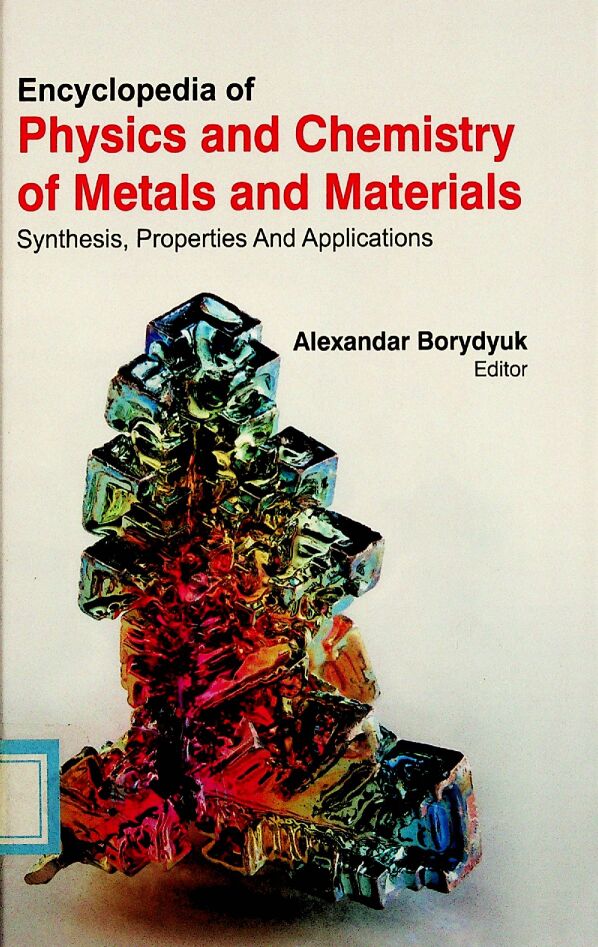
书名:Encyclopedia of physics and chemistry of metals and materials
出版时间:2014
出版社:Auris Reference,
前言
Materials science is an applied science concerned with the relationship between the structure and properties of materials. Chemists who work in the field study how different combinations of molecules and materials result in different properties. They use this knowledge to synthesize new materials with special properties. This relatively new scientific field investigates the relationship between the structure of materials at atomic or molecular scales and their macroscopic properties. It incorporates elements of applied physics and chemistry. With significant media attention focused on nanoscience andnanotechnology in recent years, materials science is becoming more widely known as a specific field of science and engineering. It is an important part offorensic engineering(Forensic engineering is the investigation of materials, products, structures or components that fail or do not operate or function as intended, causing personal injury or damage to property.) and failure analysis, the latter being the key to understanding, for example, the cause of various aviation accidents. Many of the most pressing scientific problems that are currently faced today are due to the limitations of the materials that are currently available and, as a result, breakthroughs in this field are likely to have a significant impact on the future of human technology. Whole periods of human civilization-such as the Bronze and Iron ages-are named for metals. These were the first materials to be “engineered,” that is, people changed them to fit what they needed to do, rather than just letting their natural properties determine what they could be used for. These days, materials scientists are using metals in ways no one could have pictured even a few years ago-for example, shaping copper into tiny wires a thousand times skinnier than a strand of your hair! The basis of materials science involves relating the desired properties and relative performance of a material in a certain application to the structure of the atoms and phases in that material through characterization. The major determinants of the structure of a material and thus of its properties are its constituent chemical elements and the way in which it has been processed into its final form. These characteristics, taken together and related through the laws of thermodynamics, govern a material's microstructure, and thus its properties. The manufacture of a perfect crystal of a material is currently physically impossible. Instead materials scientists manipulate the defects in crystalline materials such as precipitates, grain boundaries(Hall-Petch relationship), interstitial atoms, vacancies or substitutional atoms, to create materials with the desired properties. Not all materials have a regular crystal structure. Polyrners display varying degrees of crystallinity, and many are completely non-crystalline.Glasses, some ceramics, and many natural materials are amorphous, not possessing any long-range order in their atomic arrangements. The study of polymers combines elements of chemical and statistical thermodynamics to give thermodynamic, as well as mechanical, descriptions of physical properties. In addition to industrial interest, materials science has gradually developed into a field which provides tests for condensed matter or solid state theories. New physics emerge because of the diverse new material properties which need to be explained.
The book covers fundamental concepts on the basis of materials science. It conveys the central issue of materials science, distinguishing it from merely solid state physics and solid state chemistry, namely to develop models that provide the relation between the microstructure and the properties.
-Editor
查看更多
目录
Preface vii
1. Introduction 1
Historical Perspective·Atomic Structure and Bonding·Structure of Crystalline Solids·Coordination Number·Packing Factors·Cubic Crystal System
2. Defects in Crystals 33
Point Defects·Interstitial Defect·Schottky Defect·Stone-Wales Defect·Dislocation·Symmetry Breakdown·Partial Dislocations·Jog(Dislocations) ·Peierls Stress·Kroger-Vink Notation·Burgers vector·Planar Defects
3.Introduction to Ceramic Materials 70
Types of Ceramic Materials·Ceramic Structures·Silicate Structures·Processing of Ceramics·Glasses·Composite Materials
4. Concrete Material 117
History·Concrete was used for Construction in Many Ancient Structures·Properties of Concrete·Metal Matrix Composite·Ceramic Matrix Composite
5.Electrical and Electronic Properties of Materials 156
Electrical Properties of Materials·Electrical Conductivity·Ionic Conductivity(Solid State) ·Intrinsic and Extrinsic Semi Conductivity·Extrinsic Semiconductor·Semiconductor Devices·Transistor·Piezo-electricity
6.Mechanical Properties of Materials 221
Concepts of Stress and Strain·Stress(Mechanics) ·Stress-Strain Diagrams·Elastic Deformation·Plasticity(Physics)·Strain Rate Effects and Impact Behaviour·Hardness of Materials
7. Magnetic Materials 258
Background on the Physics of Magnetism and Magnets·Magnetism·Para magnetism·Ferromagnetism
8. Magnetic Domain 282
Ferrimagnetism·Antiferromagnetism·Superparamagnetism·Magnetic Fields or Quantities, Types of Magnetism
9. Magnetic Materials: Soft Magnets 329
NanoMaterials·Nanoparticles·Silicon Carbide·Wide Scale Production·Nanomagnet
Bibliography 341
Index 343
查看更多
馆藏单位
中科院文献情报中心